


Pros

-
 Excellent operating speed; Great build quality including weather resistance; Full customisation of most controls Great JPEG image quality
Cons

-
 Raw image quality doesn't quite match competition; Menu interface somewhat challenging; A few design errors
Olympus OM-D E-M5 Mark II Review – First Look

When the original Olympus OM-D E-M5 was announced almost exactly two years ago, it garnered wide acclaim thanks to the combination of retro styling akin to the OM series of the 70s with advanced functionality including an impressive electronic viewfinder.
In the proceeding few years the competition has largely followed where Olympus led, with premium CSCs from Fujifilm and Sony pairing similarly advanced features with retro styling.
It could then be argued that the Olympus OM-D E-M5 Mark II, officially announced today, has some ground to make up on its competitors. Thanks to a combination of improved and completely new features, that certainly looks set to do so.
We met up with Olympus ahead of the new camera’s launch to go hands-on with the latest premium CSC.

Olympus OM-D E-M5 First Look
As you might expect for an update that was two years in the making, the OM-D E-M5 Mark II’s boasts a range of improvements in comparison to its predecessor.
Two areas that benefit in particular are the model’s viewfinder and LCD screen. The new EVF now boasts an improvement in resolution up to 2.36M dots, offering a real life field of view arguably on a par with that found on a full frame DSLR.
The viewfinder also performs well when it comes to shutter lag, operating at an almost-imperceptible speed of 0.01 seconds.
The LCD screen also sees a substantial bump in resolution, increasing from 610k-dots to 1,037k-dots. The screen is also improved in terms of its versatility – out goes the simple tilting mechanism and in comes full articulation, allowing for shooting at a wide range of angles.
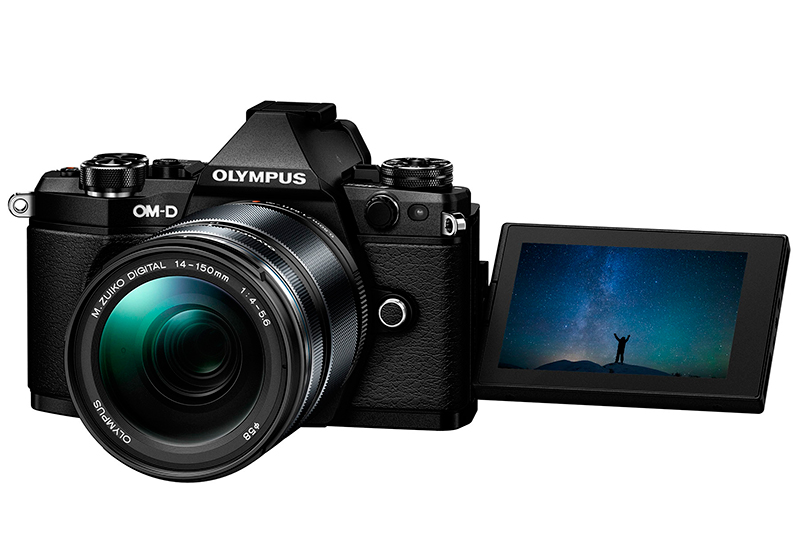
It’s also now possible to display more advanced shooting information on the LCD screen, rather than one simple set of information.
Another key area of improvement is the camera’s image stabilisation set-up. The E-M5 Mark II now incorporates an in-body 5-axis image stabilisation system that compensates for circular movement around the lens alongside traditional horizontal and vertical movement.
What this means in real terms is that the OM-D E-M5 Mark II should compensate for a truly impressive level of around 5 stops of image stabilisation.
In terms of the camera’s sensor, the OM-D E-M5 Mark II sees the utilisation of a 16MP Four Thirds sensor as was the case in the Mark I.
One really interesting feature of the new sensor is a ‘40MP composite stills’ mode. As the name suggests, when this setting is enabled the E-M5 Mark II captures 8 images 0.5 pixels apart, by utilising the new 5-axis stabilisation functionality, and then composites them in to a single 40MP image.
Although this setting necessitates the use of a tripod and won’t be of use when shooting moving subjects, it’s certainly of interest to landscape photographers.
While the sensor remains the same, the Mark II does, however, feature an update with regards to its processor. The camera features the latest TruePic VII processor as originally featured in the flagship Olympus OM-D E-M1.
This new process aids the delivery of a continuous shooting speed of 10fps with a fixed focus point, dropping down to 5fps with auto focus enabled.
Other performance highlights include a fully-electronic silent shutter which offer benefits including both being discreet and also offering a fastest shutter speed of 1/16000 sec.
As you might expect, the OM-D E-M5 Mark II now features Wi-fi functionality for easy connection to either a smartphone or tablet.
Also the E-M5 Mark II might not feature a built-in flash, the model does come with a welcome small hotshoe-mounted flash in the box which can be tilted should the need arise.
First Impressions
Although the E-M5 Mark II is much the same size as the Mark I, it features a completely redesigned interface that is more akin to the flagship E-M1 than its predecessor.
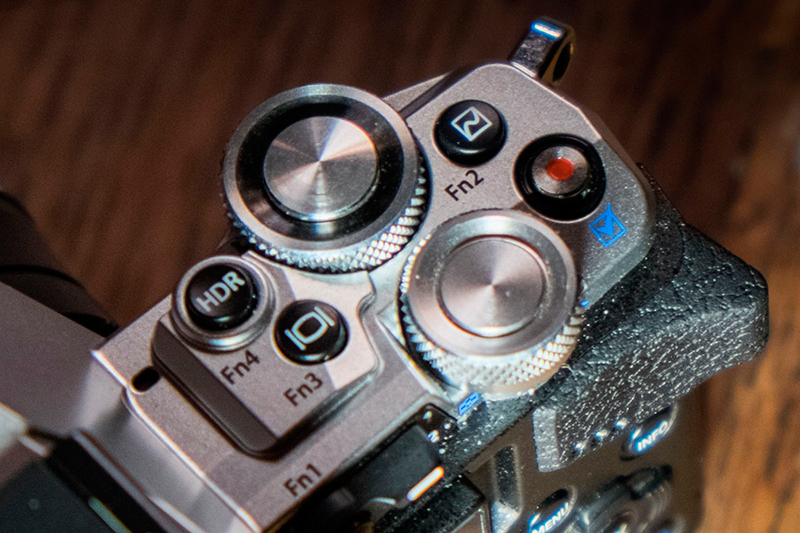
The most notable adjustments are the replacement of the spongy 4-way controller with an improved larger unit, while the dual control dials are now much deeper and more responsive as a result.
The model also features a newly designed handgrip that is marginally larger than that on the Mark I, and as a result provides a more substantial grip on the camera.
These improvements to the camera’s design are certainly welcome, and the wide range of tweaks to the E-M5’s performance and spec ably support them.
Although the silent electronic shutter, EVF resolution boost and LCD screen articulation might not seem like huge changes they’ll be welcome for current E-M5 owners.
So while the camera is entering a much more crowded marketplace than its predecessor, it’s well set to mount a good challenge . We’ll find out how it gets on in our full review later this year.
The Olympus OM-D E-M5 II will be available from late February, for £899.99 body only, £1099.99 with 12-50mm f/3.5-6.3 lens, or £1249.99 with a new, weathersealed 14-150mm f/4-5.6 II lens.