









What Digital Camera’s Opinion

For all the fabulous high frame rates, buffer size and increased focus speed in this second version of Fujifilms GFX100S you’d really need your head testing if you bought it for action photography. Yes, it would be lovely to have medium format shots of birds in flight and motorcycles flying around the track, but that just isn’t where the heart of this camera lies. There are plenty of other cameras much better suited to speed and motion. If you were going to buy this camera it would be for the image quality, and then when using it you’d adjust your photography to what it is good at rather than what it will clearly find challenging. The advantages the Fujifilm GFX100S ll offers are in detail collection, colour fidelity, dynamic range, the ability to produce exceptionally shallow depth-of-field and the chance to slow down a little. All of these things it does outstandingly and exceptionally well. If you believe that a new camera can’t make you a better photographer it’s probably because you haven’t tried this one – even average shots will look very much better when recorded on this sensor and through a medium format Fujinon GF lens. The system gives everyone a leg up, and that’s a leg up I always need and appreciate.
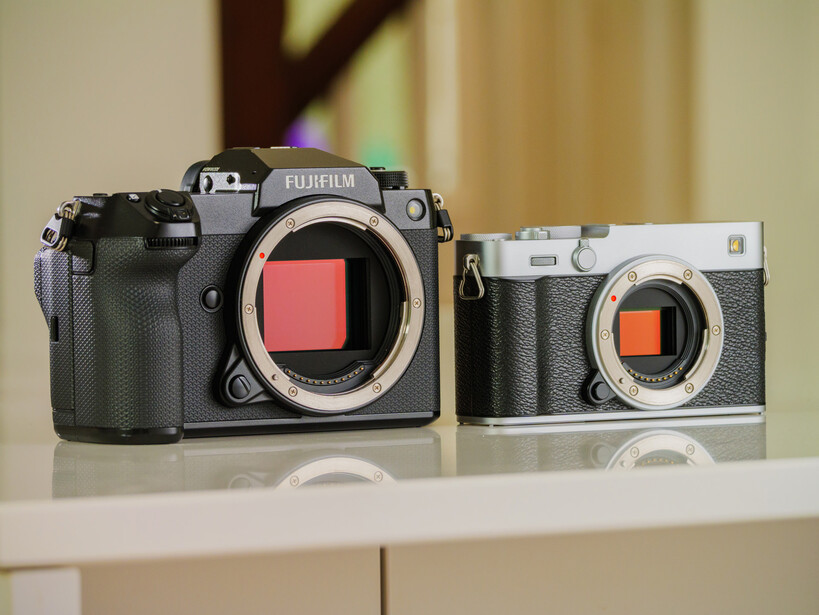
Yes, the focusing system isn’t as snappy or reliable as that in Fujifilm’s APS-C system or in the latest Sony mirrorless model, but if I need the best AF systems I probably wouldn’t be looking at a medium format camera. I was though actually surprised how well the GFX100S ll’s AF behaved, and found it much quicker, consistent and controllable than that of the Hasselblad H2D ll 100C and the previous Fujifilm GFX cameras I’ve used – the whole system is more nimble and light on its feet. I also found the shutter response quick, with the camera actually shooting when you want it to, and the touch operation is swift enough to use in street photography if you are stupid enough (as I am) to use this hulk instead of something smaller. But the AF system is a little too lumbering to tackle one-shot attempts at moving people in the street, and it more often than not found the background more interesting than the subject.

The camera is very nice to use, comfortable to look through when to the eye and easy to control. The buttons are all in the right place, though as a fan of exposure compensation I customised the rear wheel. As much as I’m a rear-screen shooter, it’s a joy to look through the viewfinder, to see that green square find the sitter’s eye and the focus to snap into place. It all seems to work really well, and made life pretty straightforward. I shot some fun portraits in available light and some commercial heads with lots of continuous light, and enjoyed an experience no slower than had I used my usual mirrorless full frame camera. The post-processing experience though was quite different and with the Fujifilm Film Simulation modes there wasn’t always a great deal to do.
Where the camera stands out and hovers above the vast majority of the field is in portraiture, landscape and things that don’t require the reactions of a caffeinated teenage gamer. The difference it makes in these areas makes it worth owning whether it can hold focus on a sprinting leopard or not. The shooting experience is very pleasing, but it’s the moment you open a raw file on the big screen and pull the highlights down and the shadows up that reveals the true value of the system. The dynamic range, the smooth tonal transitions, the details, and the colour information are all to die for. I may have been a quarter of my way through the testing process when I found myself working out if I could sensibly justify the expense of the camera with the lenses I’d need. When that sort of thing happens a camera is really making a very good impression.


What is the Fujifilm GFX100S ll?
Price: £4999, €5499, $5699
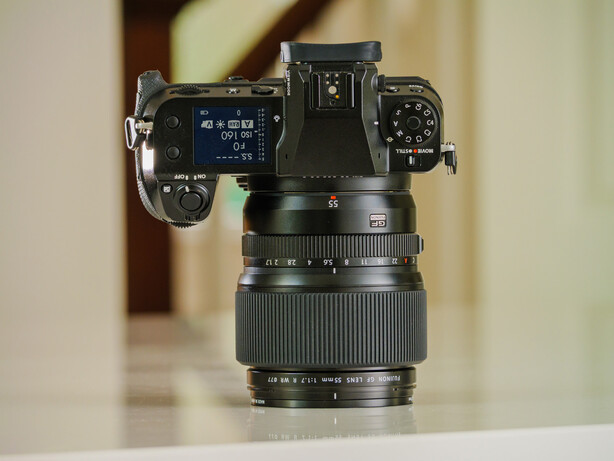
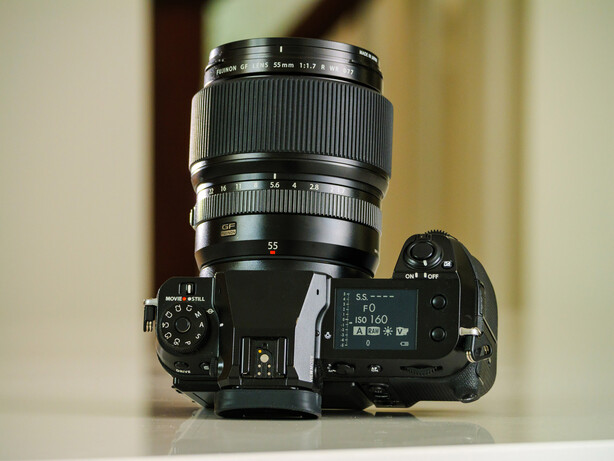
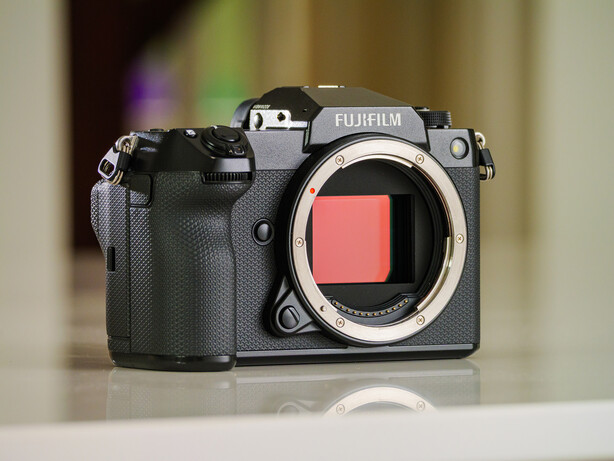
The Fujifilm GFX100S II is a medium-format mirrorless camera aimed at serious photographers who’ve always fancied a sensor 68% bigger than full frame but who were put off by the cost of entering the market. At $4,999 the GFX 100S ll undercuts both the flagship GFX100 II and the Hasselblad X2D-100C, which, by the standards of 102-megapixel medium format, makes it something close to a bargain. The upgrade from the original GFX100S is significant too. A new X-Processor 5 brings subject-detection AF for animals, birds, vehicles and aircraft. IBIS climbs from a claimed 5 stops to 8. The viewfinder gets a sharper 5.76-million-dot panel. Video bitrate jumps from 400Mbps to 720Mbps, and Blackmagic RAW, Apple ProRes, vectorscopes and Frame.io support round out a surprisingly credible video toolkit, even if it tops out at 4K 30p.
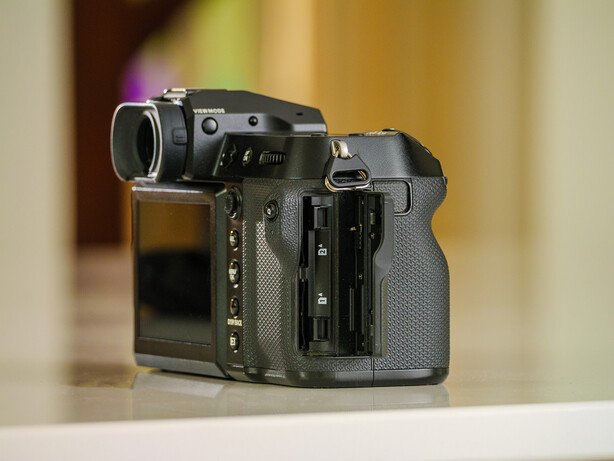
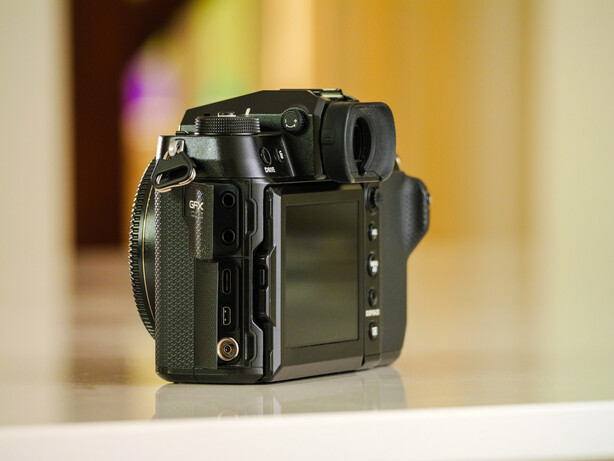
Storage is dual UHS-II SD only – no CFexpress – and the micro-HDMI port will annoy anyone shooting tethered. But for landscape, portrait and studio shooters chasing enormous resolution in a body roughly the size of a Nikon Z8, this is a proper reason to pause before buying one of the usual full-frame alternatives. Landscape, portrait, and studio photographers will get the most out of it.
Fujifilm GFX100S ll Opinions From Around The Web
Averaged Score: 9.2/10
Pros

-
 Fabulous detail resolution
 -
Excellent dynamic range
-
Superb colour
-
Lovely to use
Cons

-
 Quite big
 -
AF not as quick as smaller formats
-
Costs a lot
Fujifilm GFX100S ll Collective Verdict
Reviewers are almost unanimous in their admiration of the GFX100S II. Amateur Photographer and Digital Camera World each hand it a rare perfect score, and everyone else clusters just below. The 102MP image quality gets consistent praise, and the upgraded viewfinder, better stabilisation and modernised AF all read as meaningful steps up from the original GFX100S. Where opinions split is around autofocus. FCRacer points out it leads the medium-format field but still trails full-frame rivals from Sony, Canon and Nikon, while Tom’s Guide notes the pricier GFX100 II and Hasselblad X2D 100C keep advantages in shooting speed and CFExpress support. CameraLabs and ePHOTOzine both stress the practical portability and weather sealing as part of the appeal. At an aggregated 9.2 out of 10, this is about as strong a collective thumbs-up as medium format gets. Anyone willing to stretch to the price is unlikely to feel short-changed.


Fujifilm GFX100S ll Specifications
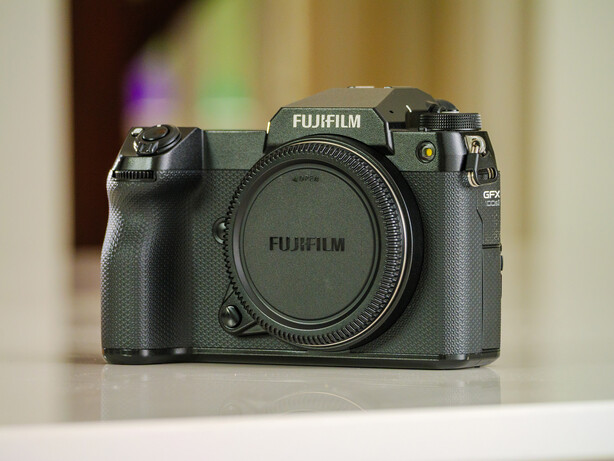
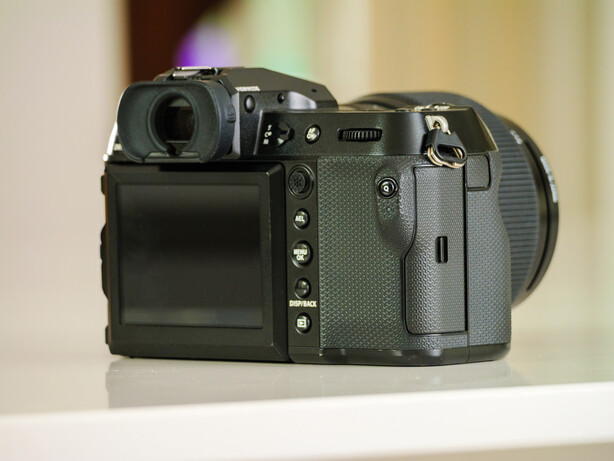
The whole idea of these cameras is the sensor size and the pixel count: 102 million pixels on a 43.8 x 32.9mm BSI CMOS sensor which is 68% larger in area than a full-frame chip, as Amateur Photographer confirmed. That physical scale is the entire argument for spending the money. And at under five grand it’s a startling proposition. Digital Camera World pointed out it actually costs less than its predecessor did at launch, which almost never happens. The sensor has been quietly reworked too, with new microlenses and a revised pixel structure dropping the base ISO from 100 to 80, giving ePHOTOzine a claimed 14.2EV of dynamic range to work with. You can shoot 14-bit or 16-bit Raw, and Pixel Shift mode stacks sixteen exposures into a 400MP equivalent file. Burst runs to 7fps mechanically, with a buffer good for 30 compressed Raws, though FCRacer noted the camera drops to 12-bit capture at that top speed. IBIS is one of the biggest upgrades, jumping from 6 stops on the predecessor to a claimed 8 stops of 5-axis compensation, per Amateur Photographer. Battery life is quoted at 530 CIPA frames on the familiar NP-W235.
Fujifilm GFX100S ll Video specifications
The GFX100S II isn’t trying to be a cinema camera, and Tom’s Guide said as much in so many words, but the video credentials it does carry are more serious than the modest frame-rate ceiling implies. Internally you get DCI 4K or UHD 4K up to 29.97p, and Full HD to 59.94p, with 4:2:2 10-bit H.265 or 8-bit H.264, both at an uncropped horizontal field of view. Turn on digital IS and you pick up a 1.1x crop, but even so CameraLabs found overall IBIS effectiveness in video slightly behind a modern X-series body, so bear that in mind if handheld work is central to your plans.
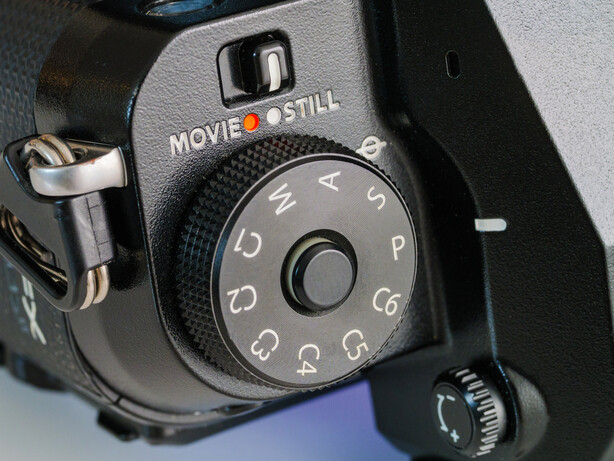
The maximum bitrate has jumped to 720Mbps from 400Mbps on the predecessor, says Amateur Photographer, a real quality lift. ProRes recording is available but demands an external SSD via USB-C, and you can’t write to both SSD and the SD card simultaneously. Then there’s 12-bit RAW out over HDMI, plus F-Log 1 and 2, Blackmagic RAW and Atomos support, which FCRacer rightly identified as a trickle-down from the GFX100 II. The catch is the HDMI port itself. It’s a Micro Type-D connector, and both Amateur Photographer and FCRacer called it fiddly and unreliable, with FCRacer adding the unofficial rule that the adapter is always the one thing left at home. No fan attachment is available, unlike on Fujifilm’s flagship camera, so long recording sessions survive entirely at the mercy of the camera’s thermal heat sinks.
Fujifilm GFX100S ll Focusing system
The GFX100S II uses an Intelligent Hybrid AF system that pairs phase and contrast detection, with subject recognition covering animals, birds, aircraft, vehicles, trains, and insects. In practice, results depend enormously on what you’re pointing it at and how fast it’s moving.
For portraits, it’s really rather good. Tom’s Guide had no trouble getting “razor sharp faces and eyes” in portrait sessions, and the camera tracked a face in near-total darkness at EV-5. FCRacer measured a 90% human-eye tracking hit rate, up from 80% on the GFX100 II and well ahead of the GFX100S’s 60%, though still short of Sony’s A7R5 at 99%. Bird tracking hit 95%, close to the best full-frame competition.

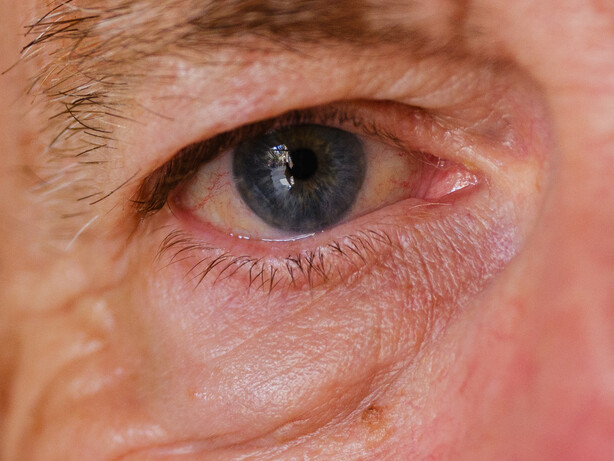
Animal detection is another story entirely. FCRacer‘s animal hit rate sat at just 60%, unchanged across two generations, and the problems run deeper than statistics. The camera “doesn’t do a very good job of correctly identifying the eyes of animals,” often locking onto nostrils or the nose instead. FCRacer found their dog’s posterior consistently getting sharp focus when the animal looked back at the camera. Worse, FCRacer points out false positives as a serious systemic issue: “the camera confidently shows a green box around an animal’s eye” in the EVF, but the resulting image is focused somewhere else entirely. The green confirmation box, FCRacer warns, cannot be trusted when a subject is moving. This may now be fixed by the latest Fujifilm GFX100S ll firmware update. FCRacer also notes that subject tracking lags every competing brand, a weakness compounded by the heavier GF lenses that take longer to physically move.

Multi-subject scenes gave Digital Camera World trouble too, with the camera changing its preferred deer several times in a matter of seconds. That said, Amateur Photographer found the system delivered “a very respectable hit-rate” shooting fighter jets and a steam train once configured properly, and CameraLabs concluded it doesn’t hold you back in general use, calling it “fast for medium format” if not as snappy as the best full-frame or APS-C systems.


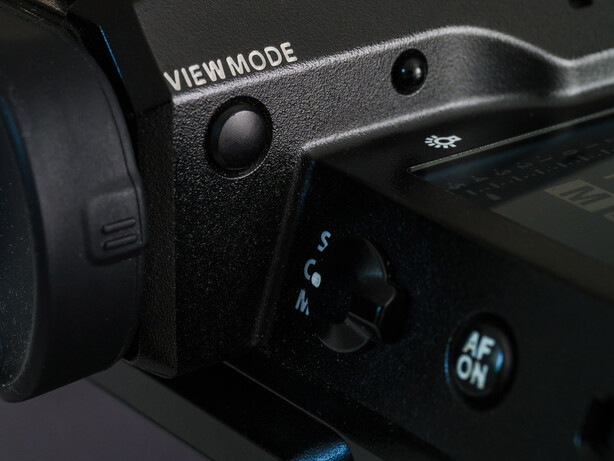
The setup demands attention. Face detection and subject detection are mutually exclusive modes with no Auto option, so you have to pick your subject type before shooting, and Amateur Photographer calls the switching process “a bit chaotic.” The focus mode switch beside the viewfinder can’t be saved into Custom setups, so you’ll need to remember to set it manually every session. Amateur Photographer recommends turning on AF Boost when tracking movement, picking Focus Priority over the default Speed Priority for the sharpest continuous shots, using Zone AF for a single defined subject, and switching to Tracking mode when several possible subjects are competing for attention. FCRacer adds a useful workaround for moving subjects: shoot, fully release focus, reacquire, then shoot again, giving the system two real chances to lock accurately rather than trusting a green box that may be telling you something optimistic rather than true.
Fujifilm GFX100S ll Rear screen and EVF
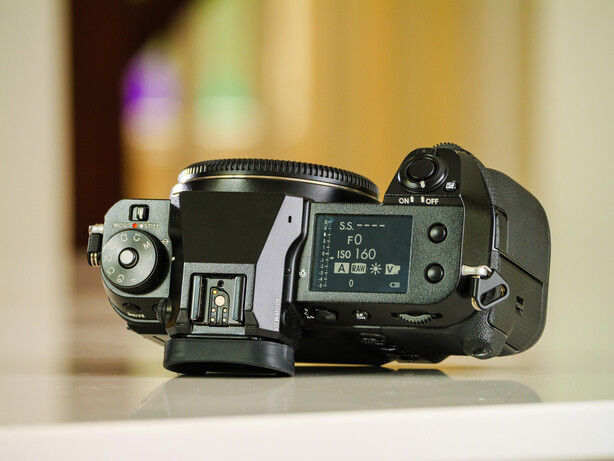
The rear monitor is a 3.2-inch touchscreen rated at 2.36 million dots, mounted on a tri-axial mechanism that tilts 90 degrees up, 45 degrees down, or 60 degrees to the side. CameraLabs notes it’s unchanged from the predecessor. Tom’s Guide found both the tilting LCD and the backlit top panel performed well in bright sunlight once the reviewer cranked LCD brightness to +2, a setting worth bookmarking before you head outdoors. Articulation splits opinion. Amateur Photographer reckons the 3-way tilt is “the best type of screen articulation for photography” but concedes it’s “not so well suited to video, as the screen can’t be positioned facing forwards.” CameraLabs is more relaxed, reasoning most owners will stay behind the camera anyway. Touch controls cover the usual compositional tasks, and no reviewer called them out as a standout or a frustration.
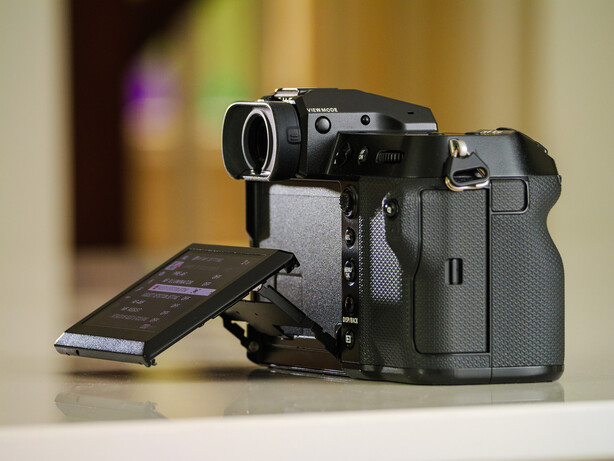
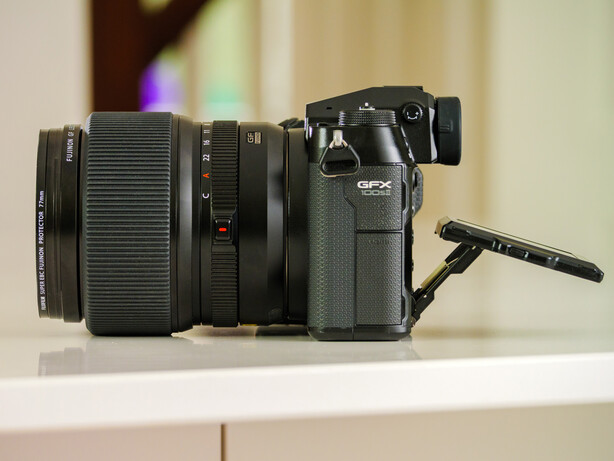
The EVF is where things get properly exciting. Fujifilm has swapped the original’s 3.69 million dot, 0.77x panel for a 5.76 million dot, 0.84x OLED unit, the same one used in the X-H2 and X-H2S, and the improvement is tangible. Amateur Photographer calls it sharp, detailed, and bright enough for direct sunlight, rating it “very good indeed.” CameraLabs describes an “immersive experience” helped by the squarer medium-format sensor filling the full height of the panel. ePHOTOzine‘s side-by-side comparison with the original confirmed a “clear improvement when critically checking focus and previews.” Tom’s Guide went further, reporting that the 100MP sensor combined with the high-resolution finder let them zoom into portraits and literally see skin pores. FCRacer uniquely mentions it also shows the resolution-drop “crunchy” artifact less often during processor-intensive bursts. That said, Digital Camera World points out the EVF is neither removable nor tiltable, and ePHOTOzine notes that 5.76 million dots still falls short of the 9.44 million in the pricier GFX100 II.
Fujifilm GFX100S ll Build and Handling
The GFX100S II shares exactly the same body shell as its predecessor. As Amateur Photographer notes, that decision keeps costs down but means “the control layout may resemble the X-H2 / X-H2S twins, but it doesn’t work in quite the same way” for anyone stepping up from Fujifilm’s APS-C lineup. The most visible change is the BISHAMON-TEX surface finish, inherited from the flagship GFX100 II, and it earns consistent praise across publications. Digital Camera World, ePHOTOzine and FCRacer all found it noticeably grippier and more premium-feeling than the smoother original, with FCRacer admiring something that “looks and feels like something Leica would use.”
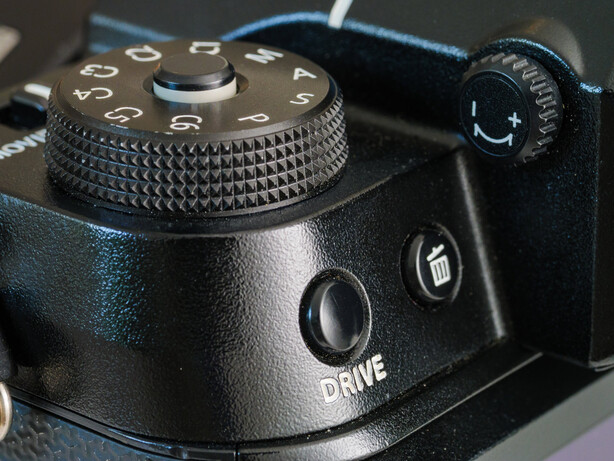
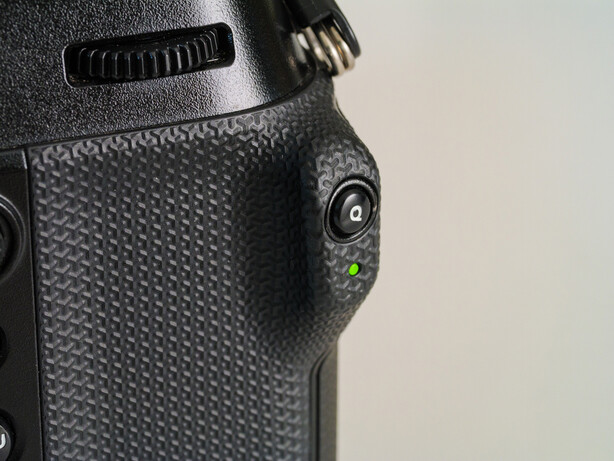
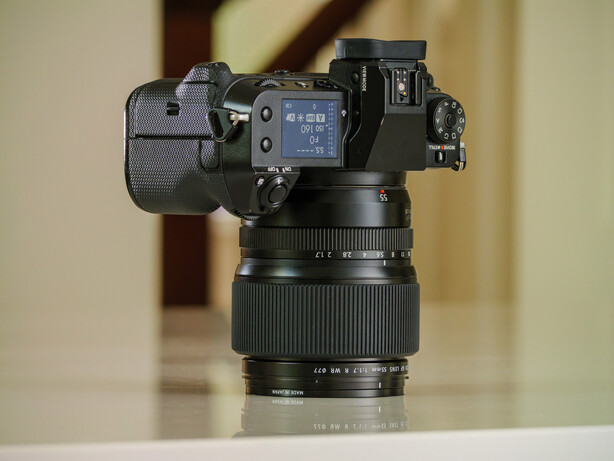
At 883g with battery and card, this is the lightest GFX body yet, fractionally lighter than a Nikon Z8. CameraLabs found it feels “not dissimilar to an old school DSLR,” and Tom’s Guide comfortably wore one on a three-mile uphill hike. That said, Digital Camera World warns that GFX lenses “can be monsters, so one-handed shooting is mostly out the window,” though the reviewer was pleasantly surprised gripping the body even with the substantial GF 500mm attached.
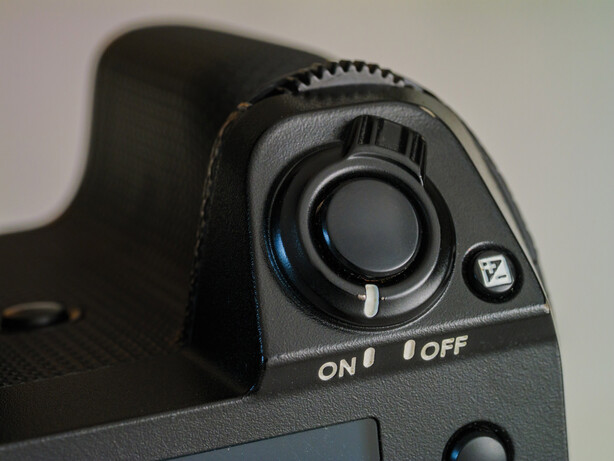
Button quality is a recurring gripe. FCRacer says the buttons “feel mushy and not up to par with the competition from Canon, Sony or Nikon.” Both Digital Camera World and Amateur Photographer single out the exposure compensation button as too small and hard to find quickly, and ePHOTOzine finds the AF-ON button insufficiently prominent, calling the equivalent control on the APS-C X-T50 “much more user-friendly simply because it is more prominent.” The joystick splits opinion further. FCRacer reports Fujifilm has deliberately stiffened it to stop stray focus-point movement, but the fix creates its own problem, needing conscious effort to engage and restarting the learning curve every time you pick up a different body. Digital Camera World, meanwhile, just wishes there was a D-pad instead.
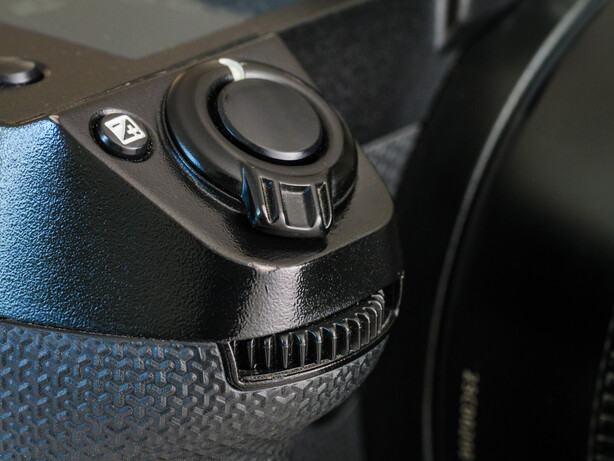
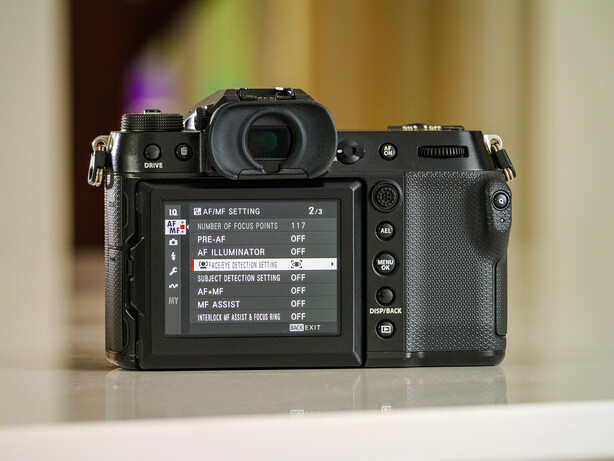
Amateur Photographer recommends a smart dial reassignment, changing the rear dial to exposure compensation and converting the exposure compensation button to an on/off toggle, which largely sidesteps the fiddly default behaviour. The touchscreen can navigate to AF points but won’t let you tap through menus, and both the joystick and Q Menu touch response can feel sluggish under pressure. The Micro HDMI port drew a wry dig from CameraLabs, who noted videographers “will curse whoever chose the tiny Micro port,” and FCRacer takes issue with the rubber port doors, describing their hinges as feeling “squishy” and cheap. The twin UHS-II SD card slots live inside the grip, with no CFexpress option on this body.
Fujifilm GFX100S ll Performance
Burst shooting on the GFX100S II is genuinely impressive in some ways and quietly limiting in others, so it’s worth paying attention to. CameraLabs confirmed 7.2fps in mechanical shutter mode, firing 16 uncompressed 14-bit RAW files in 2.22 seconds, while ePHOTOzine notes you can hold up to 30 compressed RAWs before the buffer protests. Tom’s Guide found that at maximum 7fps with uncompressed RAW plus fine JPEG, you get roughly 3 seconds and 21 frames “before the buffer was filled and the camera ground to a halt.” After that burst, CameraLabs measured a sobering 26 seconds to fully clear the buffer onto a UHS-II SD card, which is precisely why the flagship GFX100 II’s CFexpress slot matters if you shoot fast-moving subjects seriously.

Worth mentioning: ePHOTOzine points out that continuous shooting is only available in 14-bit RAW, not 16-bit, and FCRacer adds this is no great loss, finding “very, very little difference between the 14-bit and 16-bit images, except for the extra storage space and slower camera response time,” and recommending you just stick with 14-bit. Also be aware that 7fps is greyed out entirely with the electronic shutter selected. Amateur Photographer cautions that live-view tracking drops to just 2fps, making moving subjects properly tricky.
Battery life splits opinion partly because of a duff sample. Tom’s Guide received a faulty battery delivering only 260 shots, then a replacement achieving well over 500, which broadly matches Fujifilm’s 530-shot CIPA figure. Amateur Photographer landed closer to 400 shots in real-world use, and Digital Camera World found it possible to “easily churn through a battery in just a few hours.” CameraLabs offered an upside for video shooters, recording 98 minutes of 4K ProRes LT on one charge, nudging past Fujifilm’s 80-minute claim. Amateur Photographer suggests turning on Auto Power Save and switching off always-on Bluetooth to eke out more life.


On IBIS, the eight-stop claim is contested across the board. CameraLabs measured roughly 4.5 stops of real-world compensation with the 45mm lens, Tom’s Guide found handheld shooting below 1/25 sec became a serious problem. All agree, though, that it’s a real step forward. Digital Camera World found the stabilisation “absolutely outstanding” handheld at slow speeds from a moving vehicle. Card choice matters too. Digital Camera World‘s ProGrade V90 SD card produced no slowdowns during high-speed bursts, and images can also be recorded straight to an external SSD via USB-C.
Fujifilm GFX100S ll Image quality

The 102MP sensor at the heart of the GFX100S II is, frankly, a remarkable piece of engineering, and reviewers across the board spent proper time trying to find its limits. CameraLabs captured the feeling well: “it feels like you can just keep getting closer and closer.” Tom’s Guide made the point by cropping so deep into a foxglove that “the minute fibres inside the foxglove bell flowers” became clearly visible. Digital Camera World makes the practical case that this resolution has real-world use beyond the studio, finding the ability to crop into distant wildlife subjects properly useful in the field. Dynamic range at the new base ISO of 80 is exceptional. Tom’s Guide found shadow detail fully recoverable from near-black areas with very little noise, and no blown highlights even against a studio softbox.

And of course we get that all important Fujifilm colour and the genuinely useful Film Simulations that are worth engaging even if you only ever shoot in raw, as they can be reassigned in Photoshop.
Fujifilm GFX100S ll Frequently asked questions
Is the GFX100S II worth the price compared to high-megapixel full-frame alternatives?

The GFX100S II launched at $4,999 or £4,999, which Digital Camera World points out is notably cheaper than the closest Hasselblad rival at $8,199, but Digital Camera World also acknowledges that at full price it is less immediately competitive against high-megapixel full-frame options such as the Sony A7R V at $3,899. The extra outlay does buy a sensor that is 68% larger in area than full frame, and Digital Camera World‘s lab tests found the GFX100S II produced cleaner images than both the Hasselblad X2D 100C and Sony A7R V on noise control. Tom’s Guide and Digital Camera World both warn that GF lenses add substantially to the overall investment, though Tom’s Guide points out that second-hand GF glass is considerably more affordable than Hasselblad or Leica equivalents. Whether the sensor size advantage justifies the premium over full-frame depends on your use case; for portrait and landscape work where ultimate dynamic range and resolution matter, the reviews suggest it does.
How capable is the Fujifilm GFX100S ll for video?
Serviceable, but not a priority. The GFX100S II records internally at 4K 30p with 4:2:2 10-bit capture and a maximum bit-rate of 720Mbps. However, Tom’s Guide is explicit that this is not a video camera, and several practical frustrations compound that verdict. Amateur Photographer found rolling shutter a genuine risk with the electronic shutter, the HDMI output port is Micro rather than full-size, which CameraLabs describes as something videographers will curse, and FCRacer notes there is no optional cooling fan as on the GFX100 II. Video autofocus is inconsistent; CameraLabs found it sometimes nailed focus pulls and at other times hesitated, rating the system best suited to mostly static subjects. If video is a significant part of your work, the reviews are broadly united in pointing you elsewhere.
What is the Fujifilm GFX100S ll battery life like in real-world use, and how does IBIS perform in practice?

Battery life is a recurring frustration across the reviews. Fujifilm rates the NP-W235 at 530 shots, but Amateur Photographer found real-world yield closer to 400, Digital Camera World drained a full charge in a few hours of shooting, and an early Tom’s Guide test battery delivered only around 260 shots before the warning light appeared, though a replacement battery cleared 500. Spare batteries are treated as essential kit rather than optional extras. On stabilisation, the claimed 8-stop figure should be treated as a ceiling rather than a guarantee. FCRacer achieved consistently sharp handheld shots at half a second with the GF 45mm lens, which he calculates as roughly six stops of real benefit. CameraLabs measured approximately four and a half stops in comparable conditions, while Amateur Photographer found half a second reliable but one second and beyond inconsistent. That is still a clear and meaningful improvement over the predecessor, and Digital Camera World found the IBIS outstanding in genuinely demanding conditions, shooting at slow shutter speeds from a moving vehicle in low light.


Further reading – other great reviews of the Fujifilm GFX100S ll
Full Specs
 Fujifilm GFX100S ll
|
|
|---|---|
| UK RRP | £4999.00 |
| USA RRP | $5699 |
| EU RRP | €5499 |
| Brand | Fujifilm |
| Model | GFX100S ll |
| Body type | SLR-style mirrorless |
| Lens mount | Fujifilm GF |
| Sensor size | Medium format |
| Sensor type | CMOS |
| Effective pixels | 102 MP |
| Max resolution | 11648×8736 pixels |
| Aspect ratio | 4:3 |
| Image stabilization | Sensor-shift |
| CIPA stabilization rating | 8 stops |
| File format | JPEG, RAW, HEIF, TIFF |
| Colour space | RGB, sRGB |
| High Resolution mode | 400 MP via sensor shift |
| Aspect ratio options | 4:3, 3:2, 1:1, 16:9, 65:24, 5:4, 7:6 |
| Minimum Standard ISO | 80 |
| Maximum Standard ISO | 12800 |
| White balance options | 12 |
| WB bracketing | Yes |
| Autofocus method | Phase Detect, Contrast Detect |
| AF modes | Single, Continuous, Face/eye detection, Object detection, Tracking |
| Number of focus points | 117 |
| Articulated LCD | Flip up and out |
| Screen size | 3.2 inches |
| Screen resolution | 2360000 dots |
| Touch screen | Yes |
| Live view | Yes |
| Viewfinder type | Electronic |
| Viewfinder coverage | 100 % |
| Viewfinder magnification | 0.84 x |
| Viewfinder resolution | 5760000 dots |
| Mech shutter speeds | 60-1/4000sec + Bulb |
| Elect shutter speeds | 60-1/16000sec + Bulb |
| Max flash sync | 1/125sec |
| Exposure modes | Program, Aperture priority, Shutter priority, Manual |
| External flash | Hotshoe, Sync socket |
| Flash modes | Slow Sync., Autoflash, Rear Sync. |
| Drive modes | Single, Continuous, Bracketing |
| Max fps (mechanical shutter) | 7 fps |
| Max fps (electronic shutter) | 3 fps |
| Self-timer | Yes |
| Self-timer delay | 2, 10 |
| Metering modes | Multi, Center-weighted, Spot, Average |
| Exposure compensation | +/-5EV |
| AE Bracketing | Up to 9 frames |
| Storage types | 2 slots, UHS-II SD |
| Shooting to SSD | Yes |
| Shooting to SSD capacity | 2 TB |
| USB | 3.2 Gen 2×1 |
| HDMI | Micro |
| Microphone port | 3.5mm |
| Headphone port | 3.5mm |
| Bluetooth | V4.2 |
| WiFi | IEEE802.11a/b/g/n/ac |
| Remote control | Via port |
| Battery | NP-W235 Li-ion battery |
| Supplied battery capacity | 2200 mAh |
| Battery Life (CIPA) | 530 shots per charge |
| Environmentally sealed | Dust and splash proof |
| Size | 150×104.2×87.2mm |
| Weight | 883 g |
Videography Features
| Format | MP4, ProRes Raw, MOV |
|---|---|
| Image area | Full frame |
| Aspect ratio options | 17:9, 16:9 |
| Max 4K | 30p |
| Max FHD | 60p |
| Max ProRes | Apple ProRes 422 HQ, Linear PCM (Stereo sound 24bit / 48KHz sampling) |
| Max Bit Rate | 720 Mbps |
| System frequency | 25Hz |
| Clean HDMI feed | Yes |
| Format | LPCM |
| Max Bit depth | 24bit |
| Frequency | 48kHz |
| 4-channel | No |
For more information see the Fujifilm website