


How do you sell 660 lenses nobody actually needs? Make a limited run of and romanticise their origins with hints of spies and the Cold War. I doubt anyone will buy one of Leica’s new Summicron-M 66mm f/2 lenses because they have a critical focal length gap that needs to be filled, but the war stories and the rarity of the lens will make it a must-have for at least 660 collectors around the world.
This new lens for the M-system is a modernisation of the military issue Elcan 66mm f/2 that was designed and made for the US Navy’s reconnaissance teams in the late 60s. At the time a simplified Canadian-made 50mm f/2 would have been standard for military use, in a design that used just 4 elements un-cemented in 4 groups and which could resist drops and blasts more easily than a more complex optical system. These lenses might have survived the rigours of war but were not especially sharp and wouldn’t have been suitable for reconnaissance situations in which images needed to be enlarged to discover fine detail.
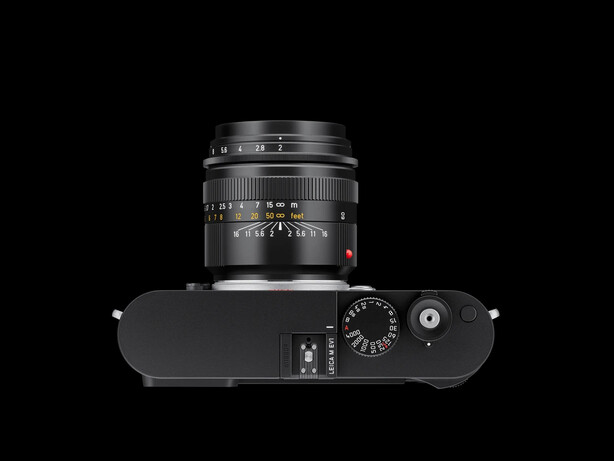
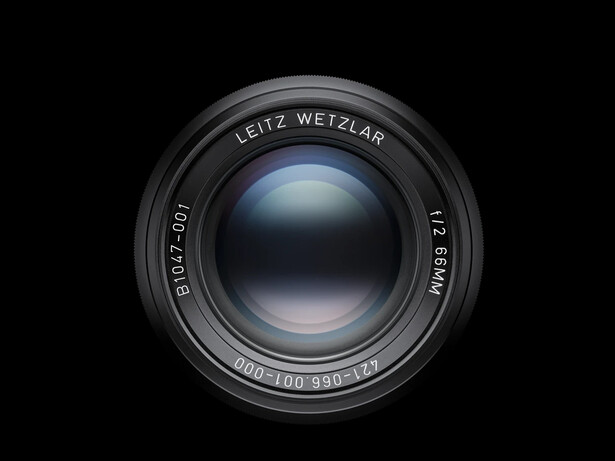
Reportedly the US Navy requested a new lens that offered high contrast, excellent resolving power and which was small enough to carry easily, so Ernst Leitz Canada made them the Elcan 66mm f/2. The 66mm focal length was not specifically requested, according to Leica, but was the focal length that allowed the best balance of contrast, resolution and size. ‘Elcan’, formed E(rnst) L(eizt) Can(ada), was the name given a series of mostly military-exclusive lenses made by the company in its military and industrial-focused Canadian factory. Although the use of the lens hasn’t been explicitly explained, it is likely that the higher resolution was required for aerial surveillance rather than for the James-Bond style copying of submarine blueprints. The minimum focus distance of the lens was, and still is, 1 metre, so it would have been no good at all for close-up work.
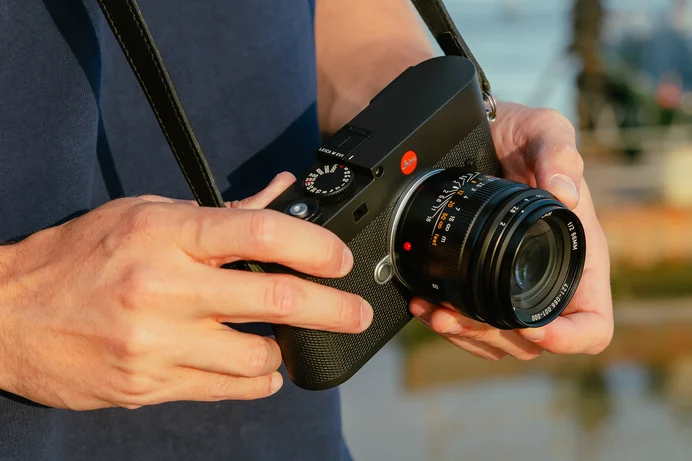
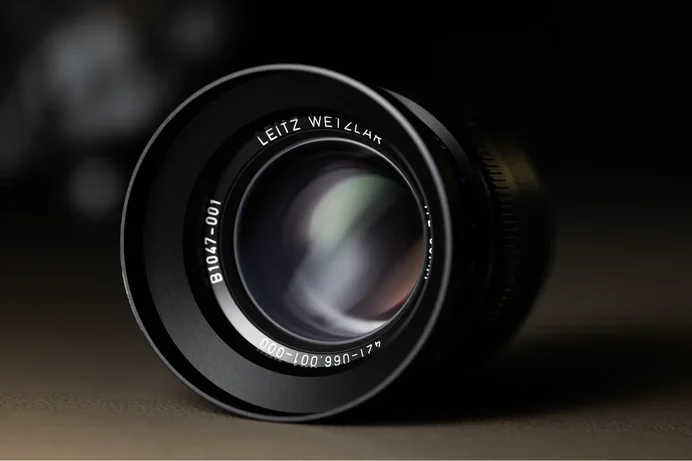
Leica says this is the first time this lens has been released for purchase by enthusiasts, but it’s likely enthusiasts would have had no use for the original lens. The new version is updated to modern standards, says Leica, which probably means the resolution of the original would not have compared well to today’s lenses. Leica also notes as a point of interest that the aperture ring on the original lens, and recreated in the new version, rotates in the opposite direction to standard Leica M lenses. The likely reason for this is that servicemen at the time would have been more used to camera and lens systems from other manufacturers – such as the Nikon F series – in which the aperture ring rotated clockwise to close down. Leitz would have been asked to mimic this to save confusion in the heat of the moment when the lens was in operation. The focus rings of Nikon F and Leica M lenses also rotate in opposite directions, but that may not be such as issue in a lens that will be focused at infinity most of the time.
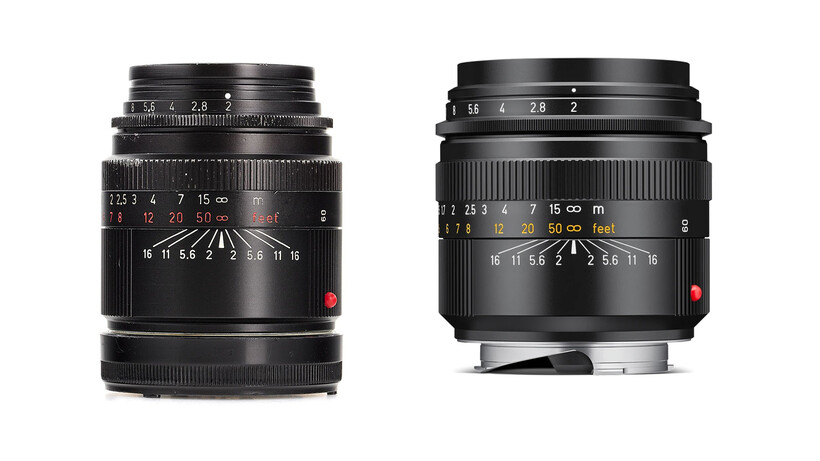
Elcan image from www.leitz-auction.com
While the original lens used nine elements the new version uses six in five groups but retains 9 bladed in the iris as well as the markings in metres and feet on the distance scale. Some of the earliest Elcan 66mm lenses used red paint in the feet engravings but this new model sticks with the yellow of the modern M lenses. Leitz sold its factory in Canada in 1990, hence the new engraving on the front ring says ‘Leitz Wetzlar’ instead of ‘Elcan’.
Leica’s new version of the lens will be considerably less rare than the original, of which 200 were made. Only a fraction of those can be traced so when they come up for sale they attract a lot of attention from collectors and those using rare camera kit as an investment. Those same groups will probably show an interest in the new lens, but with 660 in circulation, and it being a recreation rather than an original, it is unlikely to hold the same sort of value.


Leica Summicron-M 66 f/2 price and availability
The new Summicron-M 66 f/2 is available now, and costs £8410, €9,850.00, $10,900. If that isn’t enough for you, there will be an auction of the first unit of this new lens, with a serial number 001, in November. That is certain to go for many times those prices.
For more information see the Leica Camera website.
Leica Summicron-M 66 f/2 specification
| Lens | Leica Summicron-M 66 f/2 |
| Angle of view (diagonal/horizontal/vertical) | |
| Full-frame (24 × 36 mm) | 36.3°/30.5°/20.6° |
| Lens system | |
| Number of lenses/assemblies | 6/5 |
| Position of the entrance pupil before the bayonet | 31.40 mm |
| Focus range | 1 m to infinite |
| Focusing | |
| Scale | Combined scale meters (m)/feet (ft) |
| Smallest object field | Full-frame: 321 × 481 mm |
| Largest scale | 1:13.4 |
| Diaphragm | |
| Setting/function | Click-stop diaphragm with half-increment lock settings |
| Smallest aperture | 16 |
| Number of diaphragm blades | 9 |
| Bayonet | Leica M bayonet with 6-bit encoding |
| Filter thread | E49 |
| Lens hood | Screw-on |
| Dimensions | |
| Length | Approx. 60.1 mm |
| Diameter | Approx. 60 mm |
| Weight | Approx. 456 g |
Press release
New: The Leica Summicron-M 66 f/2
This reinterpretation of the historic spy lens extends the Leica Classic Line by adding the unique 66 mm focal length
Dr Walter Mandler developed the Elcan 66 mm f/2 at Ernst Leitz Canada in the late 1960s. Designed for use by the US Navy, only around 200 units were produced. This makes the lens one of the rarest in the Leica M-System, giving it special optical and historical significance. To honour this lens, Leica Camera AG is presenting a reinterpretation of it by expanding its Classic Line with the new Summicron-M 66 f/2.
Dr Mandler was already regarded as a leading authority in optical design back then. He developed a bespoke lens for covert reconnaissance photography in response to a US Navy commission. According to Dr Mandler, Head of Development and Vice-President of Ernst Leitz (Canada) Ltd. in Midland, Ontario, at the time: “The Naval Intelligence Service wanted a lens that looked like any other but delivered an unparalleled level of resolution.” The unusual focal length of 66 mm was no coincidence, but rather the result of striking a precise balance between maximum resolution, fine contrast rendition and a compact design. This extraordinary, rare spy lens, with a purely military history, embodies one of the most extraordinary chapters in the history of the Leica M.
Historical accounts also suggest that equipment of this type found use beyond its original US Navy commission, among Western allied partners during the Cold War. Many Elcan 66 mm f/2 lenses are also associated with the Leica KE-7A, the special military variant of the Leica M4. Together, camera and lens formed compact sets for discreet photography in situations where exceptional detail was essential.
The original sets were supplied with an instruction manual that explained how to destroy the camera and lens in the event of capture. Striking in retrospect, this detail reflects the sensitivity of the assignments for which the equipment was created, while the lens itself remains remarkable for the optical performance that made such use possible.
The new Summicron-M 66 f/2 continues this story and represents the first time that Leica is making this focal length available to all photography enthusiasts. While the optical design is based on the original, it has been optimised and adapted to meet today’s standards, just like the lens body. As with the Elcan, the Summicron-M 66 f/2 differs mechanically from standard Leica models: its aperture ring rotates in the opposite direction to that of standard M-Lenses, and the distance scale arrangement follows military specifications. The engravings are reminiscent of the original design and have been reinterpreted for the Summicron-M 66 f/2. Thanks to a visibly finer typeface, the new 66 mm focal length stands out from current Leica lenses.
The Summicron-M 66 f/2 range is being released in a limited edition of 660 units. The special serial number is engraved on the front ring alongside the optical calculation number B1047 and the 12-digit internal material number. This is similar to the original, which featured the production number and the initial calculation number C283, as well as the 13-digit US Navy order number, in the same position. Additionally, the ‘Leitz Wetzlar’ engraving on the front ring replaces the previous model name ‘Elcan’, which stood for Ernst Leitz Canada back then. Another stand-out detail is that the small, engraved number ‘60’ on the side of the lens indicates the exact focal length. This was customary for precision lenses at the time and is testament to the Leica factory’s precise manufacturing. In order to specify the focal length with the utmost accuracy, the digit before and after the decimal (without a decimal point) were also engraved on the lens. Therefore, the marking ‘60’ stands for a precisely measured focal length of 66.0 millimetres.
With a maximum lens speed of f/2, the Summicron-M 66 f/2 produces images with distinctive rendering, as do all lenses in the Leica Classic Line. This is characterised by the interplay of soft bokeh and high contrast. When stopped down, its original purpose becomes apparent: maximum resolution for clearly reproducing the finest details. With a focal length between that of the classic 50 mm lens and longer portrait focal lengths, it offers a natural perspective and subtle image compression. This reinterpretation of a classic carries its own history into the present, capturing today’s moments in exceptional quality.
The Leica Summicron-M 66 f/2 will be available worldwide from 3 September 2026 in Leica Stores, on the Leica Online Store and from authorised dealers. The recommended retail price is €9,850.00 including VAT.
In November 2026, the Summicron-M 66 f/2 with serial number 001 will be auctioned at Leitz Photographica Auction in Wetzlar. As the first-numbered lens in the worldwide limited edition of 660 units, it holds a special position. The auction offers a unique opportunity to acquire this exceptional example of contemporary Leica history.