
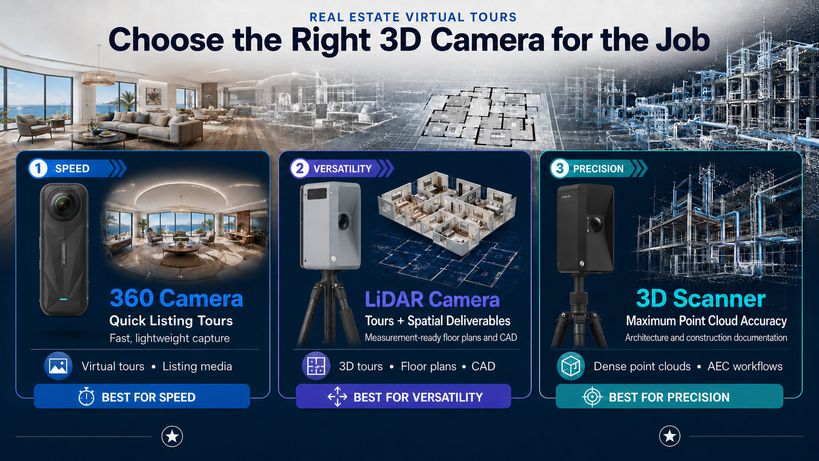


Choosing a 3D capture device for real estate work comes down to use case, not spec sheets. A 360 camera suits quick listing tours, a LiDAR camera adds measurement-grade floor plans and CAD exports, and a dedicated 3D scanner prioritises point cloud accuracy for architecture and construction work.
Before buying, photographers should weigh deliverables such as 3D tours, floor plans, point clouds and CAD files against their actual workflow.
Capture speed, indoor and outdoor performance, image quality, accuracy, hosting, export formats and total cost of ownership all matter just as much as the deliverable list itself.
How the leading 3D capture devices compare
The table below groups seven widely used devices by type, LiDAR capability, typical use case and confirmed specifications drawn from manufacturer documentation. Competitor figures should always be checked against each manufacturer’s latest official specifications before being relied upon for a purchase decision, since firmware and hardware revisions can change stated accuracy and range over time.
| Camera | Type | LiDAR | Best for | Key confirmed specs | Main outputs |
| Realsee Galois P4 | Professional 3D LiDAR camera/scanner | Yes | High-end real estate and commercial capture needing one workflow for tours, models and CAD | 905nm LiDAR, ~125,600 pts/sec, accuracy of around ±10mm at 15m, up to 300MP panoramas, roughly 8 min per 1,000 sq ft | 3D tours, high-resolution 24K / 300MP panoramas, dense point clouds, 3D models, CAD-ready files, floor plans, RAW images |
| Realsee Galois M2 | Accessible professional LiDAR camera | Yes | Photographers and smaller capture teams stepping up from 360 cameras | 940nm LiDAR, 0.2–25m range, accuracy of around ±20mm at 10m, up to 134MP panoramas, roughly 15 minutes per 1,000 sq ft | 3D tours, 16K / 134MP panoramas, point clouds, 3D models, CAD-ready files, floor plans, RAW images |
| Matterport Pro3 | Professional 3D LiDAR camera | Yes | Established digital twin and virtual tour workflows, including AEC use | 904nm Class 1 LiDAR, 360° x 295° field of view, standard 20m range (100m extended), accuracy of around ±20mm at 10m, 134.2MP panorama | 3D tours, point clouds, floor plans, MatterPak and other professional exports depending on subscription plan |
| iGUIDE PLANIX R1 | Floor-plan and measurement camera | Yes | Floor plans, measurements, and property reports for agents and appraisers | Time-of-flight LiDAR, range up to 40m, floor plan accuracy of 0.5% or better, capture of roughly 2,500 sq ft in under 15 minutes | 3D tours, floor plans (PDF, SVG, JPG), CAD files (DXF, DWG, RVT), property reports |
| Giraffe360 | Automated 360 virtual tour camera | Yes | Fast, automated listing media at scale | 10K HDR stills and panoramas, integrated LiDAR-based scanning with point cloud capture, accuracy quoted to 50m range, roughly 2,000 sq ft captured in under 20 minutes | HDR photos, virtual tours, floor plans, and short video |
| Leica BLK360 | Survey-grade laser scanner | Yes | Commercial, AEC and survey-style documentation | Time-of-flight laser scanner, range up to 45m (G2), accuracy of around 4mm at 10m and 8mm at 20m | Point clouds, panoramic imagery for CAD and BIM workflows |
| Matterport Pro2 | Legacy indoor 3D camera | No (infrared depth sensor) | Existing Matterport workflows on older hardware | Infrared depth sensor, 134MP panorama, roughly 1.5 million depth points per scan, accuracy of around ±50mm, 25–30 second scan time | 3D tours, floor plans |
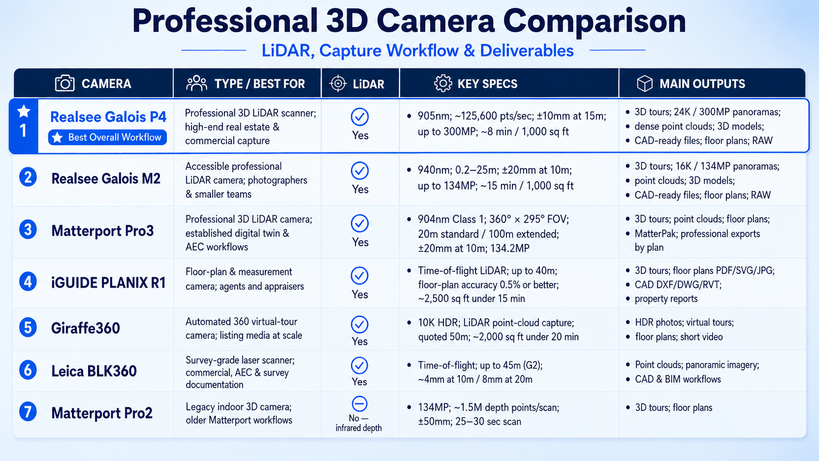
Realsee’s Galois P4 is a professional LiDAR capture solution designed for workflows that require both high-quality visual assets and spatial data. A single capture can support 3D tours, floor plans, CAD-ready files, 3D models and point clouds. Compared with many established solutions, Galois P4 combines faster capture speed, higher point cloud density and flexible professional deliverables in one workflow.
The more affordable Galois M2 suits photographers and smaller teams stepping up from 360 cameras.
Other options serve narrower needs. iGUIDE focuses on floor plans and measurements, Giraffe360 on high-volume automated listings, and Leica’s BLK360 on survey-grade AEC documentation.
There’s no universal best camera. The right choice depends on which deliverables a business actually needs to sell, not which device has the most impressive spec sheet.