
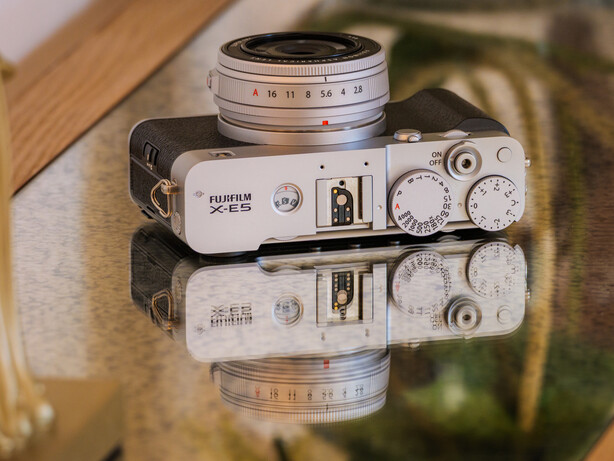





Fujifilm X-E5 – WDC Opinion

While I love all genres of photography and any excuse to be behind a camera, the type of photography I do most involves hanging around in the street waiting for something to happen.
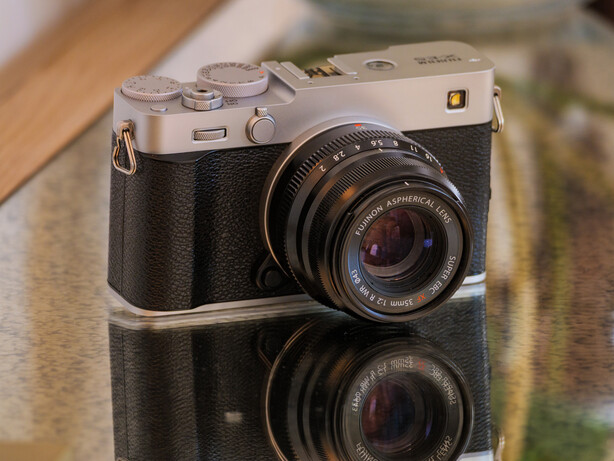
I don’t necessarily feel I need a small camera to be discreet, but it certainly makes holding and carrying more comfortable when out for a long time. Flat-topped cameras are also a preference, so favourites have been the Lumix GX8/9, the Leica Q series, Fujifilm’s own X-Pro cameras and the new Lumix DC-L10 compact. Smaller than the X-Pro models and the full framed fixed-lens Leica Q3, the X-E5 is just larger than those Panasonic cameras, but comes with a larger sensor – physically and in terms of pixel count. Delightful as it is, the Leica Q3 is over 3.5x the price of the X-E5 with its pretty Fujinon 35mm f/2.8 lens, but currently at £1550 this Fuji kit is actually pretty costly itself. The Lumix DC-L10 however isn’t far behind, and as it offers quite a lot less in terms of basic spec for stills shooters it rather flatters this rival.
I really enjoyed using this sleek and good-looking camera – looks aren’t important obviously, but a neat and stylish design certainly helps, and a lot of non-camera (‘normal’) civilians admired it during the test. The elements I love are the feel of the camera, and that most things I need fall to hand easily. The colour controls are nice, but the default film simulations are better. For all the choices, I found I was shooting Astia most of the time, and pulling Adobe Camera Raw away from its own dull colours in the Camera Matching browser to Astia, Provia or Reala Ace V2. It is slightly annoying that Fuji’s Daylight white balance comes in at 4950K, when really it needs closer to 5500K, so shifting blue and adding a touch of magenta almost gave me a repetitive stress injury. Shooting AWB solved this issue in straightforward daylight situations, but I don’t want to have to shoot AWB for everything.

As others mention, the AF system isn’t the best available, but getting deeply acquainted with it really does make a difference, and after a while I was able to get it to do what I wanted most of the time. Despite the Daylight white balance, and the slight mash-up of fine detail in grass and trees, I loved using this camera – and equally loved looking at the finished images. The Fujinon XF 23mm f/2.8 R WR that is often bundled with it is nice, compact and looks good on the camera – but it’s designed to be small rather than quick and critically sharp.
Damien Demolder
What is the Fujifilm X-E5?
Price: £1299/€1549/$1699.95
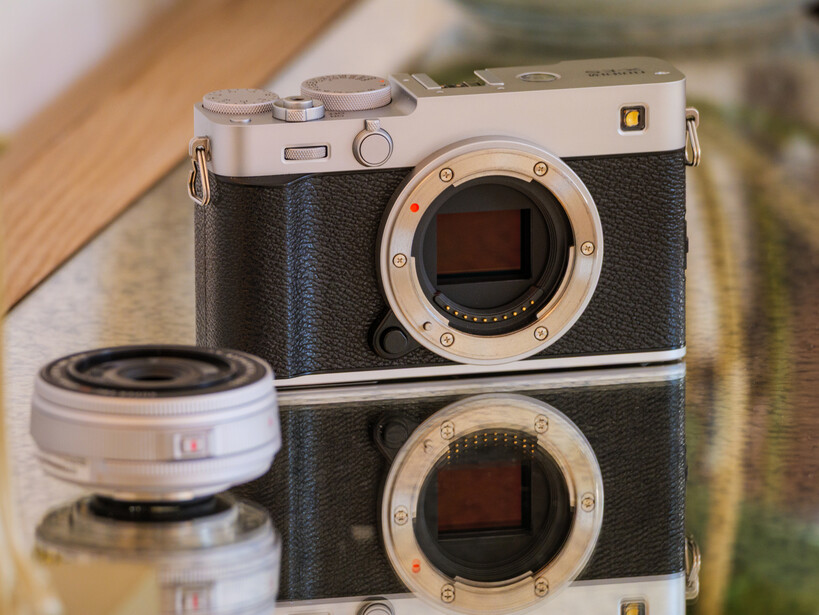
Fujifilm’s X-E5 is a compact, rangefinder-styled APS-C mirrorless camera pitched at enthusiast photographers who want the tactile, dial-driven feel of the X100VI but with the freedom to swap lenses. After a four-year gap, the X-E4 having disappeared almost immediately thanks to divisive design choices and pandemic supply chaos, Fujifilm returns to the format with a much more polished offering.
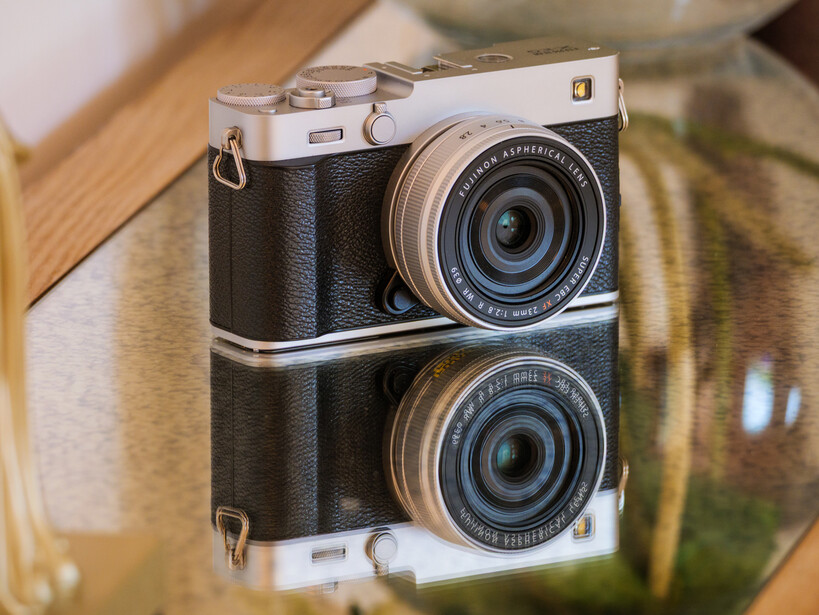
The headline upgrades are big ones. The 40.2-megapixel X-Trans CMOS 5 HR sensor and X-Processor 5 arrive from the X-T5, bringing a serious resolution jump and meaningfully better autofocus over the outgoing model. And crucially, the X-E5 becomes the first camera in the X-E line to include in-body image stabilisation, rated at up to seven stops. There’s a genuinely clever hidden Film Simulation dial machined into the top plate, a new front lever borrowed from the X-Pro and X100 lines, and proper support for Film Simulation recipes as a distinct feature. If you’ve been holding out for a more refined, feature-complete successor to the X-E4 that doesn’t force you to pick between pocket-ability and capability, the X-E5 is built with you in mind.
Fujifilm X-E5 Opinions From Around The Web
It’s easy to see why the Fujifilm X-E5 has gathered a lot of favourable reviews for its looks and its pictures. Its price though is a sticking point for some. This WDC report explains what the main photo websites are saying about it
Averaged Score: 9.3/10
Pros

-
 Great looks and design
 -
Improved AF
-
High resolution sensor
-
Generally very nice handling
Cons

-
 A bit pricey
 -
Great video clearly not a priority in the menu
-
AF system needs work to get the most from it
-
Daylight white balance pre-set too cool
Fujifilm X-E5 Collective Verdict
The Fujifilm X-E5 has landed to near-universal praise, with reviewers consistently calling out its excellent image quality, charming retro handling, and the clever design touches that fix the shortcomings of its predecessor. Amateur Photographer awarded it a rare perfect score, describing it as “a joy to shoot with,” while Digital Camera World, ePHOTOzine, and DPReview all celebrated its satisfying mix of traditional controls and modern internals. The most consistent gripe across reviews is pricing, particularly in the US.
Digital Camera World and DPReview both note that the X-T50, X-T5, and even the X100VI offer comparable or greater feature sets for similar or lower money, although DPReview reckons the value stacks up considerably better at UK pricing. CameraLabs and PetaPixel flag a few hardware compromises, including the lower-resolution viewfinder, the lack of weather sealing, and the absence of a built-in flash. Those are worth weighing against the flexibility a swappable lens mount brings. At an aggregated score of 9.3 out of 10, the X-E5 is clearly a very good camera. Buyers outside the US will find it easier to justify. American photographers will want to compare prices carefully before committing.
Fujifilm X-E5 Specification
The 40.2MP X-Trans CMOS 5 HR sensor is the headline here, the same chip that debuted in the X-T5 and has since proven itself. Paired with the X-Processor 5, it covers ISO 125 to 12,800 natively, stretching to ISO 51200 at the extended end, with 14-bit RAF raw files and HEIF capture at 4:2:2 10-bit rounding out a format list that punches well above the camera’s compact dimensions. Perhaps the biggest photo story is that IBIS has arrived in the X-E series for the first time. Amateur Photographer confirmed the 5-axis system delivers 7.0 stops of compensation at the centre of the frame and 6.0 stops towards the corners, measured to CIPA 2024 standards with the XF 35mm f/1.4. That’s quite remarkable, and surprising in a body measuring just 124.9 x 72.9 x 39.1mm and weighing 445g with battery and card.
Continuous shooting reaches 20fps via the electronic shutter, but CameraLabs notes anything faster than 13fps triggers a 1.29x crop, dropping resolution from 40MP to around 24MP. Mechanical shutter tops out at 8fps with effectively unlimited JPEG buffering. The NP-W126S battery is rated at 310 frames in normal mode or 400 in economy mode. Modest figures. But Amateur Photographer points out that Fujifilm, has been using this NP-W126 battery for a decade now, so cheap and reliable third-party alternatives are easy to find. Flash sync is limited to 1/180sec on the focal plane shutter, a practical consideration for anyone shooting with studio lights.

Fujifilm X-E5 Video specification
Fujifilm positions the X-E5 firmly as a stills camera, and Amateur Photographer and ePHOTOzine both note that video mode is accessed via the drive button as the last entry on a long list. Even so, the specs are genuinely capable. Internal recording reaches 6.2K at up to 29.97p in 4:2:2 10-bit H.265, and DPReview confirmed the same video modes as the X-T50: 6.2K at 30p with a 1.23x crop, 4K at 60p with a 1.14x crop, and full-width 4K at 30p. The full-width 4K is subsampled, which PetaPixel says costs some detail, while DPReview measured the 6.2K and HQ modes at a fairly slow 24.9ms rolling shutter rate, producing noticeable jello when panning. Standard 4K fares better at 15.3ms.
12-bit RAW HDMI output at 6.2K is a genuine surprise inclusion at this price
High-speed 1080p reaches 240p, but audio recording is disabled in that mode. F-Log2 and all 20 Film Simulation settings are available for video, and 12-bit RAW HDMI output at 6.2K is a genuine surprise inclusion at this price. Audio capture is Linear PCM stereo at 24-bit/48kHz in MOV format. There’s a 3.5mm microphone input, which CameraLabs notes is more practical than the 2.5mm jack on the X100 series. Headphone monitoring requires a USB-C to 3.5mm adapter; DPReview confirmed that adapter is included in the box. The Micro HDMI Type D port handles external monitoring. The X-E5 is also incompatible with Fujifilm’s optional cooling fan accessory, but DPReview found it didn’t overheat quickly during typical short-clip shooting.
Fujifilm X-E5 Focusing system
The X-E5 inherits Fujifilm’s latest phase-detection system, with AF sensitivity reaching down to -7 EV in phase-detection mode according to ePHOTOzine, and subject recognition covering animals, birds, insects, vehicles, aeroplanes, trains, and drones. In general shooting, the results are encouraging. Amateur Photographer found the AF “every bit as fast and accurate as you’d expect from a modern camera,” with a respectable hit rate on wildlife and trains, and DPReview reported that “the vast majority of the shots we took while testing it were perfectly in focus, with only a few coming out a touch soft.“
Against serious competition, Fujifilm still trails. DPReview says the tracking system “continues to be off the pace set by the likes of Canon, Nikon and Sony,” occasionally wandering off target or failing to lock on. Subject recognition is the strongest mode, but DPReview has historically found it can misjudge distance with moving objects or lock onto eyelashes rather than pupils. PetaPixel echoes the praise for subject, eye, and face detection in stills, but flags that continuous AF in video mode “is still a little unreliable.“

The AF menu structure doesn’t make life easy, it seems. Human and face detection sit in a separate menu from animal and vehicle detection, a point that Amateur Photographer, DPReview, and CameraLabs all flag. If you want a custom button for subject detection, DPReview notes you’ll need to decide whether it covers humans or everything else, or devote two buttons to switching between them. CameraLabs adds that the X-E5 also lacks the Auto subject detection mode found on the X-T50. Amateur Photographer is blunt that “it’s definitely not as straightforward to use as some other brands.” Their practical advice: set the AF mode slider to its C position for face or subject detection to work properly, and pick the largest available focus zone to give the camera the best chance of grabbing a subject. DPReview also reckons spending time tweaking AF settings can meaningfully improve tracking. One further caveat worth considering: Amateur Photographer found the bundled XF 23mm F2.8 R WR kit lens focuses slowly, because it moves the entire optical group rather than using a lightweight internal-focusing arrangement, which undermines what is otherwise a capable AF system.
Fujifilm X-E5 Rear screen and EVF
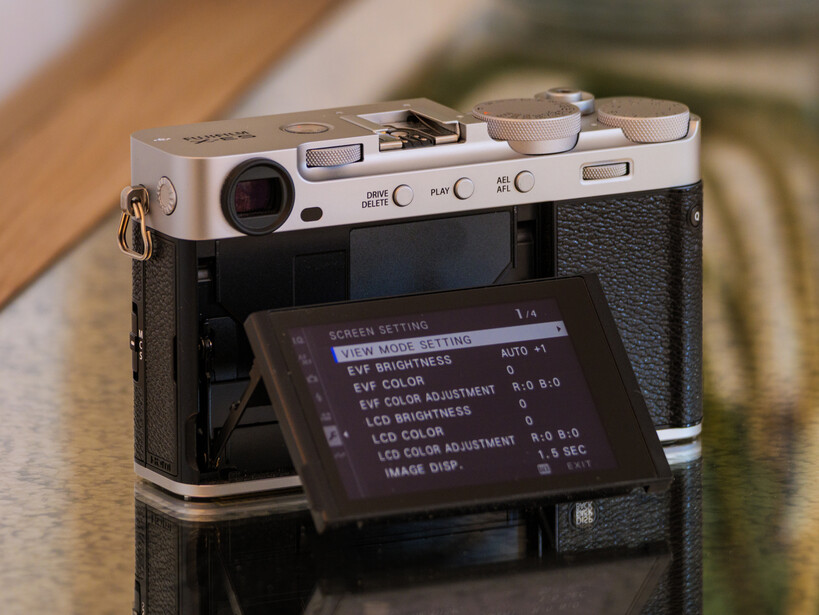
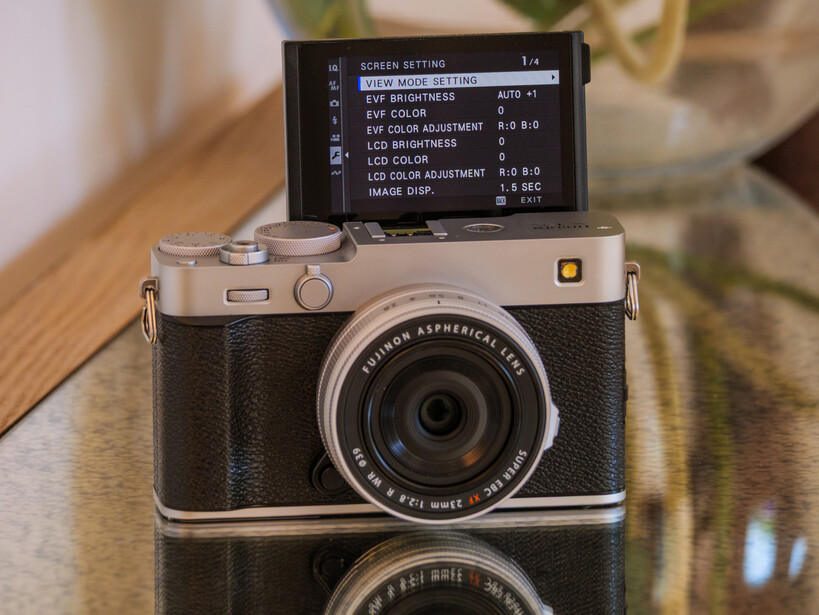
The rear screen is a 3-inch tilt-only panel running at just 1.04 million dots (720x480px), and that resolution figure draws consistent criticism across publications. CameraLabs points out it’s notably coarser than the X100 VI (1.62M), the X-E4 (1.62M) and the X-T50 (1.84M), calling it “a disappointing decision at the price.” That said, CameraLabs and ePHOTOzine both found it acceptable in practice, with CameraLabs admitting it didn’t notice it “being glaringly low-res in practice” and ePHOTOzine describing the panel as simply “bright and clear.” Digital Camera World tested it in sunny Valencia and found it held up well outdoors, failing only in the harshest direct sunlight.
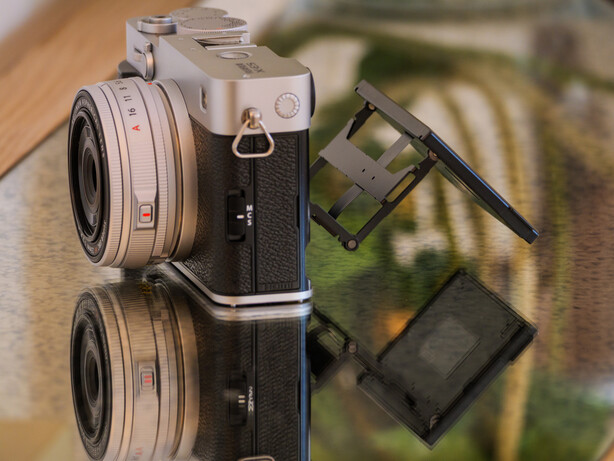
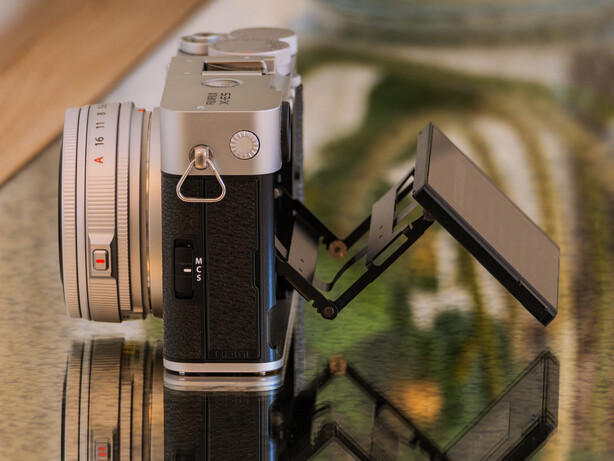
Articulation is a genuine bright spot. CameraLabs notes the X-E5 inherits the X-E4’s more flexible mechanism, tilting upward to fully face forward for selfies and downward to nearly 90 degrees, going further in both directions than the X100 VI or X-T50 manage. Amateur Photographer confirms neither of those cameras can match it for self-shooting. The catch, flagged by both Amateur Photographer and DPReview, is that anything on the hot shoe wrecks the selfie view: “pretty much any microphone will block it,” as DPReview puts it.
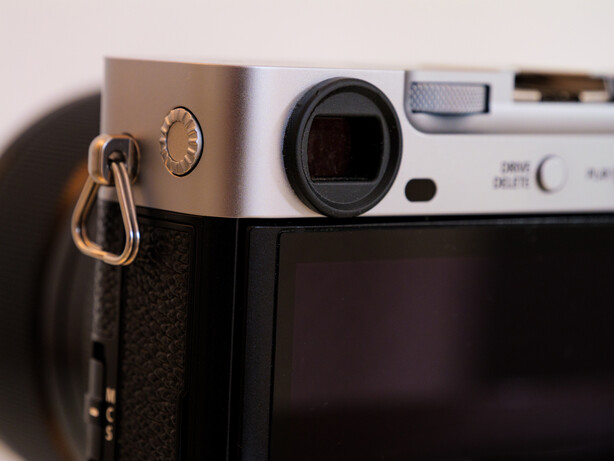
The EVF is a 0.39-inch 2.36-million-dot OLED with 0.62x magnification. PetaPixel and CameraLabs both note it falls short of the X100 VI’s 3.69-million-dot panel, though CameraLabs found little visible difference in practice except on fine diagonal lines. DPReview raises a more practical concern: “It has a fairly short eye-point, so glasses wearers are likely to find they can’t see the whole finder at the same time,” adding that the tiny hard rubber surround offers no real eye cup against stray light. Amateur Photographer found it bright enough for sunny conditions and a reliable guide to exposure and colour. The film-SLR-style display mode divides opinion sharply. PetaPixel “absolutely loves” the match-needle exposure interface, while Amateur Photographer found the whole thing “downright gimmicky“.
Fujifilm X-E5 Build and Handling
There’s near-universal agreement that the X-E5 is a significant step up from the X-E4 in feel. Digital Camera World put it plainly: “The X-E4 felt a little cheap and hollow, but the X-E5 feels much more premium and solid, and is up there with the X-T5 and X-T50.” DPReview concurs, noting the whole camera feels denser than earlier models, while ePHOTOzine points to the machined aluminium top plate as giving an immediate impression of solid, precision manufacture. The weight has climbed from 364g to 445g, which all four sites logged, but Amateur Photographer notes the body still measures just 125mm x 73mm x 39mm despite the addition of IBIS. ePHOTOzine found it small enough to pocket with a pancake lens, and PetaPixel compares its footprint to an X100.
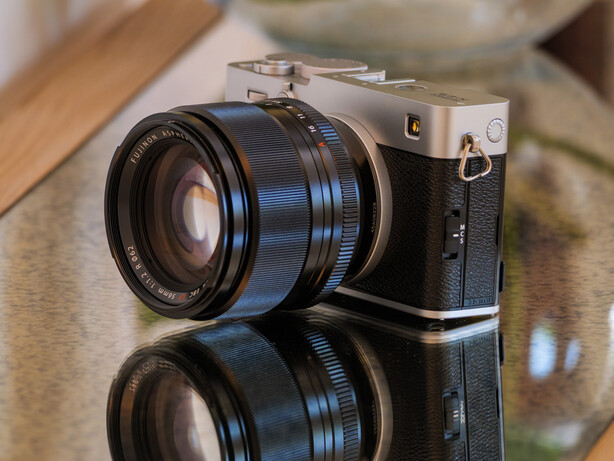
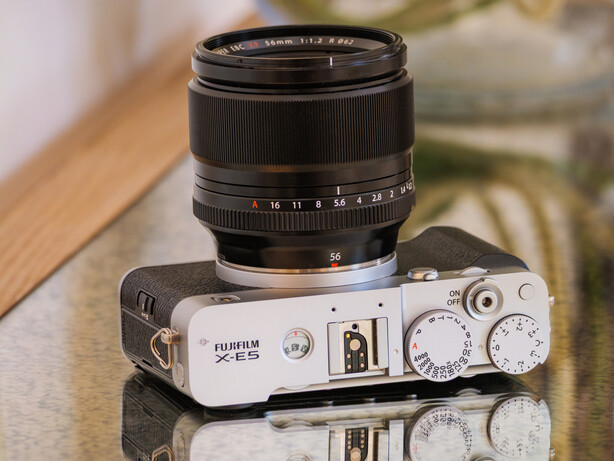
The moulded grip, set into the body rather than bolted on, is comfortable with small primes, Digital Camera World reports, but becomes challenging with larger lenses like the XF 16-55mm f/2.8. DPReview adds that it stops just above the base plate, leaving a hard edge you probably don’t want your fingers under, so left-hand support is required. No weather sealing is fitted, which Amateur Photographer, DPReview, and PetaPixel all flag as a meaningful omission at this price.
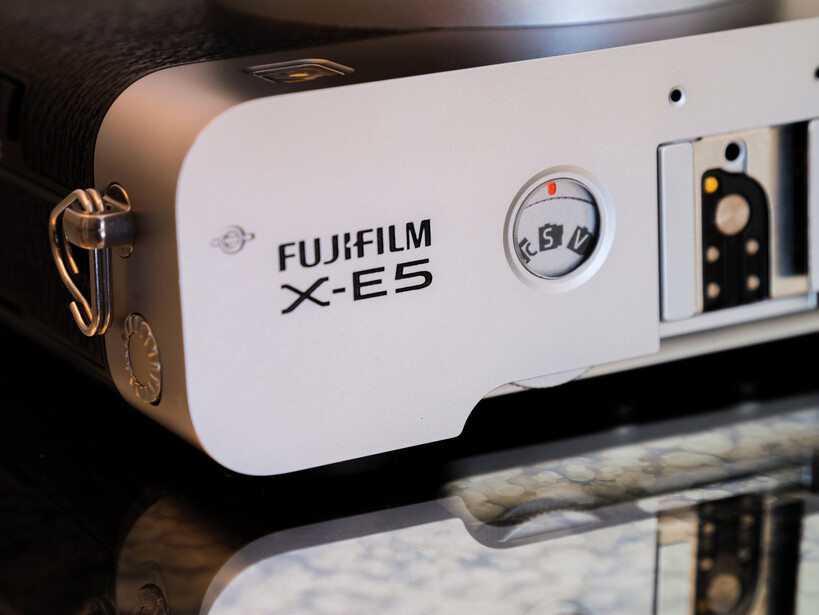
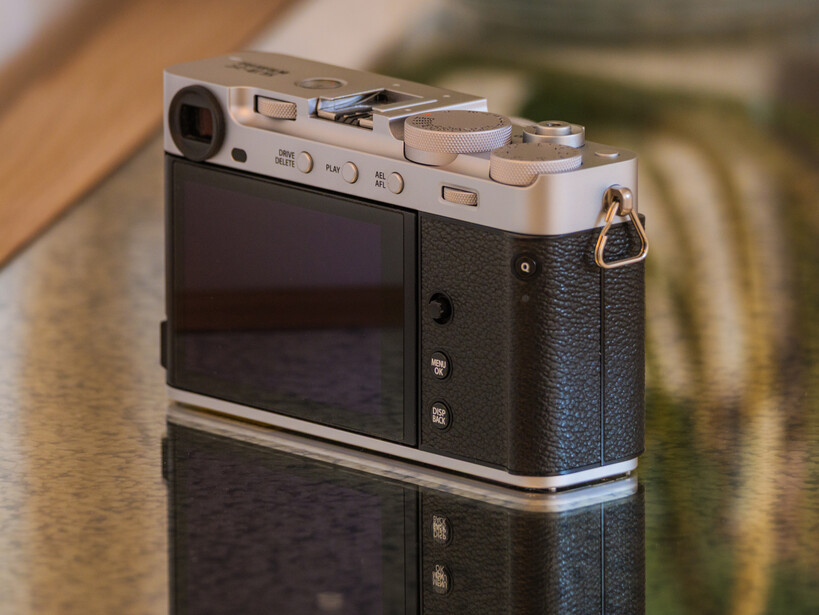
The headline control story is the new Film Simulation dial, hidden under the top plate to preserve the flat rangefinder profile. Digital Camera World considered this a masterstroke, avoiding the loss of an existing dial that happened on the X-T50, and called it “by far the best implementation yet and finally one I can get on board with.” The three programmable FS1-3 slots on that dial can store complete film recipes via a new dedicated menu, and Digital Camera World highlights a practical advantage: because Film Simulation settings are siloed away from camera settings, tweaks to autofocus or microphone behaviour apply across all recipes at once. CameraLabs and PetaPixel both welcome the ability to load personal recipes into those custom slots. Amateur Photographer notes a real ergonomic issue: the dial sits directly beside the viewfinder, making it practically impossible to reach while shooting with the camera to your eye.
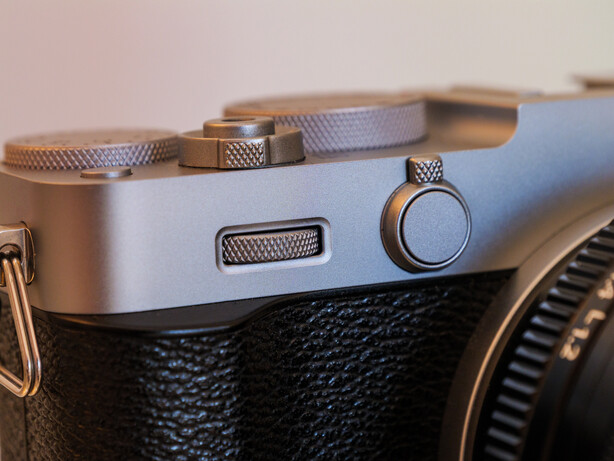
The front lever, inherited from the X100 and X-Pro lines, is new here and gives five assignable controls via short and long pushes and pulls in each direction, plus a centre button. By default it cycles through digital zoom crops, and Digital Camera World notes two new display options, a black framing box or a greyed-out surround, designed to help track fast-moving subjects entering the frame. DPReview and Amateur Photographer both flag that the long-press actions on the lever take just a little too long to register, making two of its functions less useful in practice, and Amateur Photographer hopes Fujifilm addresses this in firmware. Amateur Photographer also recommends reassigning the front lever button to aspect ratio for easier access.
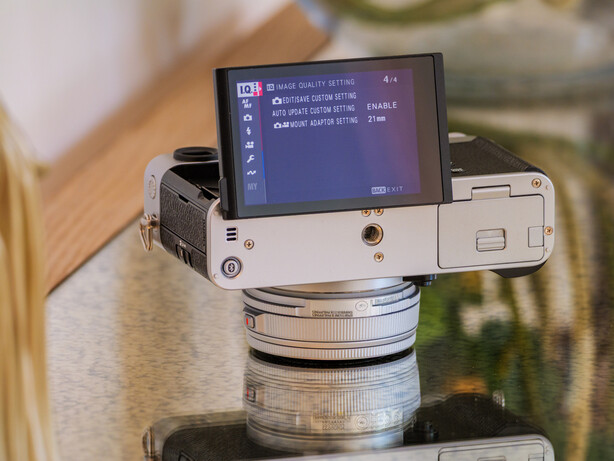
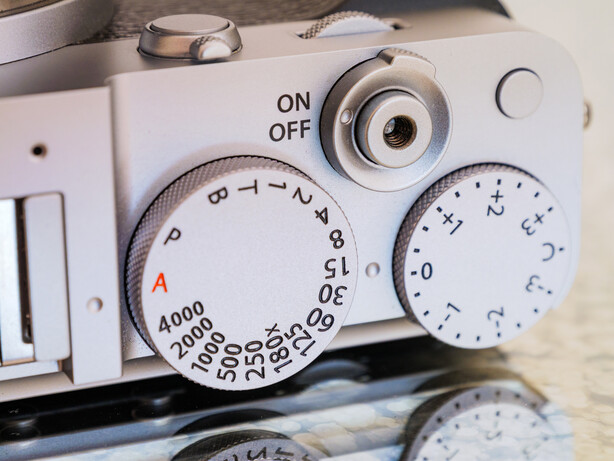
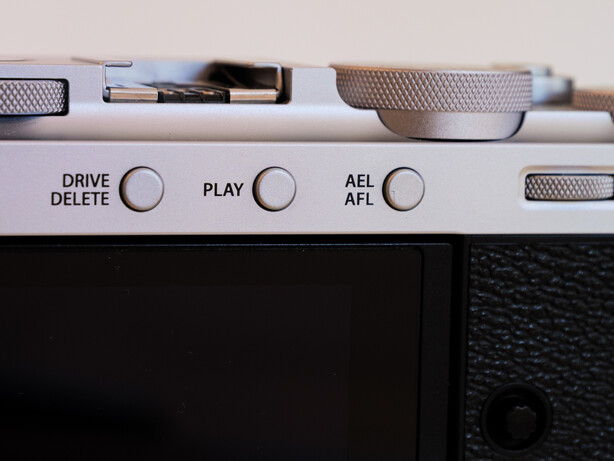
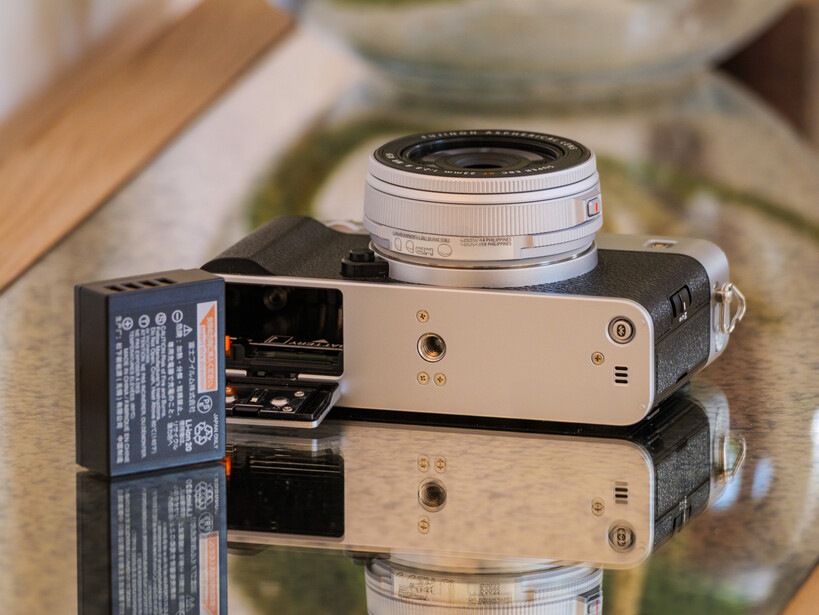
PetaPixel rated the X-E5’s control scheme the nicest they’ve used on any Fujifilm camera, though DPReview is more cautious, suggesting that twin clicking command dials, the front toggle, a Bluetooth button on the underside, and everything else risks feeling “a little unfocused and unclear how you’re expected to operate the camera.” Amateur Photographer found the front controls easy to knock accidentally, resulting in inadvertent ISO changes or unintended viewfinder mode switches. There’s no dedicated ISO dial here, Amateur Photographer notes: ISO is set via the front electronic dial with a click-in toggle between aperture and ISO. Accidentally landing on EVF-only with eye sensor mode is “especially disconcerting,” the same reviewer writes, because the camera then appears not to turn on at all when you flick the power switch.
Fujifilm X-E5 Performance
Burst shooting holds no surprises. Amateur Photographer confirmed the X-E5 matches its specified rates, hitting 8fps with the mechanical shutter and 13fps with the electronic shutter. PetaPixel cautions though that the sensor’s slow scan rate means you’ll want to stick to the mechanical shutter for fast-moving subjects to avoid rolling shutter artefacts.

On startup, Amateur Photographer found the X-E5 ready to shoot “in a fraction of a second”. On the shutter action PetaPixel notes “the mechanical shutter is smooth and fairly devoid of excessive vibration“, and CameraLabs says that, coming from an X100, they “actually quite liked the shutter sound and feel of the X-E5, providing more feedback while still remaining pretty discreet.“
Battery life figures vary between sources. DPReview quotes a CIPA rating of 310 shots but sensibly notes real-world use often doubles that, calling it adequate for a weekend of occasional shooting. Amateur Photographer found the 400-shot rating realistic. CameraLabs was more conservative, measuring around 250 shots per charge. All sources confirm USB-C charging and power delivery. The long-running NP-W126S battery is a bonus: Amateur Photographer notes cheap third-party clones are easy to find.
IBIS is a clear point of disagreement. Amateur Photographer found handheld shots usable at shutter speeds as slow as one second, while CameraLabs measured only around four stops of compensation in practice, well short of Fujifilm’s claimed seven. PetaPixel found the IBIS impressively stable even with a Sigma 100-400mm lens mounted on the compact body.
Fujifilm X-E5 Image quality
At the heart of the X-E5 is Fujifilm’s 40.2MP X-Trans CMOS 5 HR sensor, and the results it produces are striking. Amateur Photographer goes so far as to say image quality is “essentially indistinguishable from the likes of the X-T5 and X100VI,” calling it better than any other APS-C camera and competitive with many full-frame options. DPReview backs this up in resolution testing, finding that raw detail capture “outperforms the 24MP Nikon Z5II and 26MP Sony a6700.” Digital Camera World adds that the X-E5 resolves marginally more fine detail than the X-T50 despite sharing the same sensor, putting it down to “subtle processing and firmware improvements.”

Dynamic range is a genuine strength at low sensitivities. DPReview confirms the sensor’s “low read noise” gives “plenty of room to bring up shadows in post,” and Amateur Photographer found you can pull back three or four stops of shadow detail at base ISO without significant noise problems. The X-E5’s base ISO of 125 also gives it a slight cleanliness advantage over the X-E4, as DPReview notes.
the resolution advantage over rivals shows up more clearly in raw files than in JPEGs
High-ISO shooting is where the sensor’s APS-C dimensions start to show. Both DPReview and Digital Camera World note the X-E5’s detail lead slips past ISO 1600, and the full-frame Panasonic Lumix S9 and Nikon Z5II pull ahead in noise from that point. Even so, Amateur Photographer is perfectly comfortable using the sensor up to ISO 12,800, particularly with modern noise reduction tools. DPReview adds a caveat worth noting: the JPEG engine isn’t quite as effective as competitors at rendering fine detail, so the resolution advantage over rivals shows up more clearly in raw files than in JPEGs, and “performance does suffer a bit in low-contrast areas.“

Colour rendering draws consistent praise. Film Simulations are a big part of the appeal, and Amateur Photographer points out they’re not limited to JPEGs: Adobe software makes most of them available in raw processing too.
Fujifilm X-E5 Price and value
At $1,699 body-only or $1,899 with the new XF 23mm f/2.8 lens, the X-E5 arrives at nearly double the $849 launch price of the X-E4. CameraLabs puts it bluntly: it’s gone “from being one of the more affordable models in the series to mid-range,” and DPReview acknowledges that “a camera coming in at double what its predecessor cost will always be a bit hard to swallow.”


The US pricing raises some awkward questions. Digital Camera World points out that the X-E5 is “basically the same camera as the X-T50,” yet the X-E5 body was initially $300 more expensive than the X-T50’s $1,399. DPReview notes that Fujifilm has since shuffled its wider line-up’s prices to bring things more in line, putting the original gap down to tariff headroom. That helps. But the value still invites scrutiny. Digital Camera World also flags that the X-E5 costs $100 more than the X100VI and matches the X-T5 dollar for dollar, even though the X-T5 brings a larger battery, dual card slots, and a higher-resolution EVF and LCD. PetaPixel agrees that the X100VI has “suddenly become the more affordable option,” and also reminds buyers that it adds weather sealing, a hybrid optical EVF, and a built-in four-stop ND filter that the X-E5 doesn’t offer.

UK buyers get a tidier picture. Both Digital Camera World and CameraLabs confirm that the £1,299 X-E5 body matches the X-T50 on price, with the X100VI and X-T5 sitting clearly above at £1,599 and £1,699 respectively. The kit bundle also comes in around £50 below an X100VI, which makes the comparison feel less bruising. Wherever you’re buying, the X-E5 is now firmly a considered mid-range purchase rather than an easy impulse.





Further reading. Other great reviews of the Fujifilm X-E5
Fujifilm X-E5 Specification Sheets
| Spec | Detail |
|---|---|
| Sensor type | X-Trans CMOS 5 HR with primary color filter |
| Sensor size | 23.5mm x 15.7mm (APS-C) |
| Effective resolution | 40.2 million pixels |
| Image file formats and compression | JPEG (Exif Ver.2.32), HEIF (4:2:2 10bit), RAW (14bit RAF), TIFF (8bit/16bit RGB, in-camera Raw Conversion only) |
| Dynamic range / latitude | AUTO / 100% / 200% / 400% |
| Storage media | SD Card (-2GB), SDHC Card (-32GB), SDXC Card (-2TB), UHS-I, UHS-II, Video Speed Class V90 |
| Image stabilisation | Image sensor shift mechanism with 5-axis compensation; centre 7.0 stops, periphery 6.0 stops (CIPA2024, with XF35mmF1.4 R) |
| Continuous shooting and buffer depth | CH: up to approx. 20fps (ES, 1.29x crop) — JPEG 168 frames, C.RAW 66, Lossless C.RAW 32, Uncomp. RAW 17; approx. 8.0fps (MS) — JPEG 1000+, C.RAW 79; CL: approx. 5.0fps (MS) — JPEG 1000+, C.RAW 1000+ |
| Exposure metering | TTL 256-zone metering; Multi, Spot, Average, Center Weighted |
| Exposure compensation | Still: -5.0EV to +5.0EV in 1/3EV steps; Movie: -2.0EV to +2.0EV in 1/3EV steps |
| ISO range | Standard: ISO125–12800 (1/3 step); Extended: ISO64 / ISO80 / ISO100 / ISO25600 / ISO51200 |
| White balance options | Auto (White Priority / Ambience Priority), Custom (Custom1–3), Colour Temperature 2500K–10000K, Daylight, Shade, Fluorescent Light 1/2/3, Incandescent, Underwater |
| Shutter type and speed range | Focal Plane Shutter; Mechanical: 15min–1/4000sec (S/M); Electronic: 15min–1/180000sec (S/M); Electronic Front Curtain: 15min–1/4000sec (S/M); Bulb up to 60min |
| Flash sync speed | 1/180sec. or slower (Mechanical Shutter) |
| Flash options and compatibility | Hot shoe (Dedicated TTL Flash compatible); included EF-X8 (GN approx. 11 at ISO200·m); TTL AUTO/STANDARD/SLOW SYNC., MANUAL, COMMANDER, MULTI (EF-X500); AUTO FP (HSS) with shoe-mount flash |
| Battery and CIPA rating | NP-W126S Li-ion; approx. 400 frames (Economy Mode) / approx. 310 frames (Normal Mode) with XF35mmF1.4 R |
| Charging and power (USB charging etc.) | USB charging via USB Type-C port |
| Connectivity and ports | USB Type-C USB 10Gbps; HDMI Micro connector (Type D); ø3.5mm stereo mini connector (Microphone & Remote Release); Hot shoe; IEEE802.11a/b/g/n/ac Wi-Fi; Bluetooth Ver. 4.2 |
| Weight | Approx. 445g (including battery and memory card); approx. 396g (excluding battery and memory card) |
| Dimensions | 124.9mm (W) x 72.9mm (H) x 39.1mm (D); minimum depth 33.0mm |
Fujifilm X-E5 Video Specification Sheet
| Spec | Detail |
|---|---|
| Video resolution options | 6.2K (6240×3510, 16:9); DCI4K HQ (4096×2160, 17:9); 4K HQ (3840×2160, 16:9); DCI4K (4096×2160, 17:9); 4K (3840×2160, 16:9); Full HD (2048×1080, 17:9; 1920×1080, 16:9); Full HD High Speed (2048×1080 / 1920×1080) |
| Frame rate options (including any crop factors) | 6.2K: 29.97p/25p/24p/23.98p (DIS OFF: 1.23x crop); DCI4K/4K HQ: 29.97p/25p/24p/23.98p (1.23x crop); DCI4K/4K: up to 59.94p/50p (59.94p/50p DIS OFF: 1.14x; 29.97p and slower DIS OFF: 1.0x); FHD: up to 59.94p/50p; FHD High Speed: up to 240p (DIS OFF: 1.23x crop) |
| System frequency | Not stated |
| Bit depth | 10bit (H.265 Long GOP 4:2:2 and 4:2:0); 8bit (H.264 Long GOP 4:2:0); 12bit RAW HDMI output |
| Aspect ratios / open gate | 16:9, 17:9 (DCI); 6.2K 16:9, DCI4K 17:9, 4K 16:9, FHD 17:9, FHD 16:9 |
| LUTs, colour profiles and log formats | F-Log2 (referenced in review; 20 Film Simulation modes including PROVIA, Velvia, ASTIA, Classic Chrome, REALA ACE, ETERNA, ETERNA BLEACH BYPASS, ACROS, etc.) |
| Raw video output (BRAW / ProRes RAW) | 12bit RAW HDMI output at 6.2K (6240×3512, 16:9); 29.97p/25p/24p/23.98p |
| Clip length limit | Not stated |
| Cooling | Not stated |
| Video storage options | SD memory card (UHS Speed Class 3 or higher required); single SD/SDHC/SDXC slot, UHS-I/UHS-II, V90 |
| Audio recording options | Linear PCM stereo 24bit / 48KHz (MOV/H.265 and MOV/H.264); AAC (MP4/H.264); no audio in High Speed recording mode |
| Mic input port (size and type) | ø3.5mm stereo mini connector (shared Microphone & Remote Release) |
| Headphone monitoring | Via USB-C port using a suitable adapter (headphone adapter included in box) |
| HDMI output (connector type) | HDMI Micro connector (Type D) |
| Internal audio format | Linear PCM stereo 24bit / 48KHz (MOV); AAC (MP4) |
For more information see the Fujifilm website.