
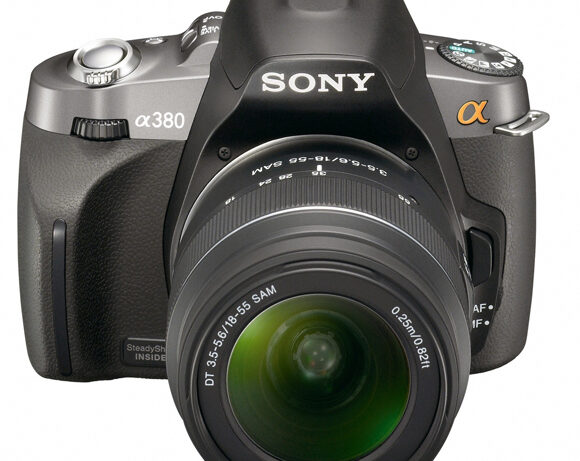

That the Sony A380 is only a minor upgrade indicates one of two things. Either the entry-level user is already well-catered for, with everything they need to take the kind of images they would require, or a better-specified model which would sit a little higher up is in the pipeline. After all, a replacement for the A700 is long overdue, and the video recording and high-resolution LCD screens tend to be seen as niceties geared towards the mid-range market than limitations to this one. It's when using live view that the camera shines, and while other manufacturers have made their own advances in this area Sony still remains on top. It's only really the design of the body which may be problematic, though of course, this won't bother everyone. Even so, the usual advice of handling a camera before you buy it is something we'd strongly suggest here.
Sony A380 – Performance

The nine points of the A380’s AF system not only cover a good proportion of the frame, but in contrast to the more standard diamond formation there is one in each corner of the viewfinder’s central area; this makes it easier for the camera to pick up subjects located towards the edges and corners of the frame, and saturates the central area more effectively. And, rather than the thin lines which featured on previous models, each point is an actual ‘point’ and more clearly defined by a small box around each one. Not only is this an improvement visually, but it also makes it easier to work with.
While the 95% viewfinder coverage is fairly typical on such a model, the 0.74x magnification factor is not. This is due to?the secondary sensor in the viewfinder chamber, which restricts how large this can be, though it does make viewing the image slightly trickier. For those more likely to be using the viewfinder than the live view ?system with which to compose images I’d suggest this is something to bear in mind. Such users may be interested in the ?yet-to-be-reviewed A230, which increases viewfinder magnification to 0.83x and retains many of the same features, with the notable exception of a live view system.

For those, however, who will be primarily using the live view system, the news is much better. The same combination of fast autofocusing and the articulated LCD screen make shooting this way effortless, with each AF point highlighted by a clear green box when activated. The screen shows a little more saturation than that of the A380, and at default settings is about as bright too. In darker conditions the feed is more affected by noise in order for the camera to display the scene, but this isn’t likely to be obtrusive and isn’t a representation of how much noise will appear in the final image.
Noise in its audible sense, however, has been characteristic of previous Alpha models, and this has continued with the A380. The combined sound of the mirror, shutter and autofocusing system means that it perhaps isn’t best suited for discreet use, and even with the new kit lens with its Smooth Autofocus Motor, the camera can’t quite match the quiet operation of similar systems. A comparison with the older DT 18-70mm f/3.5-5.6 also shows the new lens to be a touch louder when trying to focus. However, although the lens shows little if any improvement in focusing speed over that optic, it’s about as fast as would be expected for a kit lens.
The camera’s maximum burst rate of 2.5fps should make it obvious that it’s not exactly designed for burst shooting. Using a Sandisk Extreme III Class 6 SDHC card – one of the fastest types of SD card available – the camera happily processed high-quality JPEGs at a consistent speed, but Raw files slowed down after about eight shots and a combination of the two after about three to four shots.