
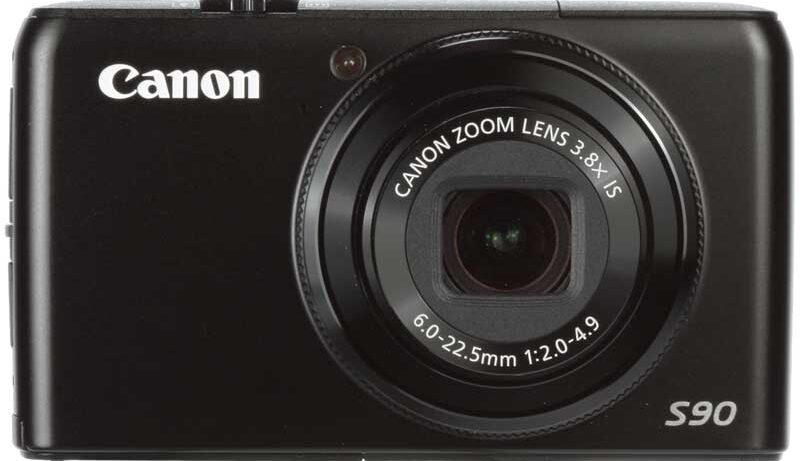

Ultimately, the appeal of this camera is that it is the smallest on the market to feature Raw capture, and a less pricey alternative to the G11 – which has an identical sensor. The expanded ISO range, fast lens and high-resolution LCD screen only add to its appeal, and though it’s not perfect – and at times frustrating to use – it is capable of superb image quality. Had it been any dearer it would have found itself in the uncomfortable position of competing with other high-end compacts or even Micro Four Thirds system cameras. The fact that it isn’t means it can occupy a more comfortable territory further down, and thus having a broader appeal. I have no doubt that the S90 will be a popular compact camera – for the simple reason that it deserves to be.
Pros

-
 Compact proportions, fast lens, lens control ring, Raw mode, good quality LCD screen, overall image quality, fast start-up
Cons

-
 Operation hampered by a few design issues, flash sometimes raised when not needed, some WB inaccuracies, mode dial stiff and slightly inaccessible
Performance
Canon PowerShot S90 review – Performance

Start-up takes less than a second, while powering down takes just a fraction longer. Given the zoom’s relatively short range, its motion from the wide to the telephoto end is actioned a little slowly to allow for fine-tuning, though the control ring around the lens allows you to move incrementally through five preset standard focal lengths, should you wish. I found the control ring particularly useful for adjusting manual focus, as it mirrors how it is typically done on a DSLR.
The camera also offers a surprising level of control with other functions. The self-timer, for instance, may be adjusted in increments of a second, and may be programmed to take anything from one to 10 consecutive exposures. It’s also possible to delete Raw and JPEGs independently from each other, which is still not possible on many DSLRs.
The menu system follows the somewhat tried and tested formula of previous models, with the L-shaped design facilitating speedy operation. I only found myself slowed down when selecting simultaneous Raw and JPEG recording, as this requires a trawl through the main menu, rather than being selectable from the same sub-menu as all the other image quality settings.
The maximum wide aperture of the lens allows the camera to be used in low-light conditions, together with the relatively large sensor meaning it has the further benefit of slightly greater depth of field control than many other compacts. Together with the high-resolution LCD screen, it is easy to assess depth of field when composing an image, which should no doubt please macro photographers looking for a small camera.
The AF assist light is powerful enough to illuminate a fair distance when shooting in low light, and because of this there’s little difference in focusing speed to images shot when it is not necessary. However, I did find that the camera had a strong tendency to mis-focus when shooting at night, even when the scene displayed relatively good contrast. At first I assumed this was due to me having accidentally selected the macro function, but upon examining the shooting details I found that this wasn’t the case.

View more Canon Powershot S90 sample images