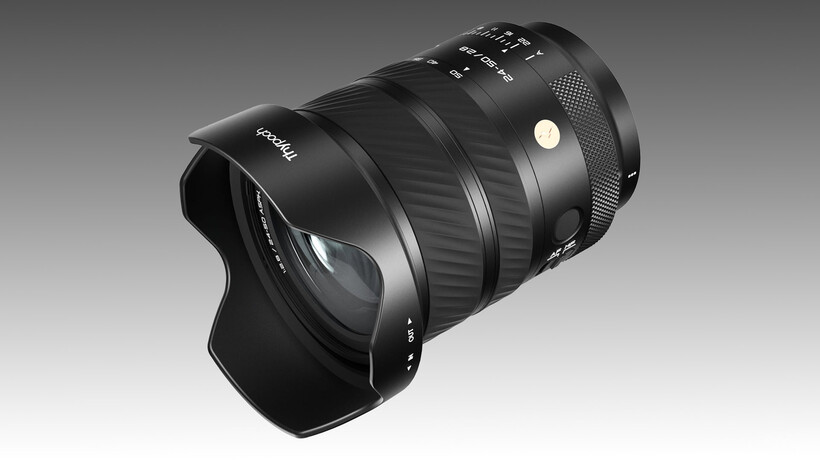


Lens manufacturer Thypoch has launched the Voyager 24-50mm f/2.8, claiming it is the first full-frame autofocus zoom lens developed by a Chinese optical brand. Available only in Sony’s E-mount at the moment, the 2x zoom costs £489/€569/$649. Other mount options will follow, and local retail availability should begin in early June 2026.
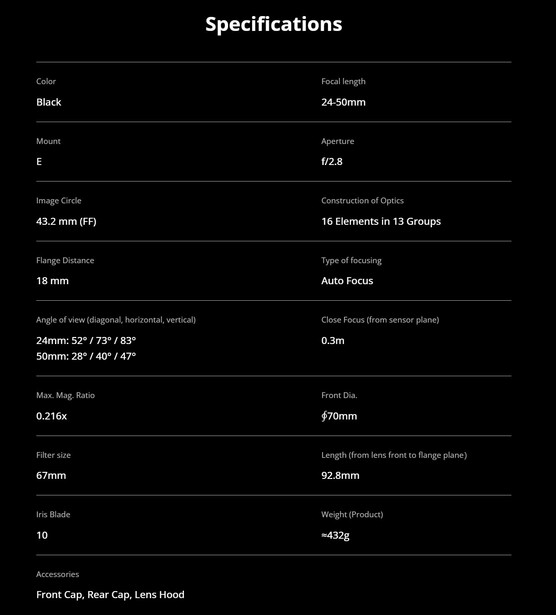
According to Thypoch, the Voyager uses an internal zoom mechanism that keeps the barrel length fixed at 92.88mm across the entire focal range, while the maximum aperture of f/2.8 is also maintained from 24mm through 50mm. Thypoch says benefits of the fixed-length design include that it prevents lens creep when the camera is stowed face-down and that the absence of extending barrel sections enhances weather sealing. Gimbal operators benefit too – because the fixed barrel doesn’t shift the centre of gravity as focal lengths change, so there’s no need to rebalance when zooming.
Three-in-one

Thypoch pitches the lens as a stand-in for three primes. “A photographer working with primes typically carries 24mm, 35mm, and 50mm,” the company states. “Those three focal lengths cover the working distances that define documentary, reportage, environmental portrait, street, and event photography.”
The optical formula consists of 16 elements in 13 groups, including aspherical, extra-low dispersion, and high refractive index elements. A 10-bladed iris keeps its circular shape across most of the working range, producing rounded bokeh at wide-to-mid apertures, and sunstars when stopped right down. The lens supports eye AF, AF-C tracking, and both in-camera and lens-side AF/MF switching through native Sony E-mount communication, with the company claiming to have tested compatibility across ten current Sony Alpha bodies including the A7 V, A9 III, A7R V, and FX3.
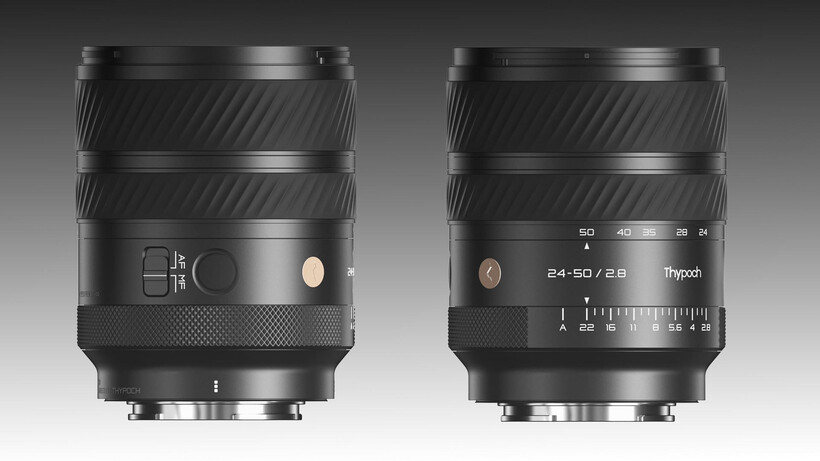
Weather sealing covers the lens mount, focus ring, zoom ring, and front element. The barrel measures 73.6mm at its widest and the lens weighs 432g. The front of the lens is threaded for 67mm filters, and the minimum focus distance is 0.3 metres across the entire zoom range, yielding a maximum magnification of 0.216x. There’s also a custom button, an AF/MF switch, and a USB-C port in the lens mount for firmware updates.
Impressions from those who’ve used it
Early hands-on impressions from around the web describe the linear-motor focusing as smooth and quiet, though reviewers noted it doesn’t match the speed of the fastest native Sony glass. One reviewer found the lens unsuitable for faster action and sports, while Thypoch itself claims the focusing speed rivals first-party Sony lenses. A front-focusing tendency, particularly near the long end of the zoom range, was flagged in at least one review, with the hope that a firmware update could sort it out.
Centre sharpness at 24mm has drawn some praise at f/2.8, though contrast has been found to improve when the lens is stopped down to f/5.6. Corner performance at 50mm is said to show significant smearing at f/2.8 that largely cleans up by f/5.6, chromatic aberration is kept well in check across the zoom and aperture ranges, and distortion is handled better than many mirrorless-optimized lenses, cutting down reliance on in-camera correction. It is reported that the aperture ring can’t be de-clicked, which rules out smooth silent aperture transitions during video recording, but that focus breathing is almost non-existent, making it otherwise well-suited to video work.
Cinema heritage
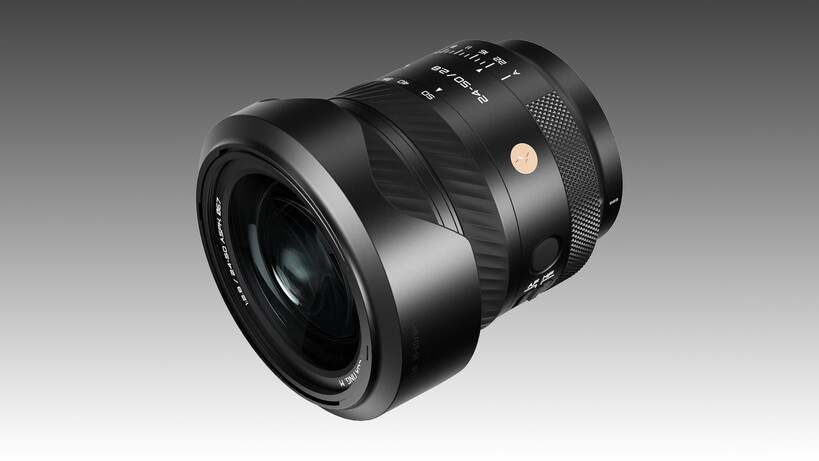
Thypoch draws on its parent group’s cinema zoom engineering background, which has previously tackled constant-aperture and internal-zoom design across several cine lens families. The company, previously known for vintage-inspired manual-focus primes including the Simera 28mm and 35mm f/1.4 M-mount lenses, says it plans to release a total of six autofocus lenses in 2026, mixing primes and zooms. Next up is a 24-70mm zoom, though no aperture spec has been confirmed.
The Voyager’s closest direct competitor is the Sony FE 24-50mm f/2.8 G, which lists at $1,298, roughly double the Thypoch’s MSRP. Reviewers acknowledged the Sony will deliver faster autofocus, sharper results, and better bokeh rendering, but concluded the Thypoch offers strong value at its price point. As Trusted Reviews previously covered in our Sony FE 24-70mm f/2.8 GM Review, constant-aperture zooms in this class have historically demanded a steep price premium, making Thypoch’s entry a meaningful new option for Sony shooters who want that capability without the usual outlay.
For more information see the Thypoch website.