
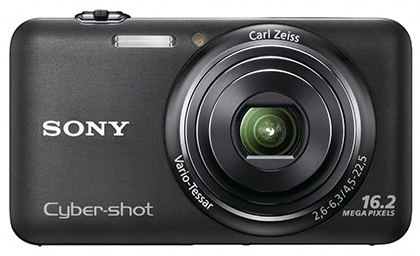

Pros

-
 Clear screen, highly specified, smart design, lightweight and compact
Cons

-
 Might be too small for some, processing artefacts, smaller screen than usual for this class of compact
Performance & Image Quality
Sony Cyber-shot WX7 Review – Performance


The WX7 takes around a second to full power up and just a touch longer to turn itself off, which is about average for a camera of its class. Its focusing speed, however, is far more impressive, with its nine central points picking out details quickly and notifying the user with bright green boxes. Only in particularly poor light and against low-contrast details does it struggle to match this pace, but even here it manages to focus where other compacts simply give up.
Images are quickly captured and displayed on the LCD screen, which has a good brightness on standard settings but slightly saturated colours. Its high resolution, which is still uncommon among compacts at this level, makes it easy to scrutinise image details, and its viewing angle is excellent. In strong light, however, the camera still suffers from the same visibility issues which plague practically all compacts.
The burst setting options works well, quickly capturing ten shots in a second and maintaining the feed as this happens. It also doesn’t take long for these to be recorded to the memory card either, only around five seconds with a Class 10 SDHC card in place.

Sony Cyber-shot WX7 Review – Image Quality
With a backlit sensor we should expect lower noise levels than on similar compacts, and while the WX7’s images show far less chroma noise than expected (there really isn’t any), much of this is likely the result of in-camera processing. Images throughout the sensitivity range display a coarse texture and processing artefacts, while oversharpening suggests that the camera is trying to compensate for the detail lost through this process. That’s not to say that images don’t show good detail, as they do, it’s just the finer details appear to be lost through noise reduction and other processing.

Elsewhere, the camera fares much better. The metering system does impressively well to balance a range of lighting conditions, and only errs slightly towards under and overexposure when we would expect it to do so. The auto white balance also does a good job under both natural daylight and artificial sources, and colours are saturated enough to give pleasing results but not so much to remove them from reality.
There’s a touch of distortion at the wideangle end of the camera’s lens, although the aspherical elements in the optic appear to correct for most of this, given the slightly uneven distortion which results. Some chromatic aberration is also visible, although this is largely confined to the edges of images with high-contrast details.