
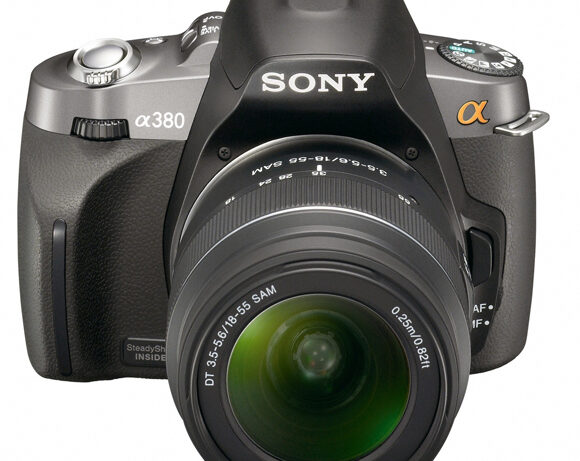

That the Sony A380 is only a minor upgrade indicates one of two things. Either the entry-level user is already well-catered for, with everything they need to take the kind of images they would require, or a better-specified model which would sit a little higher up is in the pipeline. After all, a replacement for the A700 is long overdue, and the video recording and high-resolution LCD screens tend to be seen as niceties geared towards the mid-range market than limitations to this one. It's when using live view that the camera shines, and while other manufacturers have made their own advances in this area Sony still remains on top. It's only really the design of the body which may be problematic, though of course, this won't bother everyone. Even so, the usual advice of handling a camera before you buy it is something we'd strongly suggest here.
Sony A380 – Features

While the A380’s sensor has been carried over from the A350, Sony is said to have made improvements to the Bionz processor for the benefit of image quality. The sensor itself is a APS-C sized CCD chip, with a total of 14.9MP providing an effective 14.2MP, with images output to both Raw and JPEG formats.
In contrast to the DT 18-70mm lens which shipped with previous Alpha models, the A380 comes with the new DT 18-55 f/3.5-5.6 SAM optic as standard. Aside from the slight reduction in focal range, the new lens features a new Smooth Autofocus Motor (SAM) for smooth and quiet operation, as well as both aspherical and extra low dispersion (ED) elements.

Along with every other optic mounted on the camera, the APS-C sized sensor applies a 1.5x magnification factor to the lens’s focal length. Sony continues to develop a range of lenses for its system, though it should be noted that the Alpha user is already well-catered for; in addition to Sony’s DT lenses designed for APS-C sensors, non-DT ‘full-frame’ lenses may be used, as well as the more premium range of Carl Zeiss-branded optics and older Minolta A-mount lenses.
As with every other Alpha DSLR, dust reduction and Super SteadyShot image stabilisation feature as standard, with the latter enabling sharp images when shooting between 2.5 and 3.5 exposure stops under what would usually be possible. Being camera-based this works with every mounted lens, and, unlike on previous models, is activated via the camera’s menu.

The same acclaimed live view system as on the A350 features on the new model, with a secondary sensor in the camera’s viewfinder chamber allowing uninterrupted phase detection autofocusing; essentially this makes live view focusing just as speedy as standard focusing. This is complemented with an 2.7in articulated LCD screen with a 230,400dot resolution, which may be pulled out and adjusted for shooting from awkward angles. It displays 90% coverage of the scene, with a refresh rate of 30fps providing a smooth feed.
Despite recent trends, the camera doesn’t support video recording of any sort. Whether this is due to the physical structure of its live view system or the use of CCD sensors is unclear, though the A380’s entry-level status may also have something to do with it. The camera does, however, debut a new self-timer feature which takes three or five consecutive shots after a 10-second countdown – ideal for group portrait shots.
The focusing system has retained the nine points of the A350’s system, with a central cross-type point and eight around it. The trio of AF area options allow the user to activate the central point or any one of the other eight points, or if set to the Auto Area mode the camera will decide for itself which combination is the most appropriate.

Sensitivity, meanwhile, runs from a base ISO of 100 up to the maximum of 3200, which again is the same as before, while noise reduction may also be activated for both long exposures and those taken at higher sensitivities. Elsewhere the camera’s 40-zone metering system offers multi-segment, centre-weighted and spot patterns, while the Dynamic Range Optimisation function (DRO) features Standard and Advanced settings for use when shadow and highlight detail would otherwise be lost.
Finally, the new battery is significantly smaller and lighter than those Sony has used previously, weighing just 50g and slightly larger than a standard 9V battery. This may have come as a result of its reduced performance, though; while the A350 could manage around 750 shots when using the viewfinder, the A380 is only quoted as having a 500-shot life. Using live view cuts this figure down to 230 shots (according to Sony), though these figures will vary from user to user depending on their shooting habits.