
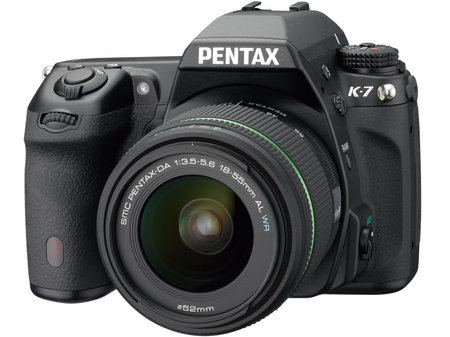

The Pentax K-7 is, without a doubt, the best DSLR that Pentax has ever produced. It'll please existing Pentax users who may be looking for faster performance, better autofocus or even a fairly solid movie mode to add to the fray. While the K10D has held strong for many users, the K20D only marginally brushed up upon this as an upgrade. As a result, many didn't part with their cash so soon for effectively so little - but the K7 tidies this up once and for all and, should you be Pentax through and through, will see you reaching for the piggy bank. There are downfalls however: the Pentax K-7 provides rather exceptional image quality in terms of noise, but completely unravels itself with consistent underexposure. Irritatingly, an exposure that looks excellent on the camera's LCD will reveal itself to be quite a distance from that on your computer screen. That's when Raw work becomes an essential - but that shouldn't have to be the case. While the K7's AF system is good, at least snappier than previous models, there's stiff competition already out there from competitors. The long-standing Nikon D300, for example, has a 51-point AF system that sounds frightfully better - at least on paper. In actuality, having so many AF points can leave you spoilt for choice, or even getting caught out tracking the wrong subject, so Pentax truly isn't a million miles behind in reality. The point is that, when looking to buy a camera, the figures so often stand out on paper that they can be a make or break for customers in the shop. And there's nothing singularly immensely stand-out about the K-7 that really places it beyond other cameras on the market. A huge benefit for the K-7 is its compatibility with older Pentax lenses. Sure there're some noisy AF ones from years back, but there are other superb manual primes that still hold their weight, even on a body such as this. And with further investment in new digital-only DA optics, plus accessories such as the optional battery grip, it's clear Pentax is pushing forward and looking to appeal not only to its existing audience, but further a field too. Whilst this is a strength, it can't help but be a weakness too: with Nikon and Canon both holding such solid followings and providing a huge range of products and lenses, Pentax is undoubtedly the underdog. But that's not to say the K-7 isn't a good camera - it's actually a great one. With a few more firmware tweaks to fix up exposure, AF in movie mode and some other niggles, it's well on the way to being a superb piece of kit.
Pros

-
 35 years worth of compatible Pentax lenses, 100% viewfinder, intuitive camera layout, HD movie, best AF system (with AF illuminator) to grace a Pentax camera
Cons

-
 Underexposed images, no AF in Movie mode, slow AF in live view, in-camera HDR a disappointment, tough competition to compete against - ought to be cheaper
Pentax K-7 review – Image Quality
Pentax K-7 review – Tone & Exposure

Given the K7’s 77 segment metering, exposure should be well-balanced – but, as with previous Pentax models, it’s still consistently underexposed. This is irrelevant of spot, selective or auto metering – there tends to be around 0.3-0.7 of a stop underexposure, and whilst leaning towards exposure compensation at all times, this can cause highlight-blowing disasters when you don’t need them. It seems Pentax has not quite achieved the subtle balance that such an advanced system should allow for.
Additionally the camera’s LCD screen equates image playback entirely different to computer screens – as tested on laptops and calibrated monitors. It’s a disappointment when an apparently well-exposed image in-camera reveals itself to be underexposed on screen. This then takes working into, and adds to time – an issue that the K20D also had. Really and truly shots should come straight from camera with little to no fuss.
Pentax K-7 review – RAW/JPEG
The K7 offers simultaneous Raw & JPEG shooting, with a choice of Pentax PEF format or the universal Adobe DNG. The difference between these two is negligible, but against JPEG there is a considerable difference.
Raw files come from camera with more realistic, albeit flatter tones and less notable noise. JPEGs appear sharpened and noisier. But the real issue is with colour balance – the two appear to have been shot in entirely different lighting conditions, the result of inconsistent white balance. Notice the very yellow cast on the JPEG image.

As a result it seems that shooting Raw in order to recover underexposure and inconsistent white balance is the best way to use the K-7. But, of course, this adds up to considerable post-production time.
Pentax K-7 review – White Balance & Colour
Like the K20D before it, the K-7’s white balance can go a little astray. Irrelevant of the Raw vs JPEG inconsistencies, standard JPEGs can err towards the greens and blue scale, plus there can be occasional inconsistency between frames, without colour bracketing.
Pentax K-7 review – Image Noise
On a positive high, the Pentax K-7 retains exceptional image noise through the range. From ISO 100-3200 all shots are useable, with images presenting a more film-like grain than destructive noise. Shadow noise is not too much of a problem either, with shadowed areas maintaining similar grain and relatively good blacks throughout.

Pentax K-7 review – Sharpness & Detail
Use the K-7 18-55mm kit lens and expect relatively sharp images, though not strikingly so. Additional lenses will perform considerably better given the chance, though older lenses had inconsistent results depending on which they were – a 100mm macro, for example, suffered notable purple fringing across the entire image, whereas the 18-55mm kit lens posed no prominent problem, not even towards the edges of the image.
Pentax K-7 review – Value for Money
The Pentax K7 certainly touts itself as a strong camera. And it is. But the £1200 asking price is near-identical to its competitors, and seems almost a little bolshy. Whilst additions such as movie mode may add some increased value, that’s often seen as a divider between the photographic community – some think its great, others will never so much as use it.
A Nikon D300 or a Canon 50D will set you back exactly the same number of notes as a Pentax K-7, and the former two are already well-sought after cameras. For Pentax to go head to head against those models is a big ask, and – allegiances asides – one that would be considerably improved if the price was slashed. ‘More kit for less money’ would surely speak volumes in stores and help Pentax get a well deserved foot back in the door. It seems all manufacturers in the £1000+ market approach the £1100-1200 price point as a sacred one. Because marketing and statistics suggests this will be the biggest sector to see most pronounced DSLR sales increases in 2009 doesn’t seem good enough a reason. If the K-7 hit the stores around £949.99 then it’d have an upper hand; the hidden card. As it stands it’s definitely good value when positioned against its competitors, but whether that’ll be enough to convince the general public is another matter.
Pentax K-7 review pages:
– Page 1: Pentax K7 DSLR review – Features
– Page 2: Pentax K-7 full production model review – Design
– Page 3: Pentax K7 full firmware review – Performance
– Page 4: Pentax K-7 review – Image Quality & Value for Money
– Page 5: Pentax K7 full first review – review specifications / specs
– Page 6: Pentax K7 DSLR review Verdict
Pentax K7 review – other What Digital Camera links:
– Compare the Pentax K-7 with other prosumer DSLR reviews
– Pentax K7 review – product images
– Pentax K-7 review – sample test image gallery