
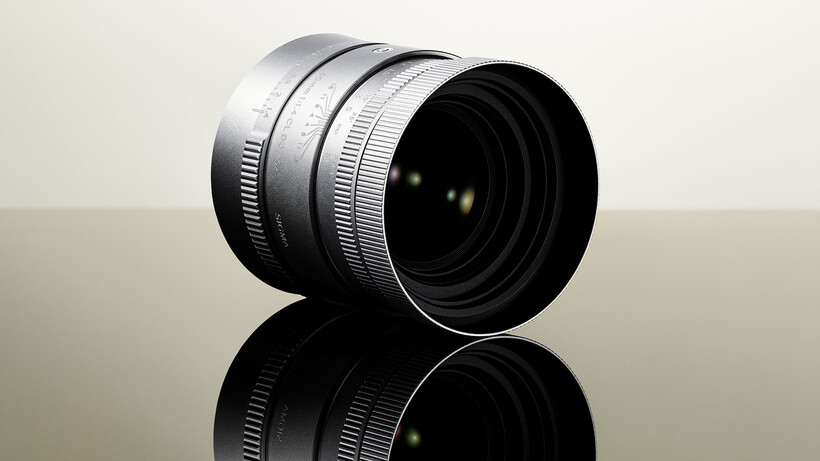


Sigma is to introduce a new line of lenses in its Contemporary I series that move away from clinical technical qualities in a drive for more characterful and atmospheric images that the company hopes will bring more joy to our lives. The first in the series will be the Sigma 50mm f/1.4 CL DG, which is a more compact lens than the company’s existing 50mm f/2 DG DN lens despite its wider maximum aperture. While the existing 50mm f/2 gets better as the aperture is closed down a few stops this new CL lens is designed to be at its best wide open.
A 14-bladed iris makes for a significant head-start in the creation of attractive out-of-focus highlights at the wider apertures, and is complemented by a lower element count that promises clean and rounded bokeh when the lens is focused on nearby subjects. Sigma says the lens will produce ‘a gentle softness within the in-focus plane’ so we can expect a lens that will make details glow a little rather than draw them crisp and technically sharp. This ‘softness’ will contribute a great deal to the attractiveness of out-of-focus areas and the transition from in-focus to out-of-focus. Sigma also talks about ‘supple rendering of texture (I think they mean ‘Subtle’) which is another indication we are looking at a ‘classic’ style lens rather than one we’ll use for precision photography. And ‘rich tonal gradations’ means we’ll get slightly lower, less biting contrast that will give us smooth progressions from dark to light areas.
This is language we rarely hear these days concerning lenses for still photography as manufacturers usually want to boast about contrast and detail resolution, but makers of cinema lenses – of which Sigma is one – often claim these characteristics as advantages for those striving for a ‘cinematic’ look. I suspect these CL (Classic?) lenses will have more in common with Sigma’s line of cine Classic Primes than with the resolving power of its Art lens line-up.
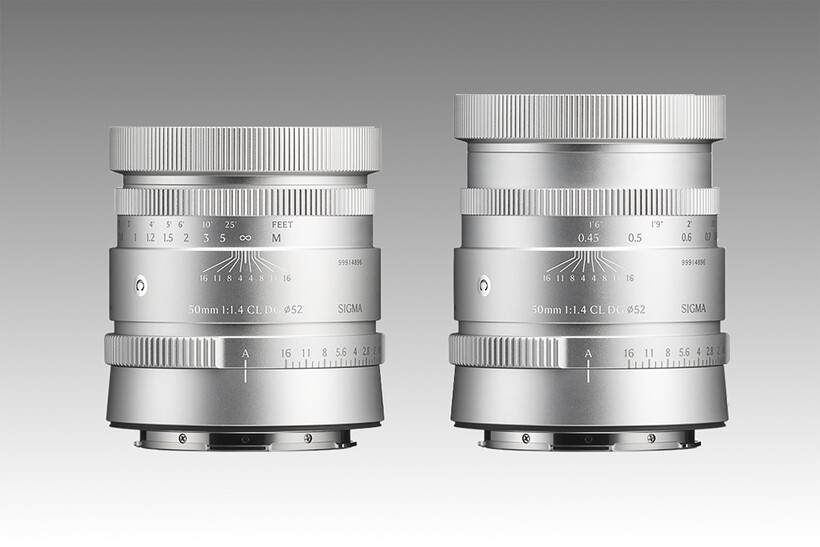
An interesting feature of the lens will be its ‘whole-lens extension focusing’ which will see the length of the lens grow and contract depending on the focus distance – just like the olden days. Manufacturers are usually proud that focusing happens inside the lens barrel with no physical changes to the length of the lens or the rotation of the front element. There’s no mention of a rotating front element here, but when we focus we should expect the entire optical construction to move further away from and closer to the sensor. In a lens this size and in one less likely to be rigged in complicated cinema set-ups, this physical extension won’t really matter – or be particularly noticed by most users. To deal with shifting that whole lens interior though, we have a new ring motor design that Sigma is calling RDD (Rotary Direct Drive). By the sounds of it the engineers have arranged the ring motor to sit in a narrower part of the optical construction so that it doesn’t make the lens barrel any wider than it would otherwise be.
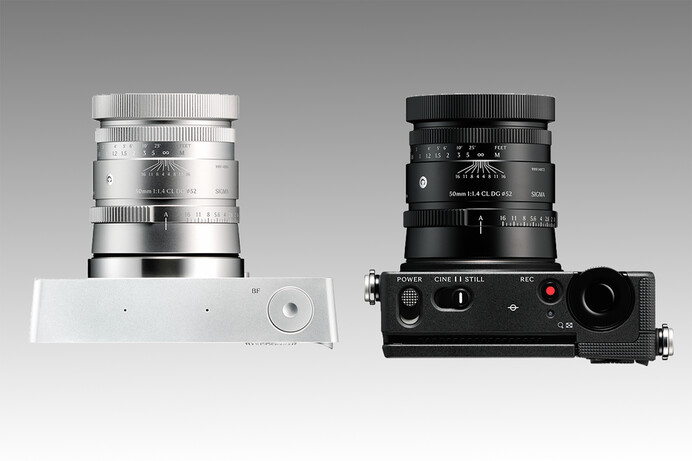
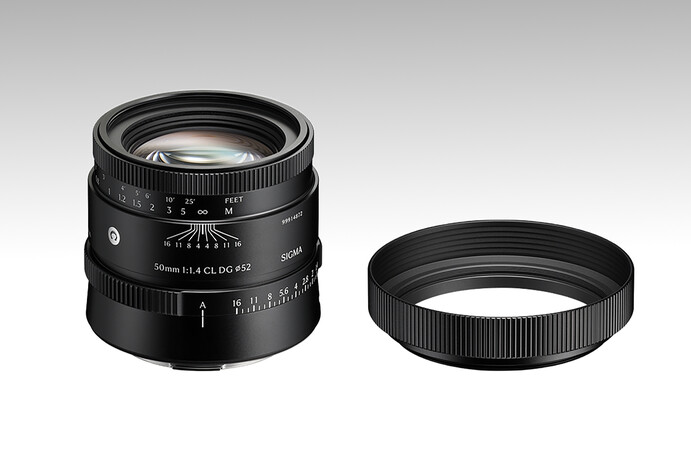
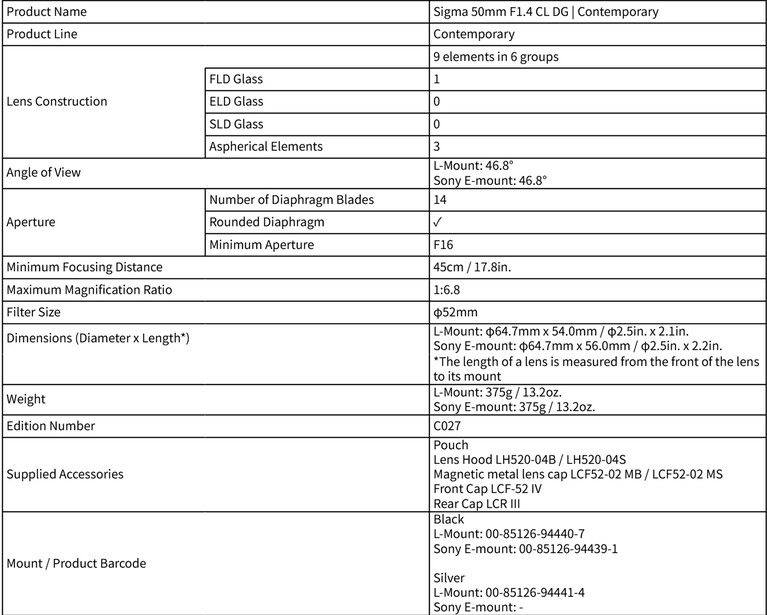
The new lens is shorter (in its shortest position at least) and thinner than the existing 50mm f/2 Contemporary lens, being just 54mm in diameter and 64.7mm from the mount compared to 68mm and 70mm. The filter size is also smaller – 52mm instead of 58mm. Close focus is the same, at 45cm, but we get a ‘simpler’ optical design that uses 9 elements in 6 groups instead of 11 in 9. Simpler may not be the right word, as we still have three aspherical elements and an element made from Sigma’s FLD fluorite-like glass. FLD elements are used to correct the chromatic aberrations that could create distractions in out-of-focus areas and around focused edges in a lens like this, though they are more often used in much bigger lenses. FLD lenses are also lighter than regular glass elements, so help keep weight down, though how much of a difference weight-wise it would make in a lens this size is hard to tell.



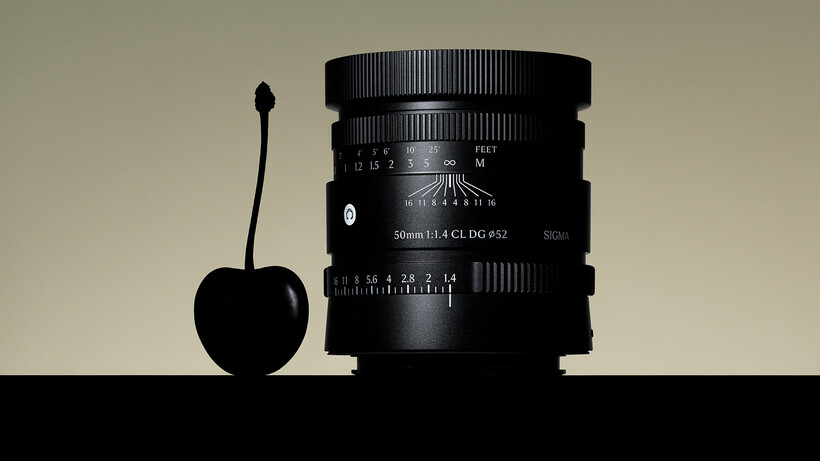
On the outside we get a very attractive metal barrel, with distance and depth-of-field scales engraved into the surface. These marking will be a characteristic of the new CL lens line we are told. Also a turn of the focus ring will take us straight from auto to manual focus without having to flick a switch.
In line with the concentration on wider apertures, the minimum aperture of this new lens will be f/16 instead of f/22. Sigma clearly wants us to make the most of the maximum aperture and the out-of-focus rendering.
Sigma says the new lens will be released in early spring next year, and has yet to announce a price. It will be available in Leica L and Sony E mounts.
For more information see the Sigma website.





Press release
October, 2026
Soft, beautiful bokeh. Rich, textured rendering.
A new lineage for “Premium Compact Primes”with unique expressive character.
Sigma announces the “Sigma 50mm F1.4 CL DG | Contemporary”
Kanagawa, Japan, October 23, 2026 – Sigma Corporation (Headquarters: Kawasaki-shi, Kanagawa, CEO: Kazuto Yamaki) is pleased to announce the Sigma 50mm F1.4 CL DG | Contemporary.
Housed in a small, lightweight and premium metal body, the lens combines a bright F1.4 aperture with rich textured rendering that gives images a unique expressive character. The CL, which is the start of a new lineage in Sigma’s I series line, harnesses the latest technology to achieve a classic aesthetic with beautiful tonal gradation, and is scheduled for release in early spring 2027.
Available mounts: L-Mount, Sony E-mount
Supplied accessories: Lens Hood LH520-04B / LH520-04S, Front Cap LCF-52 IV, Magnetic Metal Lens Cap LCF52-02MB / LCF52-02MS, Rear Cap LCR III, Pouch
Key Features
● Aberrations intentionally controlled with the latest simulation technology for soft rendering of texture that helps the subject stand out
● Exceptionally compact for a large-aperture F1.4 prime, with the newly developed RDD autofocus actuator
● A new lineage for the I series primes designed to maximize the joy of shooting
Aberrations intentionally controlled with the latest simulation technology for soft rendering of texture that helps the subject stand out
The Sigma 50mm F1.4 CL DG | Contemporary is a premium compact prime lens that delivers a bright F1.4 aperture and rich textural rendering in a small and lightweight metal body. Its authentic optical system, housed in a barrel that is exceptionally small by the standards of today’s mirrorless lenses, was designed by making full use of the latest optical technology. Through exhaustive simulations, aberrations have been intentionally controlled to achieve a gentle softness within the in-focus plane, smooth and attractive bokeh, and characterful background rendering that helps the subject stand out. Conveying warmth and a natural sense of three-dimensionality across the entire frame, the lens is ideally suited to portraits and snapshots in particular. Its body distills the pure enjoyment of shooting with dedicated photographic equipment, while the latest technology perfects its impressive image quality, with supple rendering of texture and rich tonal gradation. Sigma hopes that the CL, the first in a new lineage of I series primes will help you discover and capture more beauty and joy in your everyday life.
Exceptionally compact for a large-aperture F1.4 prime, with the newly developed RDD autofocus actuator
Beautiful bokeh and three-dimensionality only a large-aperture prime can deliver
The lens features a classic optical construction of 9 elements in 6 groups with a whole-lens extension focusing mechanism. 3 aspherical elements and 1 FLD glass element are effectively arranged to achieve a compact and lightweight design. The optimal placement of the aspherical elements also successfully suppresses ghosting, which is difficult to avoid in small, lightweight lenses. Aberrations are precisely controlled while internal reflections are eliminated. The lens is designed so that its bokeh is at its most beautiful and its three-dimensionality at its richest at the maximum aperture of F1.4, offering superb rendering, especially in the beautiful, gradual transitions of its background bokeh.
New RDD (Rotary Direct Drive) actuator
To keep the overall length of the lens short, Sigma chose whole-lens extension focusing rather than an inner focus design. To handle the heavier focusing unit this creates, Sigma developed a powerful autofocus actuator in which coils and magnets, as used in the HLA (High-response Linear Actuator), are arranged in a circle to match the shape of the lens barrel. This minimizes any increase in outer diameter, resulting in a slim, high-torque autofocus mechanism.
Instant AF/MF switching with the focus ring
Taking advantage of RDD’s ability to drive the focusing optics directly, the lens temporarily switches to manual focus automatically when the focus ring is turned during autofocus operation. This allows photographers to work quickly in fast-changing conditions without needing to adjust AF/MF settings using a switch.
A new lineage for the I series primes designed to maximize the joy of shooting
All-metal body with premium quality and a pleasing feel in operation, the hallmark of the I series
As the latest chapter in the I series, the “Premium Compact Primes” that pursue the joy of owning a photographic tool, the CL carries on the series’ all-metal body. Not only the knurled hood, focus ring and aperture ring but also the supplied magnetic metal lens cap have been inherited as signature elements of the I series identity.
Depth-of-field scale
The CL series features a distance scale that runs from the minimum focusing distance to infinity, together with a focus ring that rotates in direct sync with focusing. It is also equipped with a depth-of-field scale, which lets photographers visually check how the depth of field changes with the aperture value. These scales also serve as an icon of the CL, combining the very latest functionality with a classic aesthetic.
Dust- and splash-resistant structure* / water- and oil-repellent coating
In addition to a dust- and splash-resistant structure, the frontmost surface of the lens has a water- and oil-repellent coating applied, allowing photographers to shoot without concern even in harsh outdoor environments.
* The product is designed to be dust- and splash-resistant but is not waterproof. When using the lens near water, etc., take care not to allow large amounts of water to splash on it. If water gets inside the lens, it may cause a major malfunction.
Product information: