
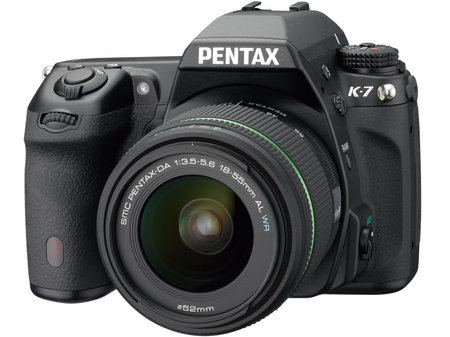

The Pentax K-7 is, without a doubt, the best DSLR that Pentax has ever produced. It'll please existing Pentax users who may be looking for faster performance, better autofocus or even a fairly solid movie mode to add to the fray. While the K10D has held strong for many users, the K20D only marginally brushed up upon this as an upgrade. As a result, many didn't part with their cash so soon for effectively so little - but the K7 tidies this up once and for all and, should you be Pentax through and through, will see you reaching for the piggy bank. There are downfalls however: the Pentax K-7 provides rather exceptional image quality in terms of noise, but completely unravels itself with consistent underexposure. Irritatingly, an exposure that looks excellent on the camera's LCD will reveal itself to be quite a distance from that on your computer screen. That's when Raw work becomes an essential - but that shouldn't have to be the case. While the K7's AF system is good, at least snappier than previous models, there's stiff competition already out there from competitors. The long-standing Nikon D300, for example, has a 51-point AF system that sounds frightfully better - at least on paper. In actuality, having so many AF points can leave you spoilt for choice, or even getting caught out tracking the wrong subject, so Pentax truly isn't a million miles behind in reality. The point is that, when looking to buy a camera, the figures so often stand out on paper that they can be a make or break for customers in the shop. And there's nothing singularly immensely stand-out about the K-7 that really places it beyond other cameras on the market. A huge benefit for the K-7 is its compatibility with older Pentax lenses. Sure there're some noisy AF ones from years back, but there are other superb manual primes that still hold their weight, even on a body such as this. And with further investment in new digital-only DA optics, plus accessories such as the optional battery grip, it's clear Pentax is pushing forward and looking to appeal not only to its existing audience, but further a field too. Whilst this is a strength, it can't help but be a weakness too: with Nikon and Canon both holding such solid followings and providing a huge range of products and lenses, Pentax is undoubtedly the underdog. But that's not to say the K-7 isn't a good camera - it's actually a great one. With a few more firmware tweaks to fix up exposure, AF in movie mode and some other niggles, it's well on the way to being a superb piece of kit.
Pros

-
 35 years worth of compatible Pentax lenses, 100% viewfinder, intuitive camera layout, HD movie, best AF system (with AF illuminator) to grace a Pentax camera
Cons

-
 Underexposed images, no AF in Movie mode, slow AF in live view, in-camera HDR a disappointment, tough competition to compete against - ought to be cheaper

The Pentax K7 is the company’s first pro-grade DSLR, and it’s been a long time coming. This review is of a pre-production sample fitted with firmware upgrade 1.0.0
First, an apology. This review is of a camera given to us by Pentax UK, who told us that it was a full production sample. Pentax has since decided to make some changes to the sensor so, to clarify, the camera tested is a pre-production model fitted with firmware upgrade 1.0.0. (More information in our news update)
Since this camera is close to being a production sample most of the information and opinion in this review still applies, but bear in mind that any changes made to the final production version may affect the camera’s performance and image quality, and so the comments on these aspects of the camera should be viewed with this in mind.
Thanks,
Nigel Atherton (Editor)
The Pentax K-7 is the new jewel in the company’s crown, with specs far beyond any Pentax DSLR to date. Existing Pentax users will be pleased to see a much-wanted upgrade, whereas new users can now consider the K7 as a true contender in the field. Pitting itself against the already well-established Nikon D300 and Canon 50D mid-level prosumer cameras it’s no doubt that the Pentax K-7 has more than one hard act to follow. But with the Pentax name synonymous with the photography of old, and with excellent – if underappreciated – performers such as the K20D already under the belt, is now the time for Pentax to go for gold and achieve the kudos that has been otherwise lacking in its digital age? What Digital Camera’s review of the Pentax K-7 DSLR gets out the proverbial magnifying glass…
Pentax K-7 review – Features
The Pentax K-7 has a high resolution 14.6MP CMOS sensor that, whilst the same as the K20D’s in terms of resolution, has a doubled the output channels. In turn this means more information can pass through the K7’s buffer for a higher continuous shooting mode – a solid 5.2 frames per second up to 40 Fine JPEGs or 15 Raw files. Raw is offered as Pentax’s own PEF format, though the universal Adobe DNG format is also optional from within the menus, too. The 15MP mark seems to be as high as manufacturers are pushing pixels onto APS-C sized sensors and, judging from excellent Canon 50D image results, this seems a wise move.

By cramming features into the K7, Pentax is on form to out-do a variety of its competitors. The K-7 opts for a movie mode, which means that you’re able to record 720p movies, unlike the Nikon D300 or the Canon 50D. However, whilst there was speculation that it’s possible to shoot Full HD, this is actually a capture at 1536×1024 and upscaled to fit the 16:9 output ratio (at 1080i). Therefore the K7 is incapable of shooting in ‘Full HD’.
The K-7’s build quality is a key sell too. Ruggedly made, but following Pentax’s ‘classic’ design, the body is a magnesium alloy that’s dust and weather-sealed at 77 points. Shooting in sand, getting splashed with rain or other treacherous conditions need not be a bother and, despite this upgrade, the whole camera is marginally smaller and lighter than the previous K20D.
In-camera ‘Shake Reduction’ ensures images are stabilised to best effect, and means all old glass from Pentax’s 35 years’ worth of K-mount bayonet-fit lenses will reap the benefits. Plus, on the upside, it’ll keep the costs of new lenses down to relatively bargainous equivalents.
With such a large output size (14.6MP generates 4672 x 3104 pixel files) the K-7 is built for the studio too. Not least because there’s a new optional battery grip – the first for DSLR with both AA and li-ion battery compatibility from Pentax (D-BG4) – but also due to both x-sync flash controls and a socket for remote use, plus the standard hotshoe. Customisable white balance settings (2500K-10000K) top off the user-defined modes, perfect for studio light colour balancing. Could this be the first step before Pentax unveils a true high end professional camera? We’ll have to wait and see if they can muster the goods, but the K-7 shows significant development in that direction that’s very much headed up by Pentax, and Pentax alone: previous models – the K10D and K20D – had Samsung counterparts (the GX10 and GX20 respectively) that interestingly ceases to be. The K-7 is a Pentax-only venture and solidifies the company’s dedication to pushing forward in the DSLR market.
In the field the Pentax K-7 is a corker too. That weather-sealed body promises to stand up to tough situations, whilst the high frame rate is ideal for sports photography or fast panning. A high shutter speed of 1/8000th sec will see you snap the action in less than a flash too plus, with the new AF illuminator lamp it’s possible to work much better in low light conditions. A new 11-point AF system (named SAFOX VIII+) also puts previous Pentax systems to comparative shame, utilising 77 metering segments (notice the ‘7’ and ‘77’ theme here) for improved autofocusing. The K-7’s viewfinder has a much-sought after 100% field of view too, ensuring what you see is exactly what you’ll capture, with no surprises.
The K-7 has a high resolution 3in LCD screen too. While it doesn’t have the tilt/swing option that many models are now coming featured with, it more than makes up for it with its 920K dot resolution and auto image rotation. Playback should be a joy and – should you happen to be using one of the many in-camera effects such as HDR, black & white or sepia toning – it’s ideal to scrutinise your work before it makes it as far as the computer.
Pentax K-7 review pages:
– Page 1: Pentax K7 DSLR review – Features
– Page 2: Pentax K-7 full production model review – Design
– Page 3: Pentax K7 full firmware review – Performance
– Page 4: Pentax K-7 review – Image Quality & Value for Money
– Page 5: Pentax K7 full first review – review specifications / specs
– Page 6: Pentax K7 DSLR review Verdict
Pentax K7 review – other What Digital Camera links:
– Compare the Pentax K-7 with other prosumer DSLR reviews
– Pentax K7 review – product images
– Pentax K-7 review – sample test image gallery