
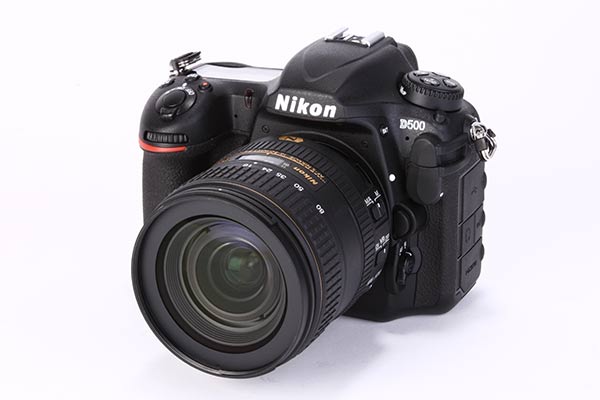

Pros

-
 - Remarkable autofocus system<br />- Excellent build quality and handling<br />- Fine image quality at both low and high ISO settings
Cons

-
 - Large and heavy compared to APS-C peers<br />- Much less capable when used in live view<br />- SnapBridge connectivity doesn’t work well (yet)
Nikon D500 review – Performance


When it comes to metering, four patterns are available – matrix, centreweighted, spot and highlight weighted. The default matrix system is very strongly biased towards ‘correct’ exposure of whatever is under the active AF area, regardless of whether this suits the scene as a whole. This approach has it merits, but does have a certain tendency to clip highlights in high-contrast scenes. In such situations I appreciated having the highlight-weighted option which, as its name suggests, aims to maintain highlight detail, allowing you to bring up shadow regions in post-processing.
In this regard, raw files are remarkably malleable at low-ISO sensitivities, and it’s possible to pull vast amounts of detail out of the shadows without it being blighted by excessive noise. JPEG shooters can use Nikon’s Active D-Lighting feature to make similar use of the sensor’s superb dynamic range.


Auto white balance tends to give extremely neutral results – indeed, too much for my tastes. For example, it’s prone to removing attractive warm casts from sunlit scenes, and I usually preferred to add back a little warmth to my images in post-processing. But while the AWB setting can be changed in the menu to retain warmth under artificial light, there’s no such option for daylight shooting.
Nikon’s colour rendition is generally very appealing, giving rich, saturated colours without going over the top. The output can be adjusted from the Picture Control menu using a range of subject-based settings, all of which can be individually fine-tuned. Sports and action shooters are likely to spend a lot of time using JPEGs, so it’s good to see that Nikon offers high-quality results straight from the camera.

Overall image quality is very good, but then again the same is true of much cheaper Nikon APS-C DSLRs. Indeed, at low ISOs there’s no real advantage in this area compared to the D7200 or indeed the D5500. But the D500 keeps going longer as the ISO is raised, and so long as you don’t expect miracles, it’s still capable of giving quite usable files at its top standard setting of ISO 51,200, and maybe even a stop higher. However, I can’t help but think that the extended settings exist more for marketing value than practical use.