
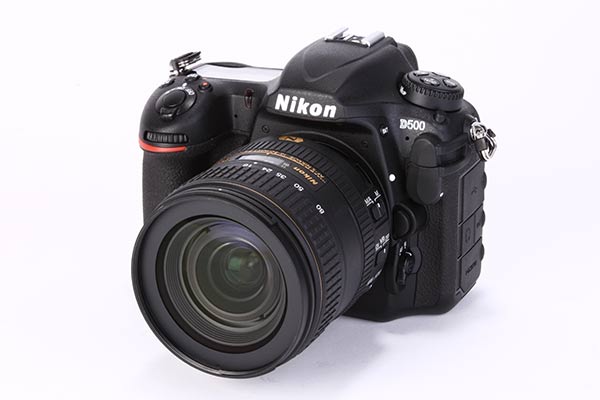

Pros

-
 - Remarkable autofocus system<br />- Excellent build quality and handling<br />- Fine image quality at both low and high ISO settings
Cons

-
 - Large and heavy compared to APS-C peers<br />- Much less capable when used in live view<br />- SnapBridge connectivity doesn’t work well (yet)
Nikon D500 review – Features


A quick glance at the D500’s key specs shows that it’s a remarkably well-featured camera. Its 20.9-million-pixel DX-format sensor affords an impressive standard sensitivity range of ISO 100-51,200, and a frankly staggering extended range of ISO 50-1,640,000. It can shoot at 10fps, and keep going for at least 30 frames in raw format and 90 or more in JPEG mode. That’s with an SD card; place an XQD card in the second slot, and it’ll keep shooting at full speed for 200 frames in raw.
Autofocus uses a 153-point system covering almost the full width of the frame and around half its height, while metering employs a 180,000 pixel RGB sensor that also feeds subject-recognition data to the AF system. Nikon specifies that both systems will work in staggeringly low light: -3EV for metering, and -4EV for AF. At this point the D500 reads less like a real camera, and more like a dream card in DSLR Top Trumps.
The D500 is also capable of recording 4K video, but with the catch that it uses a 1.5x crop in the centre of the frame, compromising wideangle shooting. Full HD movies can be captured at up to 60fps, this time with a recording area the full width of the sensor. But while it has some nice movie-friendly features, including microphone and headphone sockets, and a flat picture profile, there’s no focus-peaking display and only rudimentary zebra pattern overexposure warning.
One thing the D500 lacks is a built-in flash, and users will instead have to rely on hotshoe-mounted external units. For anyone planning to use Nikon’s excellent wireless flash system this will come as a disappointment, but it reinforces the camera’s positioning as an available light action specialist. Presumably, Nikon believes portrait photographers would be better off with a D750.