

Pros

-
 Very well made
-
Consistent performance
-
Very attractive diffusion
-
Convenient mounting system
-
Genuinely offer precision reflection
-
Can be mounted at any angle
Cons

-
 They cost a lot
-
Mounting kit is expensive
-
Big gap in characteristics between Diff 2 and Diff 3
-
They snag as they come out of the pouch

Like a lot of photographers, I spent many years using homemade reflectors. Since I was a teenager and until just this morning you might have found me employing piece of clean white card to encourage light to fill deep shadows on the darker side of whatever, or whoever, was in front of my camera. When a clean sheet of white card wasn’t to hand I might use a page from a note book to reflect light onto a small object, and when shooting something larger I have a sheet of polystyrene from the packaging that came with the oven. On a table top in the kitchen very often a length of tinfoil trailing from the box and balanced on two tins of beans does a great job of creating a harder, cooler light. These cobbled together reflectors work well most of the time, and when I’m at home in the studio they are good enough leaning up against a coffee jar or held somewhere in place with Blu Tack.
There are occasions though when I can’t get the reflector where I want it, particularly if it needs to be off the table, and other times the whole lot collapses like a house of cards when I walk past too quickly, sneeze or someone opens a window. All these improvisations are fine when I’m shooting on my own, but when I’m with a client they don’t look very professional, so I also have grown-up factory-made reflectors that look the part when I’m out – but they tend to be just white, silver or gold, and not as variable as the homemade ones.
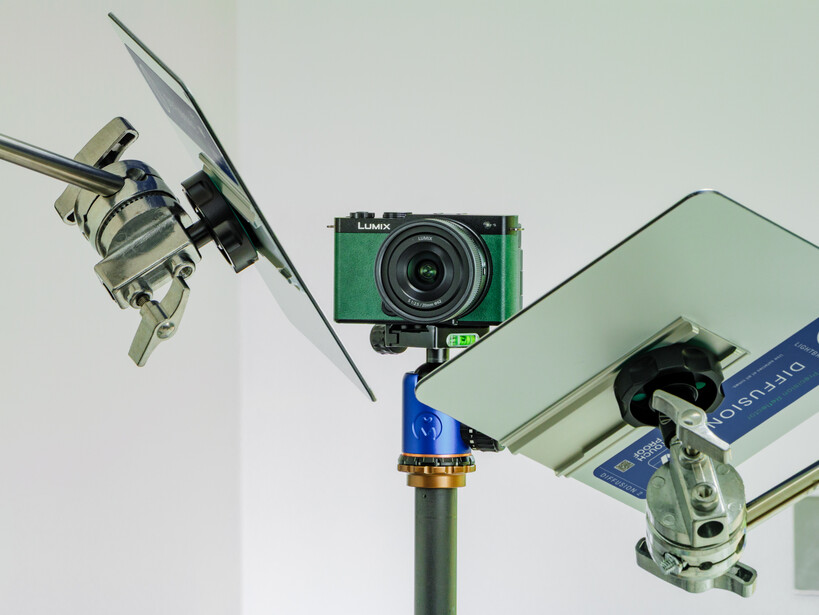
Lightbridge calls its series of metal graded reflectors ‘reflectors’, but I’m trying to decide what they really are. Are they reflectors or bounce-boards, or mirrors, or what? They actually are reflectors of course, but the way they are used and what they do makes them something quite a lot more. And ‘quite a lot more’ they should be as, at £130 each for the 25cm versions I was using, they cost a whole lot more than my sheets of card. How can they possibly be worth it?
What’s the idea of Lightbridge CRLS Precision Lighting Reflectors?
While very often we might use a reflector to bounce light from the main light source to fill the shadows on the darker side of a subject, these reflectors are really designed to have that main source directed at them so the source only reaches the subject by reflection. The grade of reflector we choose for the job then determines whether the light reaching the subject feels hard or soft. Using this method of shining the light into the reflector instead of directly at the subject also allows us to increase the distance between the light and the subject. This extra distance can be very useful when we’re trying to emulate a natural light source, such as daylight coming through a window. Obviously the sun is a long way away so just shining a light through a window doesn’t feel quite the same, but when we bounce that light into a reflector we can add a lot of extra distance to the light path.
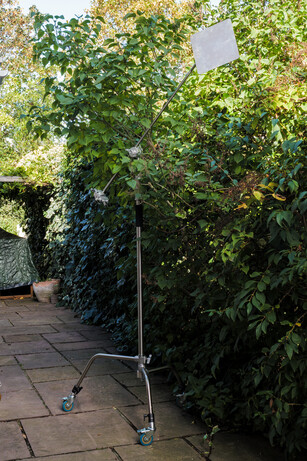
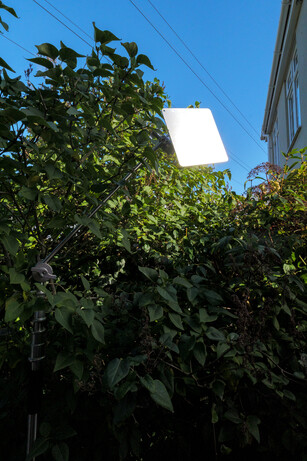
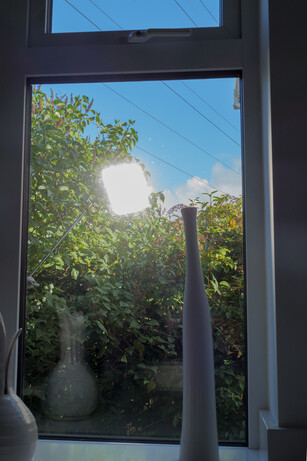
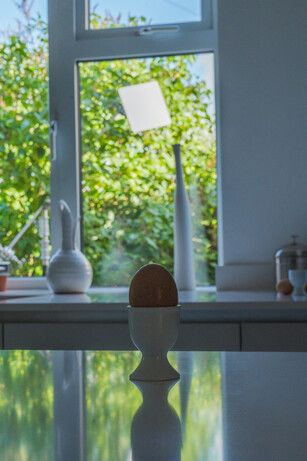
These bounce panels are useful too when we want to shine ‘sunlight’ through an upstairs window. It can be tricky mounting a light high enough, and safely enough, to shine through a bedroom window, for example, so instead we mount one of these reflectors outside the window and shine the light from the ground into it so it reflects through the glass. This gives the light the extra distance from the ground to the reflector and on to the subject, rather than only the distance from just outside the window to the subject. The reflectors are less susceptible to the wind and much less heavy than a light, so they are simpler to mount high up.
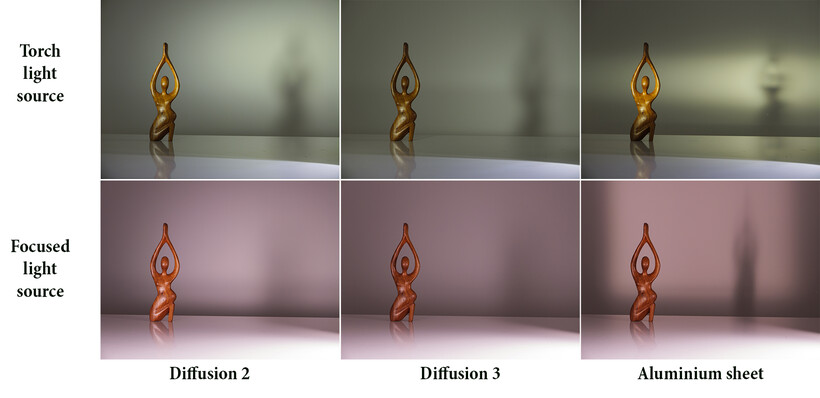
With the graded diffusion of each panel we have a choice about whether the reflected light is hard like direct sun (grade 0) or as soft as an overcast day (grade 4). By using reflectors of different levels of diffusion next to each other we can also create more complex light characteristics on the subject and the surrounding scene using only one source. So a single light source directed into a soft reflector placed next to a hard reflector can give us both kinds of light in the scene.
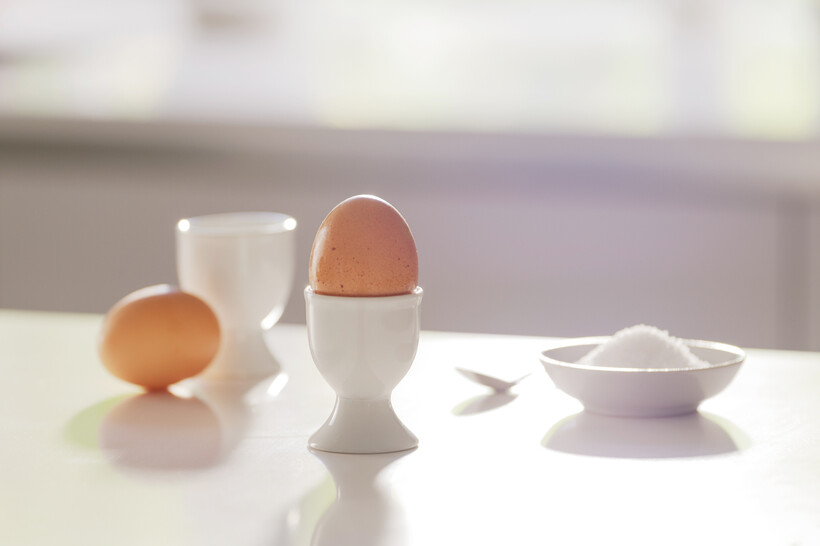
Of course we can use these as regular reflectors too, with natural or artificial lighting, but it’s the idea of using them to almost become the light source that’s particularly interesting – and different.
Lightbridge CRLS Precision Lighting Reflector Features
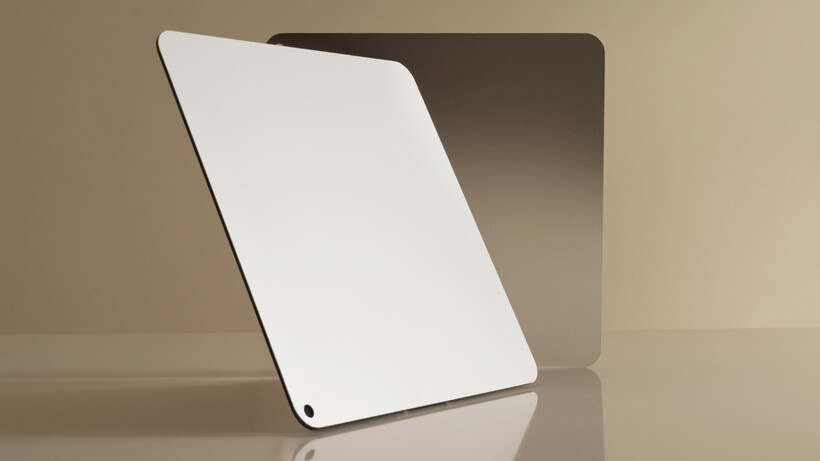
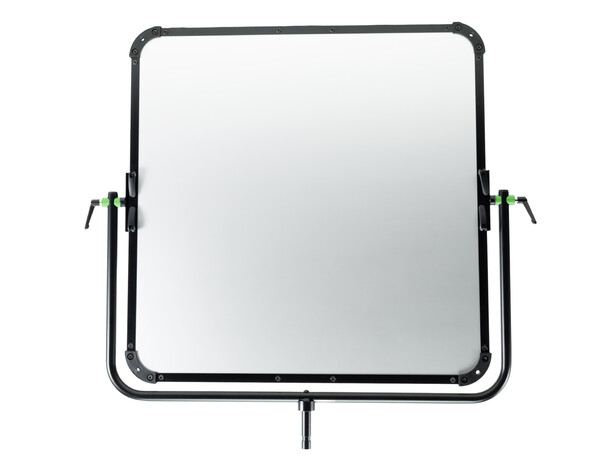
The Lightbridge reflector series are sheets of aluminium applied to board and fitted with a mounting system on the rear that allows them to be attached to standard lighting and grip stands. The metal face of the reflectors is treated to create five grades of diffusion, from sharp, crispy and mirror-like to a very soft white, but all are designed to channel light in a tight pattern that doesn’t spread it out all over the place but keeps all the light from the source focused in the direction you want it to go. The manufacturer says the reflectors don’t ‘spill’ the light, and that they are colour neutral so don’t alter the temperature of the light they are reflecting. They also only absorb 3% of the light thrown at them, so 97% is reflected, which would make them very efficient. Spill, colour and levels of reflectance are three things I have little control of with my home-made reflectors, and to a significant degree those I have bought from the standard manufacturers.
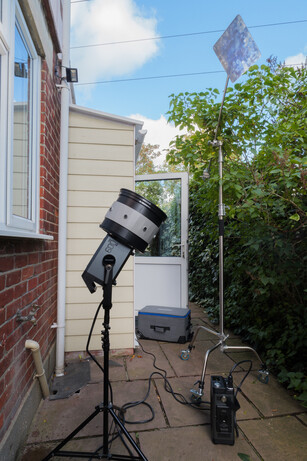
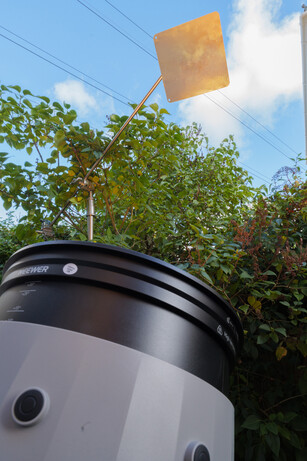
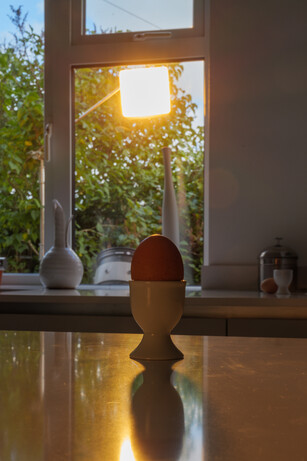
The reflector panels seem very well made, don’t flex and, according to Lightbridge, can withstand 3G of pressure. They are waterproof and can be used safely in temperatures of -25 to 75°C and can resist heat of up to 100°C – so can be used next to hot light sources. So long as they are well mounted they can also withstand wind-speeds of up to 70km/h, which makes them ideal for mounting on moving vehicles or up high on tall stands or cranes.
The reflectors come in a range of sizes that allow us to use them in table-top set-ups or for lighting room sets, but the panels I had for this review measured 25cm square. The smallest available are 7cm square, and the largest are 100cm square – there are five size options in all. The degree of diffusion is graded from 0 to 4, where 0 is a mirror and 4 is white. 1, 2 and 3 are different levels of shiny somewhere in between the two. For this review I had diffusion grades 2 and 3.
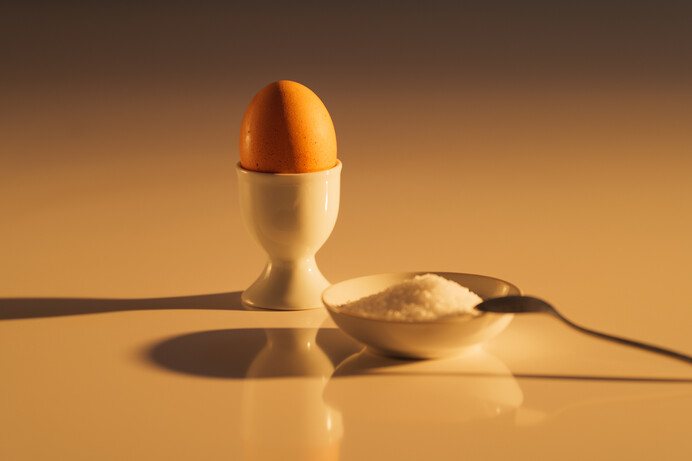
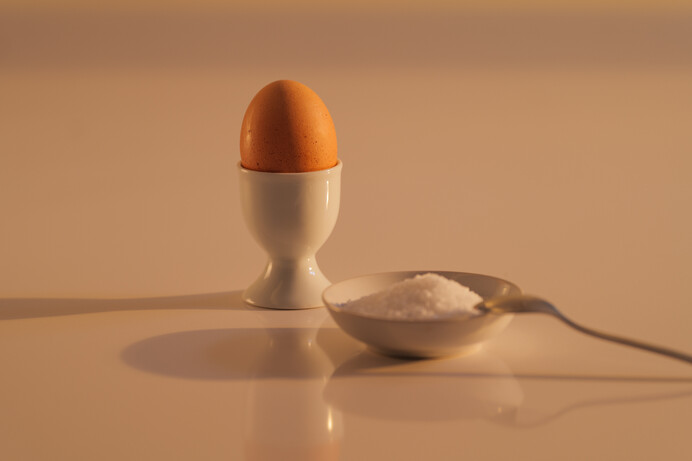
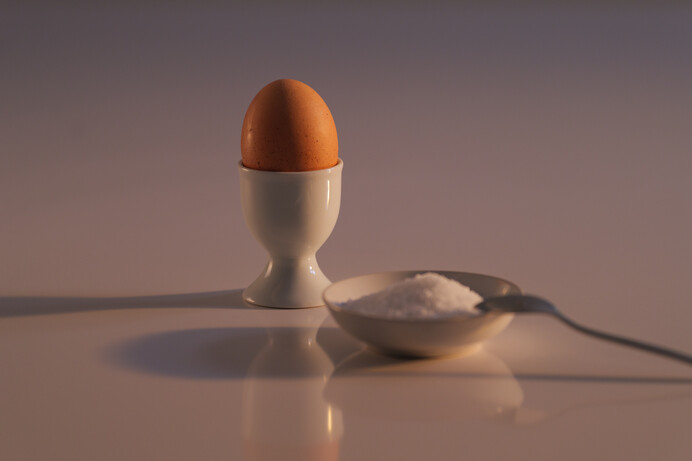
Lightbridge says the face of the reflectors is ‘touch proof’. I’m not really sure what that means and it might be a poor translation from the German, as you certainly can, and will, put your fingers on the reflective surface – and you will leave finger prints unless you wear gloves. I suppose what it means is that the prints are easy enough to clean off with water and a soft cloth. If you do touch the surface you will leave a mark whether it cleans off easily or not.
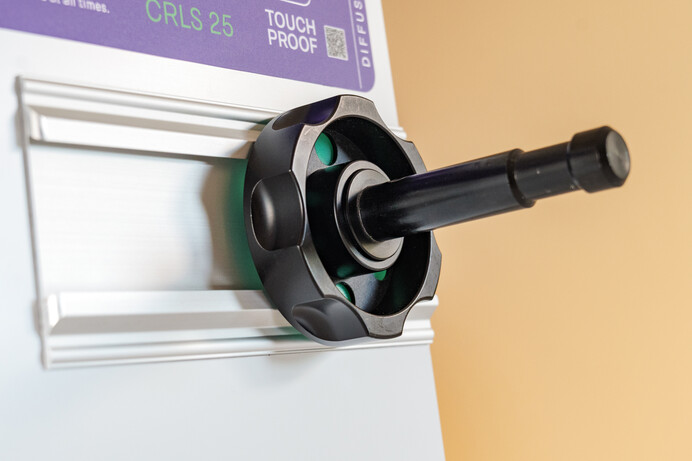
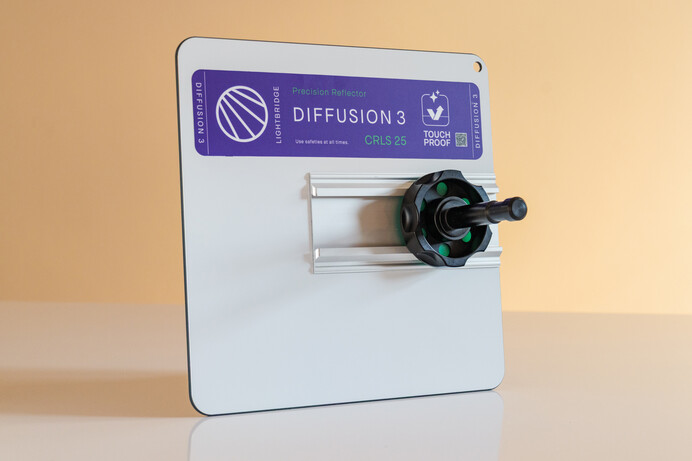
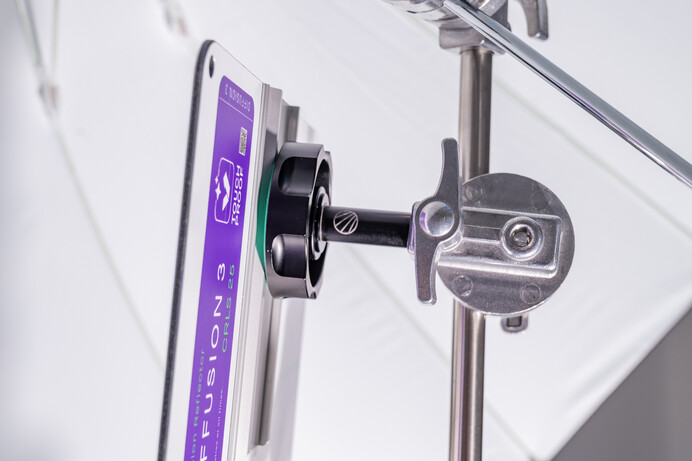
The rear side of the sizes from 7cm to 50cm has a slot that a mount system slides into, tightens and then allows the panels to be mounted on a stand. There’s a kit called C-Grip C-Wheel Pro that allows the reflectors to be mounted a number of different ways, and which comes with a safety cable to ensure the reflector doesn’t drop to the ground should it come lose. The mounting kit doesn’t come with the reflectors – you need to buy them separately, though some kits with multiple reflectors do have these mounts included.
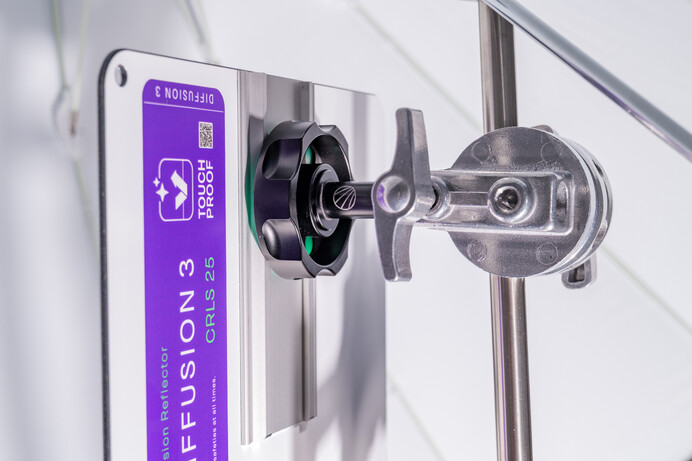
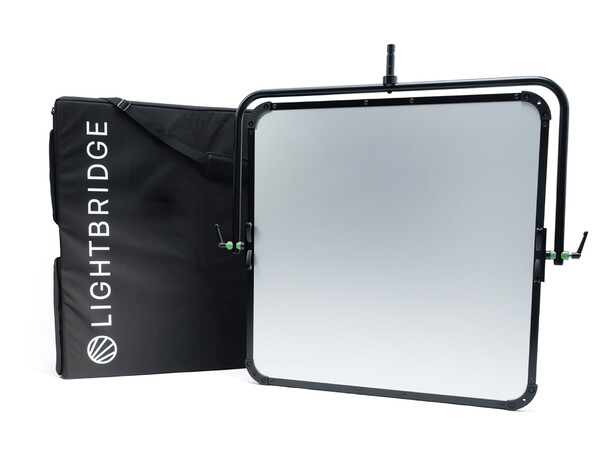
To protect them, each reflector comes in its own soft pouch with a little coloured ribbon that’s the same as the colour code of the back of the reflector that tells us which grade it is. So, we can look at the ribbon and know what’s in the pouch. The pouches are nice and well made, but you’ll have to learn how to put the reflector in and out without the mounting plate catching on the seam. It will annoy you until you learn the trick.
Are Lightbridge CRLS Precision Lighting Reflectors worth the money?
These reflectors are very good. They are well made, they work well and they really do add a new dimension to lighting a scene or a subject. They reflect so well in fact that they can be used in place of additional lights, but their key quality is that they give us numerous options for a range of characteristics in our lighting that we don’t get with just another light. The hard edged reflections that come with the less diffused reflectors is something that can’t be created with a modifier on any kind of light source, and the more diffused reflectors create a direct source that’s soft and which again is hard to emulate. That they mount so easily on a stand or a boom arm makes them simple to position anywhere, and to adjust very quickly. That they are light weight means they remain stable on the stand and don’t move around. Their build quality and usability is a major selling point, and allows them to be used outside in the rain and to last a long time.
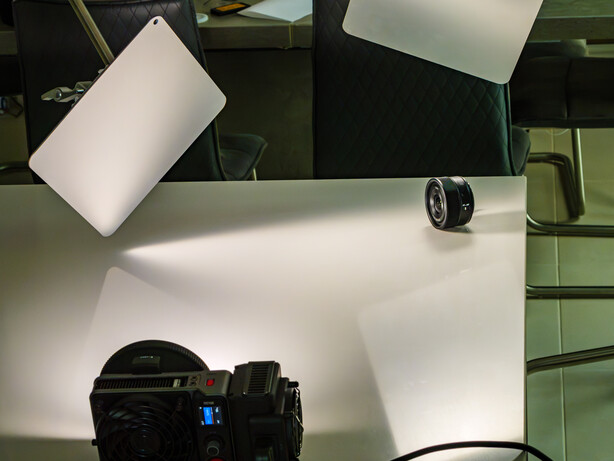
That the 25cm reflectors I used cost £132 each and then need a £92 mount makes them a particularly difficult purchase. My first thoughts were that I could buy another light for that same £224, but I had to remind myself that these do something another light wouldn’t. My mind then moved to how I could make these myself, but I realise I probably couldn’t – the spill, the neutral colour and the high reflectance are all things I don’t think I could match across a set of reflectors with different diffusion properties. And if I made them they would unquestionably look homemade, or would take so long to build so that they didn’t look homemade I’d be as well to buy them rather than use a week of my time.
Godox has what seems a very similar product in the LiteFlow system which, inevitably, costs less than the Lightbridge products. A four-panel kit of Godox LiteFlow reflectors that comes in a case costs £588, while three Lightbridge panels of the same size cost £398 in a soft pouch – so with all things being equal we’d pay £530 for four Lightbridge reflectors. The Godox mounting kit though costs £14.40 on its own without a safety cable, but a kit of the four panels and four mounting studs comes to £645 instead of £898 for the Lightbridge kit. You may of course be able to use the Godox mounts on the back of the Lightbridge panels, but I haven’t been able to try that to see they fit. They look as though they do, and if so you could buy these instead of the Lightbridge versions and make the Lightbridge kit slightly cheaper than the Godox – for the 25mm panels at least.
When it comes to the question of whether these can possibly be worth the money I have to say that they are – for all the reasons mentioned above. They are excellent and professional, will last and will produce a reliable and repeatable result. The question we all need to ask though is ‘are they worth it for me?’. I can’t really help you with that one – you’ll have to decide yourself whether you can spend this much on a set of reflectors or if you’ll stick to the sheets of card.
Lightbridge CRLS Precision Lighting Reflector Prices
| Size | Per set inc VAT |
|---|---|
| 7x7cm | 3 panels with bag £212.72 |
| 15x15cm | 3 panels with bag £300 |
| 25x25cm | 3 panels with bag £398.18 |
| 50x50cm | 3 panels with bag £790.91 |
| 100x100cm | 2 panels with yoke, frame and bag £2503.63 |
| C-Grip C-Wheel PRO (Spigot & Receiver) | £92.72 |
For more information see the Lightbridge website or the UK distributor Prolight Direct.