
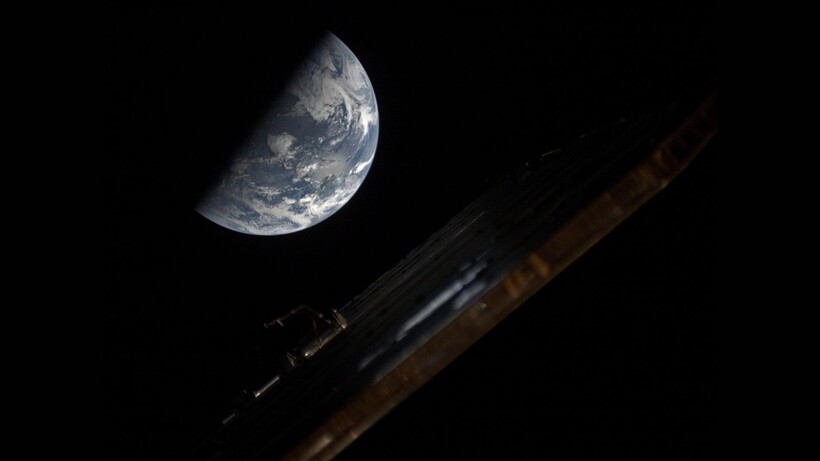


NASA’s ESCAPADE Gold spacecraft has captured a remarkable photograph of Earth from approximately 38,500 miles (62,000km) away during its departure towards Mars. Taken on 9 November 2026, the colour image offers a final view of our planet from the spacecraft as it embarks on an interplanetary journey to investigate the effects of solar wind on the Martian atmosphere.
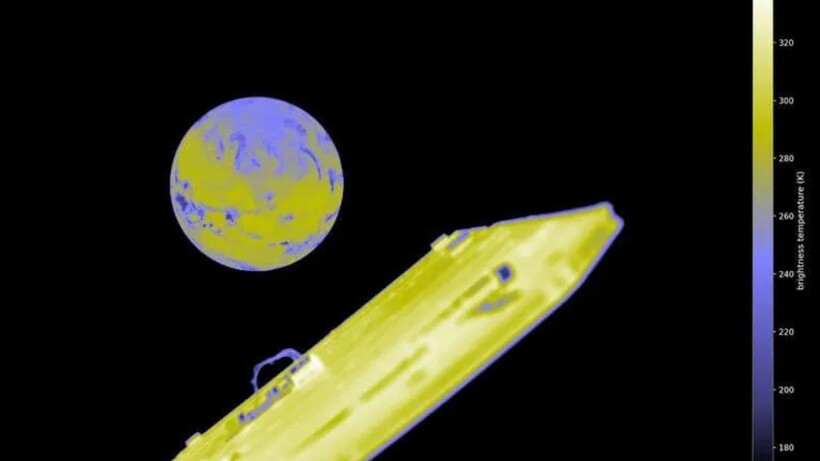
The photograph was taken using the spacecraft’s Visible and Infrared Observation System, which incorporates a relatively modest 5MP camera. Despite its resolution being considerably lower than that of most modern digital cameras, the instrument captured a striking composition showing Earth’s Western Hemisphere, with the shadowed portion of the planet and one of the spacecraft’s solar panels framing the scene. The exposure was made at approximately 2pm GMT, around three hours after the spacecraft’s closest approach to Earth during a powered flyby.
A ten-month journey to Mars
Gold is one of two identical spacecraft involved in NASA’s Escape and Plasma Acceleration and Dynamics Explorers (ESCAPADE) mission, with its companion spacecraft named Blue. Following their launch in November 2025, the pair initially travelled towards the second Lagrange point (L2), a region of space approximately one million miles from Earth. They subsequently returned towards our planet, using its gravitational pull to assist their onward journey to Mars.
Both spacecraft are expected to reach the Red Planet in early September 2027, where they will investigate how solar wind interacts with the Martian atmosphere. Using two spacecraft allows the mission to study these interactions from different locations, helping researchers develop a better understanding of the processes affecting the planet’s atmosphere.
While scientific observation remains the primary purpose of the onboard imaging system, the photograph is also a reminder that impressive images do not necessarily require exceptionally high-resolution sensors. In this instance, the unusual perspective and the inclusion of the spacecraft’s solar panel give the image a sense of scale that makes it particularly compelling.