
Pros

-
 First class colour
-
Tiny light ideal for hiding on set
-
Highly controllable with great range of modifiers
-
Many ways to power it
-
Good price for professional quality and contents of the kit
-
NFC connection to a very good app + multiple remote options
Cons

-
 Internal battery life always shorter than expected
-
Low power rating means output is limited
-
Battery grip needs a hinge to mount light at 90 degrees

I used a set of Aputure MC Pro lights a while ago. It was the 8-light kit that comes in a charging case with all the accessories, and we used them to light the face of the main character in a film as he sat at a desk. They were a bit fiddly to use, and the batteries didn’t last very long but I became slightly obsessed with them and have thought about them on many occasions since. They were rented for the occasion, and I haven’t been able to come up with a good enough way to deceive myself into buying a set of my own.
I love little lights, but in the main the inverted relationship between size and disappointment holds miserably true, as most tiny lights have a very limited output and a limited range of features. Little lights, in the eyes of manufacturers it seems, are for those who demand little and who will get little. That’s why I like the Aputure MC Pro lights – they are small and well-made but are quite bright and have lots of features.
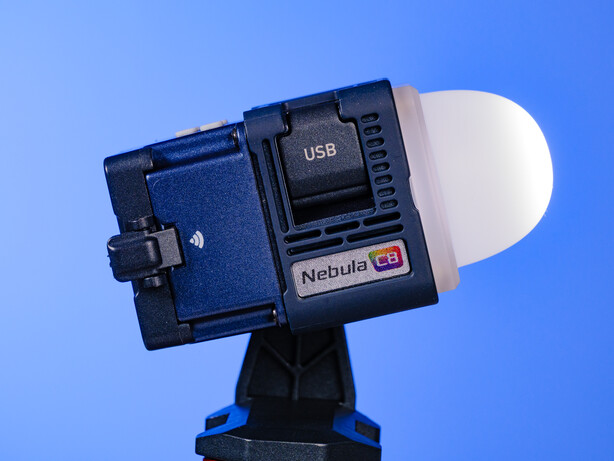
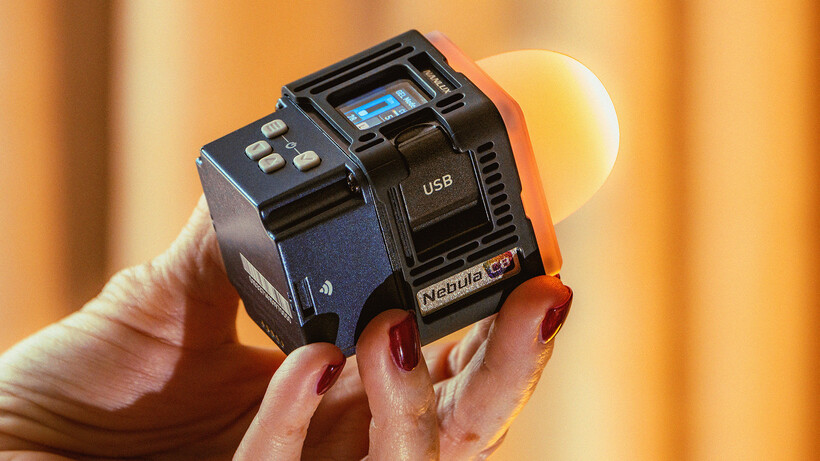
When I was first introduced to these Nanlux Evoke 5C lights at a WEX Summer Roadshow my initial thought was that they are too cool-looking to be genuinely useful. Then I noticed that they are Nanlux and not Nanlite, and that they have the Nebula C8 logo on them. They felt well made, the accessories are extensive and also well made, and they have a lot of features. Perhaps these could become my new obsession ahead of the Aputure MC Pros.
Nanlux Evoke 5C Features
The Nanlux Evoke 5C is a miniature LED light that uses eight colours to create a wide range of hues and different degrees of warm/cool whites. Finding an 8-colour system is remarkable in a light this size, as it’s a feature we’d expect in a much larger, and more expensive head, but that Nanlux has used this Nebula C8 colour system in the Evoke 5C tells us that it intended to be a professional light – not just a neat little gimmick. While most coloured lights this size use simple Red, Green, Blue systems – including those Aputure MC Pro lights – this Evoke 5C uses a mixture of deep Red (dR), Amber, Green, Blue, Red, Lime, Cyan and Indigo. Only a few years ago we’d need to find a couple of thousand pounds for access to that colour mix.

Having so many colours in the mix expands the gamut of the total number of colours the light can create, but at this stage of the development of LED lights it is filling the gaps between colours we’ve already been able to create for some time that will be more useful. Extending the range of reds we can make is nice, but being able to produce subtle differences in colours in the middle of the range helps us with things like skin tones and awkward shades. Nanlux tells us that the light covers 94% of the Rec. 2020 colour space, 823% of the CIE 1931 visible colour gamut, and offers a CRI of 98 and a TLCI of 98.
When we are looking for ‘white’ light we can choose from kelvin values between 1000K and 20,000K, and as you might expect from an 8-colour light we have significant Green/Magenta tuning of +/-200 if we need to correct the colour or add a tint for effect.
In full colour mode we have the regular Hue, Saturation, Intensity mode, along with an adaption, HSIW, that offers white point colour temperature with G/M shift. We also have RGBW controls, XY coordinates and 460 gel simulations from Lee and Rosco – just like a full-sized light. And if you want effects too you’ll have 15 to choose from, including the usual fireworks, gun shot, open fire and a miniature police car effect for when you are filming your Lego models.
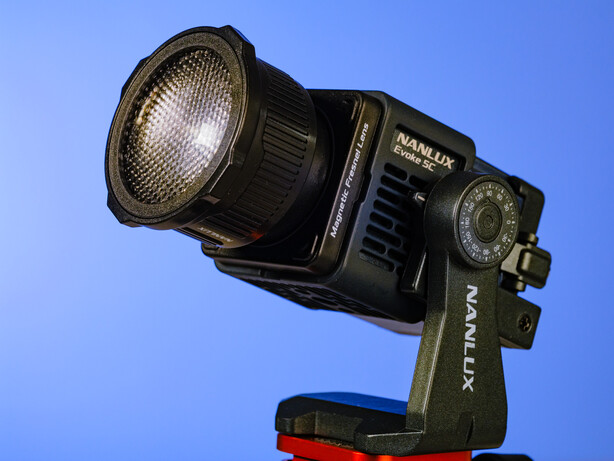
This is a 6W light, so it will always be a light that we keep relatively close to whatever it is illuminating. Nanlux tells us that with the bare bulb we can expect 2026 lux at 0.5m with the output set to 5600K, and 2755 lux with just the Green LEDs – Green appears to be the stronger source, while Red delivers 308 lux in the same conditions. Some of the accessories will push these figures up – the 25° Fresnel lens for example gives us 4040 lux at 0.5m and 5600K – and others will diminish the power – the soft dome diffuser drops the measurement to 74 lux.
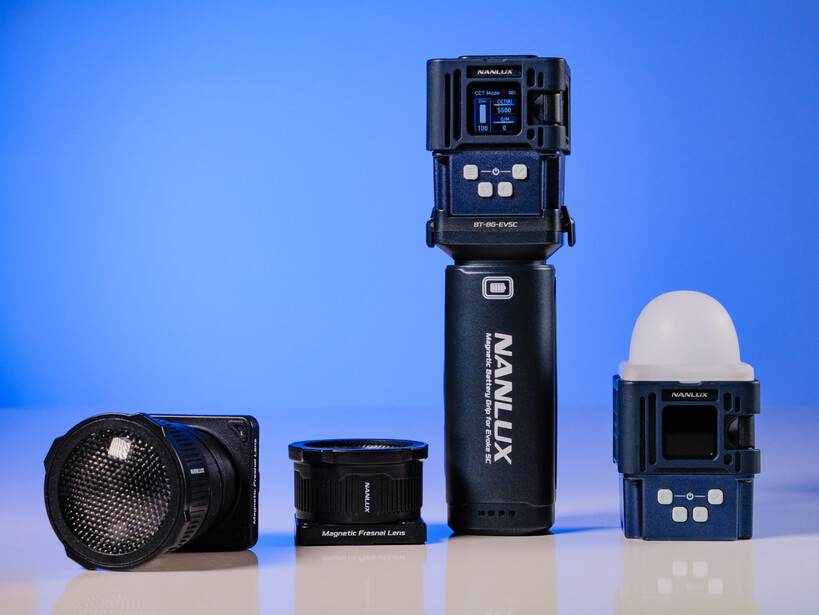
Power for the light comes from a built-in 1300mAh battery that offers us full brightness operation for up to 50 minutes according to Nanlux. Should you find 1% brightness more suited to your needs you’ll be able to run the light for over two and a half hours. On the occasions you need the light for longer than the battery can manage on its own there’s an accessory power handle that comes in the kit bundle and which adds a further 3100mAh into the mix. With the battery handle that 50 run time leaps to 4 hours and twenty minutes. A USB-C port allows us to charge the light and/or power it from an external source while it is in use, and Nanlux makes a neat E27 adapter that allows us to screw the Evoke 5C into a domestic practical lamp fitting and power the light through the socket. Remarkably, this adapter costs only £23.
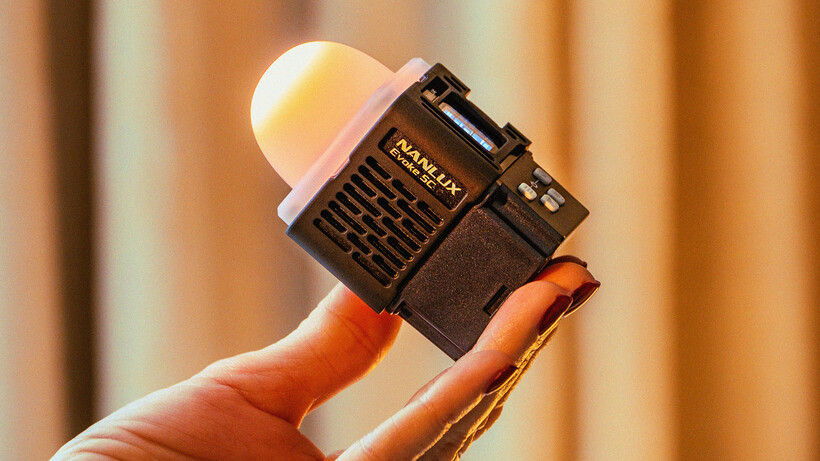
Another remarkable characteristic of the light is that it is IP67 water-proof. It can be submerged in 1 meter of water for up to 30mins, and there’s an underwater housing that extends that spectacle to 30 meters for as long as you like. I’m not sure how many people will make use of the full submergence properties, but it certainly very useful that the light can be left out in the rain without us needing to worry about it.
The light itself measures 56x44x45mm and weighs 160g – about the same weight as a Samsung Galaxy S26, and other smartphones like it.
Nanlux Evoke 5C In Use
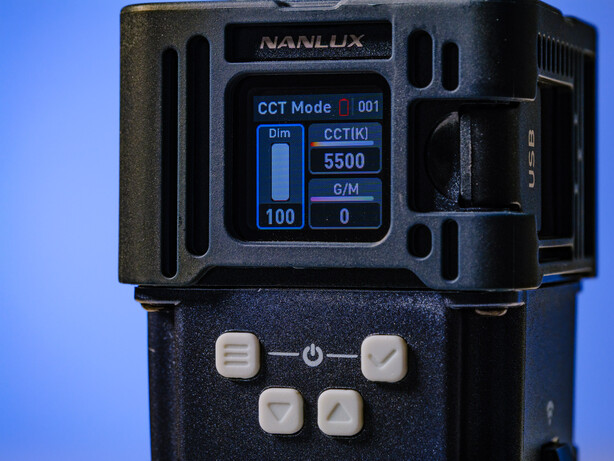
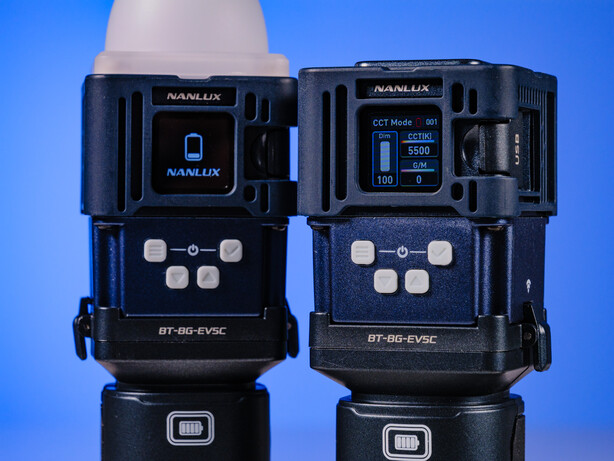
All the controls for this little light sit on the top panel right behind a small, square screen. There are four buttons to lead us around the menu and to help select the features and options that we want to use. Initially I expected this to be the big short-coming of the experience but found that, while a bit fiddly, it is perfectly possible to navigate the menu reasonably easily. However, while the light is in your hand it might be fine to work with the buttons, but if it is tucked away on the set or balanced to accurately direct a beam into a specific part of the subject we may not want to press buttons and make the light move – or indeed extract the light, alter it and then put it back. Fortunately the Nanlink app is very good and can be quickly connected to a new light using NFC or Bluetooth – then we can control the light remotely.
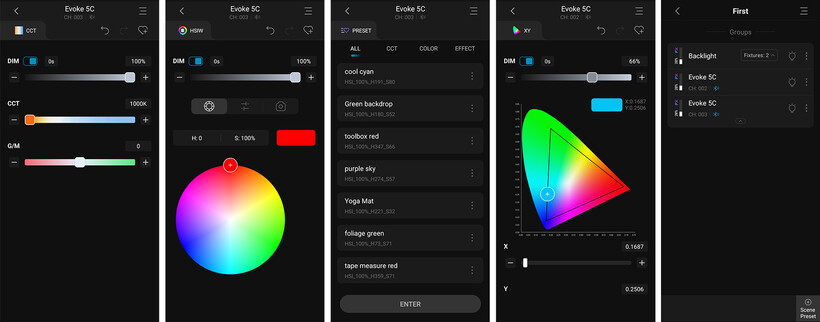
Remote control can also be achieved via more sophisticated means using LumenRadio CRMX with the help of a magnetic module, or via regular cabled DMX/RDM through the USB port. So, multiple lights can be controlled simultaneously, and controlled alongside much larger fixtures, allowing these little lights to integrate into full professional lighting set-ups. As a matter of course, I’d recommend remote controlling of the lights once they are on positions, or even before, as inevitably handling will be much easier on a larger interface.
Nanlux Evoke 5C Output
This isn’t a dramatically bright light as you may have noted from the Lux measurements provided by Nanlux, but when used close-to it will light small items, throw a flash of colour across a background, or provide a highlight or an edge to lift a subject from its surroundings.
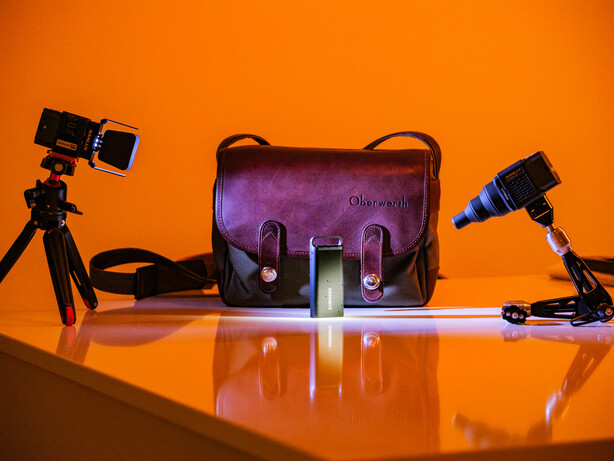
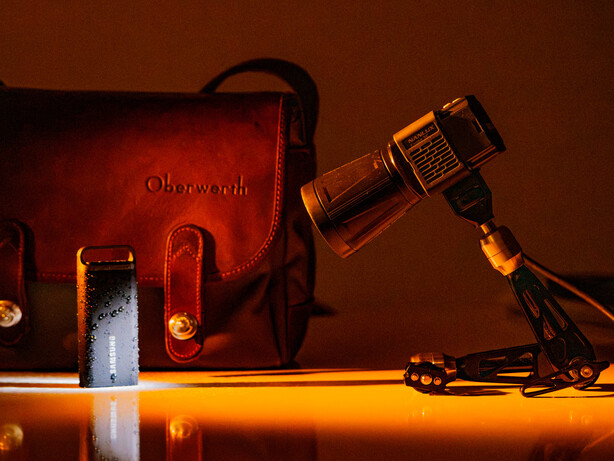
Lux measurements never really mean very much to me, so I metered for different aperture values with an ISO of 400 and a shutter of 1/60sec, and I measured from 1 meter from the lamp. If the Evoke 5C is your key light and you are aiming it at your subject you will likely be closer than 1m, but if the light is for a background or to provide ambience it may well be more than 1m from where the light is landing.
| Nanlux Evoke 5C Light Readings | ||
|---|---|---|
| 5200K | Bare Bulb | f/2.8 and 4/10th |
| Spot Beam | f/5.6 and 8/10th | |
| Fresnel lens | f/2.8 and 9/10th | |
| Snoot | f/1 and 3/10th | |
| Flat Diffuser | f/0.7 and 1/10th | |
| Projection attachment | f/2 and 7/10th | |
| 3200K | Bare Bulb | f/2.8 and 1/10th |
| Hue 120 (Green) | Bare Bulb | f/2.8 and 2/10th |
These measurements are not scientifically achieved, I used a tape measure and a Sekonic light meter in a darkened room, but they will be consistent with what most people will experience themselves.
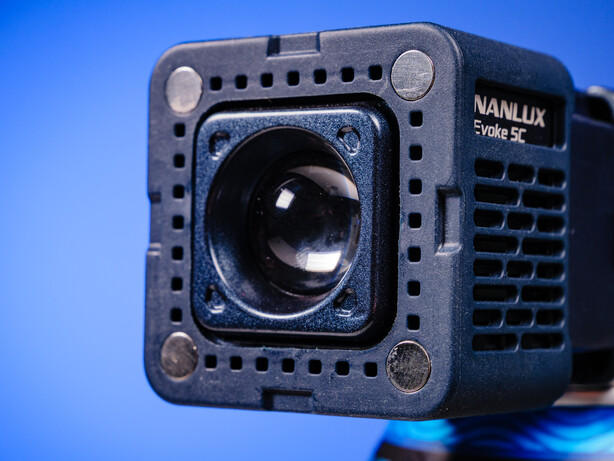
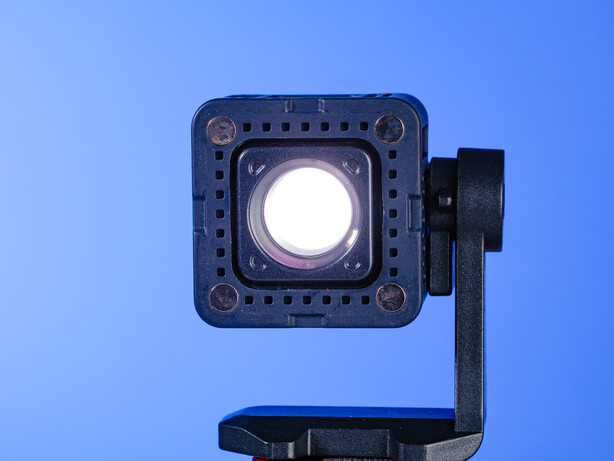
More impressive than had these figures indicated that the light was twice as bright is the range of colours the Evoke 5C can produce. I have a lot of RGBWW lights that seem to have holes in the transitions from one colour to another, but this 5C produces full and smooth colour changes and offers many more ‘in-between’ colours with saturation than I can usually manage. Crucially too, the white light is actually white – and not red, magenta, blue or green. Just this fact will save a lot of time in post-production.
Accessories and Modifiers for the Nanlux Evoke 5C
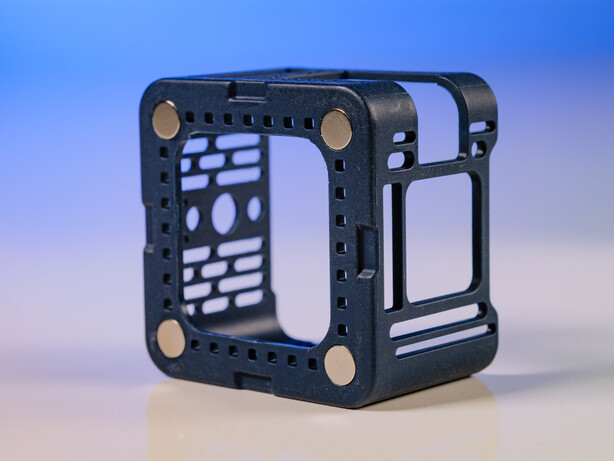
Accessories for the Evoke 5C attach to the front of the light using a magnet in each of the four corners of the face of the body, snapping on and off very nicely. And this light has a lot of accessories, which add a great deal to its appeal and the list of things we can use it for.
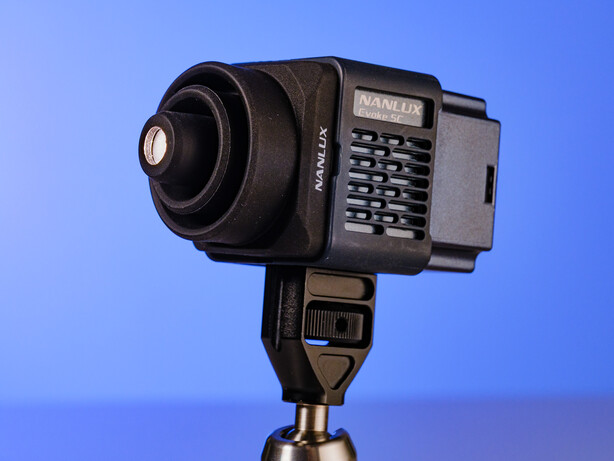
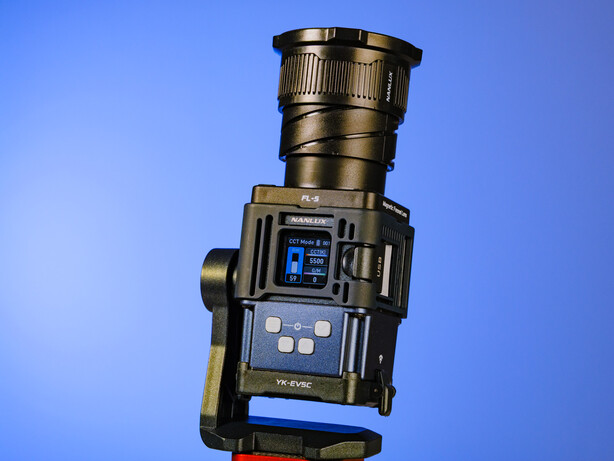
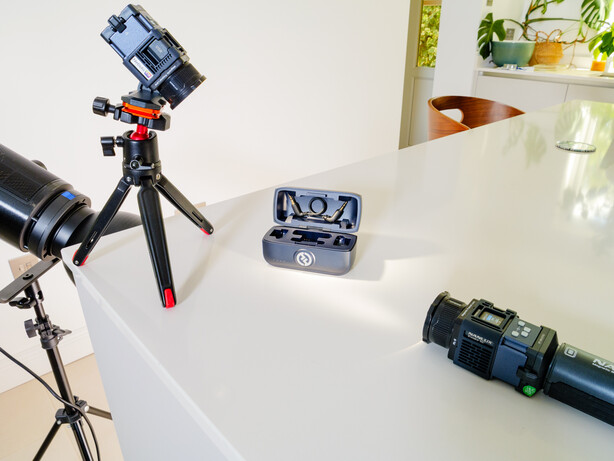
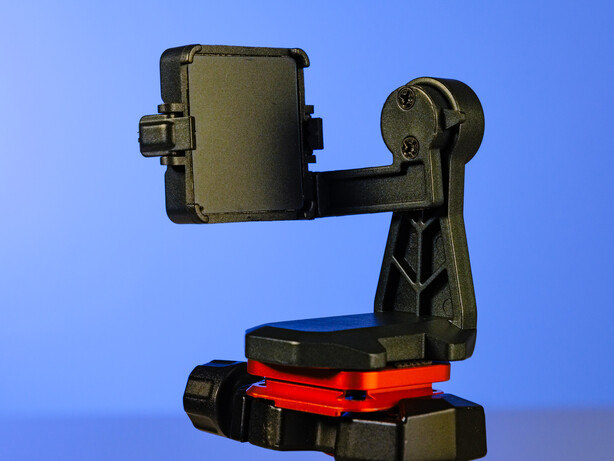
As standard the light comes with a cage to help keep our fingers off its hot body when it’s been operating for a while, a flat diffuser and a yoke that allows us to angle the light freely. The yoke is also magnetic, but it has additional clips to hold the light in place. It’s really very nicely made indeed. If you buy the Evoke 5C ‘kit’ you don’t get the yoke – oddly – but you do get barn doors, a flat diffuser, a domed diffuser, a Fresnel lens, a snoot and the battery handle. ALL of these modifiers are really well made, and they each serve a specific and meaningful purpose.
Other modifiers include focusing spots and a projection attachment that accepts miniature gobos. Each of the modifiers is useful and creates a specific and identifiable effect that will suit particular occasions.


I like the battery grip that comes in the kit, not only for the fact it offers a handle but also because it extends the life of the lamp to a useful duration. While having the light projected in the same direction as the handle, like a torch, was useful I felt the need to mount it to project at 90° on more than a few occasions. Were the light able to swivel on the handle it would make it exceptionally useful, and would allow the whole rig to mount on a stand and aim in any direction other than just upwards. Another issue with the battery handles is the cover for the USB port – it doesn’t stay in place and flaps around catching on things like a hangnail on your finger. It’s a minor point perhaps, but a bit irritating. I’m also not fully convinced the battery grips really hold their charge between sessions very well. While the battery grips are handy, I found I could plug two heads into a single 9900mAh V-Lock battery and run them at full power for almost seven hours – so the 50min internal battery life doesn’t need to be an issue.
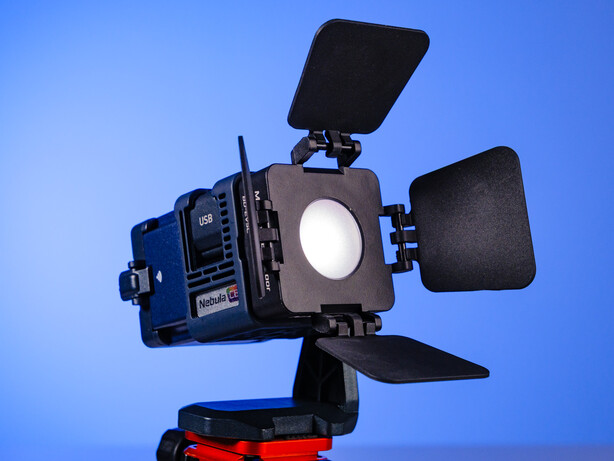
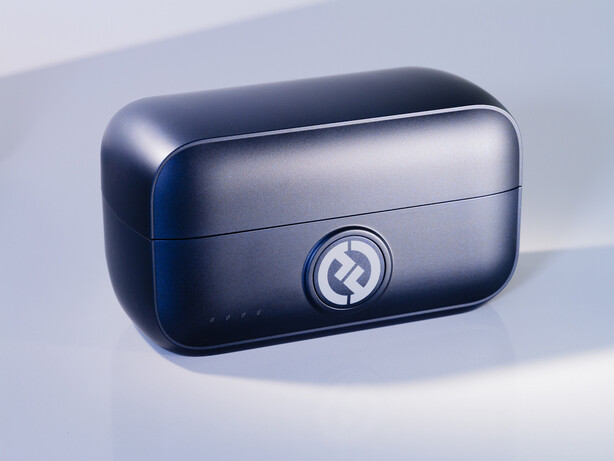
If you discover that you need eight of these lights, which you might, you can get them in a single kit that comes with all the modifiers and accessories in a case that will protect them and charge the lights and the handles at the same time. It’s really a bit too tempting.
Nanlux Evoke 5C Verdict
I am rather taken by these lights, and found that once I began using them I discovered all sort of uses for them – and even set up pictures specifically so that I could get them out. They are a lot of fun in the studio, and their system of modifiers presents so many characteristics, from a flat covering, to a splash, a streak or a spot, that they really add a great deal to the usefulness of the Evoke 5C heads. I did find on occasion that I wished for a bit more power, but once settled on what they can provide I tailored my expectations and made the most of what they can do rather than what they can’t. Out of the studio I found even with the flat panel diffuser I got enough light to add shape to a video interviewee’s face at an evening event, and on location they can quietly throw a little light into a dark corner without much fuss and without drawing attention to themselves.
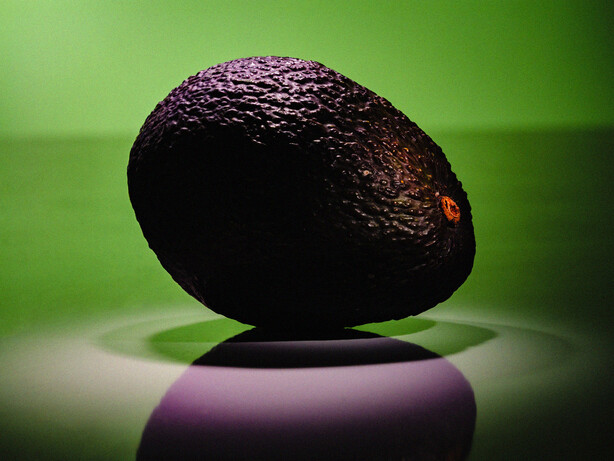

What makes these lights stand out though is their accuracy and the range of colours they can produce. What we are paying for is the mix of eight coloured LEDs and the colours the Nanlux Evoke 5C can create that sit between the colours other lights can manage. We get complex hues, colour matching that actually matches, and smoother transitions from one colour to another. And while we have green/magenta shift in the CCT modes I found I didn’t need to use it. When I dialled in 5200K that’s what I got. Frankly, that doesn’t happen often for £250.
Nanlux Evoke 5C Price and Value for Money
These Nanlux Evoke 5C heads are a bit more expensive than the Aputure MC Pros I mentioned at the beginning of the review – the MC Pros are £192 per unit compared to £246 for the Evoke 5C, and £1750 for the eight-head kit compared to £2928. However, the extra cash is well spent not only for the range of modifiers that come with the Evoke but for the accuracy of the colour, the transitional colours we can make with it and the wider colour gamut. They look cooler too, and offer point source options that just aren’t possible with the MC Pro panels. The MC Pros just create a big flat light, which is useful, but these Evoke 5C can also be used to pick things out, create a highlight, pinpoint an edge and make a neat shaped splash on a background. They are just much more versatile all round, and have rather spoiled my dream of an MC Pro kit.
Nanlux Evoke 5C Specifications
| Nanlux Evoke 5C | |
|---|---|
| Rated Power | 6W |
| Input Voltage/Current | DC5V/2A |
| Beam Angle | 25 degrees |
| LED Light Engine | Nebula C8 Light Engine (Deep Red, Red, Amber, Lime, Green, Cyan, Blue, Indigo) |
| CCT | 1,000K-20,000K (G/M±200) |
| CRI | Average 98 |
| TLCI | Average 98 |
| Dimming | 0%-100%, by 1% increment |
| IP Rating | IP67 |
| Control | On-board, Nanlink App, DMX/RDM*, LumenRadio CRMX**, NFC (*via USB-C to DMX Adapter Cable, **via Magnetic CRMX Module) |
| Special Effects | CCT Loop, INT Loop, HUE Loop, Flash, Pulse, Storm, Police Car, TV, Paparazzi, Candle/Fire, Disco, Bad Bulb, Firework, Explosion and Welding |
| Internal Battery | 3.7V/1300mAh |
| Battery Runtime | 100% brightness: 50 mins 1% brightness: 2 hours 36 mins |
| Dimensions | 56x44x45mm |
| Weight | 160g |
| Included in kit | Evoke 5C, USB-C Cable, Diffuser, Fresnel lens, Soft Dome, Barndoors, Snoot, Thermal Shield, Battery Grip, Manual, Carry Pouch |
For more information see the Nanlux website or visit the UK distributor Pro Light Direct.