



French telescope manufacturer Vaonis has announced Atlas, a modular smart telescope that allows astrophotographers to change imaging modules or use two simultaneously without replacing the main instrument.
A modular design with interchangeable optics
At the centre of Atlas is SkyDock, a connection system that allows imaging modules to be attached or removed without tools in under five seconds. The mount supports either one or two modules, giving users the option of starting with a single telescope and expanding their setup later. The modular approach means photographers could eventually change their optical setup while retaining the same mount, control software and built-in sky-monitoring camera.
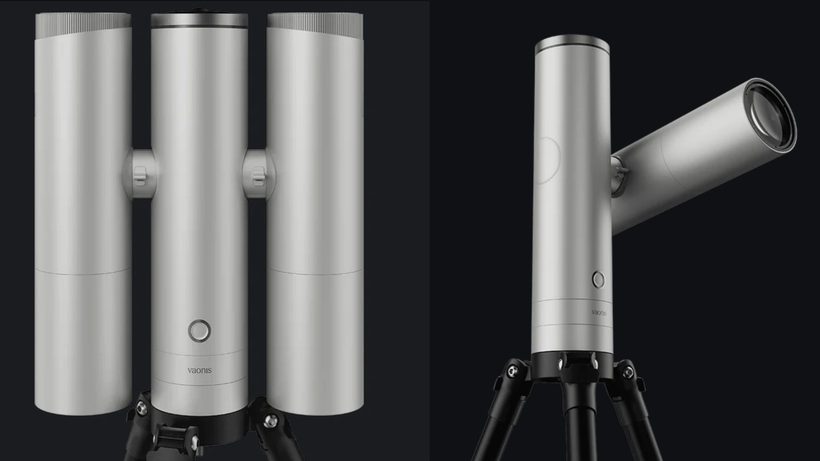
The first available module, Atlas 80, uses an 80mm apochromatic quadruplet optical design with a 360mm focal length and f/4.5 aperture. Its four-element, three-group construction includes two extra-low-dispersion glass elements and one lanthanum element, designed to control chromatic aberration and maintain sharpness across the image. The module incorporates a back-illuminated Sony IMX585 colour sensor with an 8.3-megapixel resolution of 3840 × 2160 pixels and a native field of view of 1.78 × 1 degree. Vaonis also includes a built-in dew heater, controlled by temperature and humidity sensors, to help prevent condensation during extended observing sessions.
For larger celestial objects, Atlas uses Vaonis’s CovalENS mosaic imaging technology to combine multiple frames into a wider image. This increases the maximum resolution to 24 megapixels and expands the field of view to 3.5 × 2 degrees, making it possible to photograph subjects that would otherwise extend beyond the sensor’s coverage. Images can be exported as JPEG files, 16-bit TIFFs or FITS files for further processing, while storage can be expanded using microSD cards.
Twin imaging modules collect twice as much light
One of Atlas’s more unusual features is SkyTwin, which allows two Atlas 80 modules to photograph the same celestial object simultaneously. Each module has its own sensor, with the telescope automatically combining the captured images through the accompanying software. According to Vaonis, this arrangement collects twice as much light as a single module, providing an equivalent light-gathering speed of f/3.2 and improving the signal-to-noise ratio by approximately 41% over the same exposure time.

The advantage is particularly relevant to deep-sky astrophotography, where faint nebulae and galaxies often require lengthy exposures to reveal fine detail. Vaonis says the twin-module configuration can achieve a comparable result in half the imaging time, although both modules must point towards the same subject. It cannot be used to photograph two different objects simultaneously, and the field of view remains the same as that of a single Atlas 80 module.
Atlas also introduces SkyGuard, a separate all-sky camera built into the mount. It uses a 12-megapixel Sony IMX676 sensor and a 185-degree fisheye lens to provide a live view of the surrounding sky. Through Vaonis’s new Gaia application, users can see a sky map overlaid on this image, select a visible object and instruct the telescope to point towards it automatically. The system can display the all-sky view alongside the main imaging feed, while also recording night-sky time-lapses and helping the telescope establish its position using the horizon, Sun and Moon.
Automated astrophotography with room to expand
Like Vaonis’s existing smart telescopes, Atlas handles alignment, tracking and image acquisition through its companion application, reducing the need for users to operate a conventional telescope mount manually. Gaia adds observation planning, multi-night imaging and remote operation, allowing photographers to prepare a sequence of targets or continue gathering exposures over several sessions. The telescope supports Wi-Fi 6, Bluetooth and NFC connectivity, with a claimed battery life of six hours.


The single-module configuration measures 41 × 10 × 20.5cm and weighs 6.5kg without its tripod, while the mount has an IP64 rating for protection against dust and splashing water. Atlas initially operates with an alt-azimuth mount, but Vaonis plans to release an equatorial table accessory in the second half of 2027. This will allow longer individual exposures without the field rotation associated with alt-azimuth tracking, although the accessory will not be available when the telescope first ships.
Vaonis Atlas price and availability
Atlas is available to pre-order in single- and twin-module configurations, with an introductory offer running until 15 November 2026. The single-module model is listed at $3,990 (approximately £3,010), rising to $4,990 (approximately £3,770) after the offer ends. The twin-module version has an introductory price of $5,490 (approximately £4,146), increasing to $6,990 (approximately £5,279).
Vaonis expects the first Atlas orders to ship in March 2027. Both configurations include a tripod and transport bag, while the mount carries a ten-year warranty and the imaging modules are covered for five years. Although Atlas is designed to accept additional modules, the company is initially offering complete single- and twin-module packages rather than selling the components individually.
Press release
Atlas: The modular smart telescope
One mount. The imaging module of your choice, clipped on in seconds. You make it evolve. Your telescope grows with your needs.
Ten years ago, we pioneered the smart telescope.
Ten years of research, iterations, innovation and feedback from amateur astronomers, brought together in a single platform.
You change the imaging module only, not the instrument.
Sky Dock is the interface at the heart of the mount, the part that stays. You clip on the imaging module of your choice in a few seconds, no tools. It stays mounted, ready to head out again. When your practice changes, you change the module.
The mount stays put.
- Connect and disconnect without tools, in under five seconds.
- Guaranteed alignment between modules, with no mechanical play.
- Up to two imaging modules on a single mount, shipped in alt-azimuth.
Built to evolve.
One mount, one standard. Today’s imaging modules clip on, tomorrow’s will too. Storage expands by microSD card, as far as your nights demand. And in the second half of 2027, the equatorial table.
A rugged structure on the outside. The precision at the core.
On most instruments, a fragile shell wraps a hidden frame. Atlas reverses the order. The load-bearing structure, in die-cast aluminium, is on the outside. It is what takes the knocks. The optics and the electronics, everything that must stay intact, are protected at the core. A precision instrument built for the field, not the display case.
See where you’re observing.
A wide-field fisheye camera films the whole sky above you, live, day and night. You see the stars down to magnitude 6, just as the naked eye would. You tap an object, Atlas points to it, and the image builds. What you see when you look up and what the instrument captures now appear together, on the same screen.
No compromise in the design. The only limit left is the aperture itself.
The 80mm imaging module builds on the Petzval, the historic astrograph design, and pushes its correction further. It is an apochromatic quadruplet of four lenses in three groups, opening at F/4.5, with no mirror. Across the whole sensor and the entire visible spectrum, its residual aberrations stay smaller than the diffraction blur of an 80 mm aperture.
The backlit Sony IMX585 sensor is built into the module, matched to this optic. A single imaging module already forms a complete instrument. A second module takes you further.
- Apochromatic quadruplet at F/4.5, with no central obstruction.
- Diffraction-limited optics, from the center to the corners of the sensor.
- Backlit Sony IMX585 sensor, built for faint signal.
And to go further, add a second imaging module.
Two 80mm imaging modules on the same target collect twice as much light at every moment. Together, they gather light like an F/3.2 optic. The same result is reached in half the time. Stacking across the two modules is handled automatically, from launch.
It all starts with the 80mm imaging module.
Ten years of experience. Ten years of warranty.
Vaonis has been designing observation instruments since 2016, now shipped to more than 60 countries. The Atlas mount, the part that stays, is covered for ten years. The 80mm imaging modules, the parts you evolve, are covered for five. What lasts is covered the longest.
- 2016: Pioneer of the smart telescope era
- 10 yrs: Warranty on the mount
- 5 yrs: Warranty on the imaging modules
Pre-order your Atlas.
Choose your configuration, Single 80mm imaging module or Twin 80mm imaging module. First deliveries planned for March 2027. Early bird pricing until November 15.