




Formidable quality – but it comes at a price...
Olympus Zuiko ED 7-14mm f/4 Review
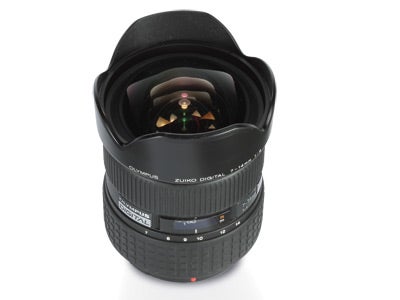
Wideangle lenses are presumably a greater design challenge for Olympus and Panasonic, thanks to the 2x magnification of the smaller sensor. This lens offers the equivalent of 14-28mm in 35mm terms; the same focal length on a camera with an APS-C sensor would be around 9-18mm.
This means that Olympus has to produce shorter focal lengths to achieve the same angle of view, but the Four Thirds system does offer an advantage. The smaller imaging circle allows for smaller lenses, and the telecentric lens design should, in theory, produce more accurate results.
The lens itself is designed to work with Olympus Four Thirds cameras, which also have an intelligent mount system that recognises the lens and thus compensates for any inherent lens flaws. In this case, as an extreme wideangle, Olympus should have firmware than can detect the lens and have algorithms to correct any distortion such as barrelling and vignetting.
The lens contains 18 elements in 12 groups and at launch it was the first ED glass-moulded, double-sided aspherical camera lens greater than 50mm (and if that doesn’t impress you I don’t know what will!). Maybe this: the optics also include two Super ED (Extra Low Dispersion) lenses and two ED elements to eliminate chromatic aberration. Need more? How about the fact the lens is also fully weatherproof and dustproof and focuses down to 10cm? On the downside, the large, rounded front element doesn’t allow for filters to be attached, and there’s no rear filter drawer.
The build is tough and robust, with a decent weight – those 18 elements add to the lens bulk, especially as they need to maintain an f/4 continual wide aperture. A wide aperture means more glass to enable the powerful light-gathering facilities, and this necessitates more weight. To add to the feel of quality, deep grooved zoom and focus rings provide a sense of security when used.
Focusing is quick and effective, with the lens rarely struggling to find the subject, though this is also enabled by the fast AF system of the Olympus E-3 used for this review.
Image Quality
Image quality is very good, with excellent resolution at the 7mm end, dropping to merely formidable resolution at 14mm. I expect this, because lenses usually provide the best results at the shortest focal length. Similarly, chromatic aberration is very well handled, rising to no more than half a pixel at the corners and showing a trace of or no fringing in the centre.
This is also visible in the real-world test images, which are sharp and free from chromatic aberration thoughout the frame. On top of this the lens shows no vignetting and, while distortion is present, this is more because of the nature of the beast than any inherent optical fault.
Verdict
This is an excellently constructed objective, with image quality to match. It’s particularly sharp at its widest end, although it’s fairly heavy and expensive, and would be of limited use to all but the most ardent fans of wideangle lenses.
Details
AF Motor Type:Floating mechanism
Maximum Magnification:0.11x
Other:-
Weight:780g
Minimum Focus:25cm
Number of Diaphragm Blades:7
Dimensions:86.5 x 119.5mm
Lens Construction:18 elements / 12 groups
Minimum Aperture:f/22
Maximum Aperture:f/4
Diagonal Angle of View:116-77
(APS-C):-
35mm Equivalent Focal Length:14-28mm
Focal Length:7-14mm
Maximum Format Size:4/3
Date Introduced:2005
Lens Mount:Four Thirds
Focus Method:Inner focus
Image Stabilisation:No
Filter Thread:None
Optional Accessories:Tele-converter EC-14