




A ruggedly built zoom lens with near-silent AF
Sony 70-300mm f/4.5-5.6 G SSM Review
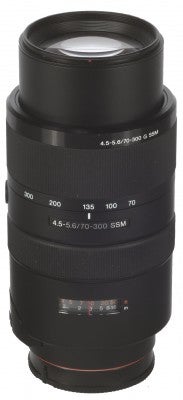
There are two Sony 70-300mm zooms and the model tested here is the pro-spec G-series lens for full frame and APS-C cameras. If you are a Sony user who would prefer to pay much less for a 70-300mm zoom, look to the sub-£200 DT lens, which is similar in price to other manufacturers’ 70-300mm zooms reviewed.
G-series lenses are intended for professional use and date back to when Minolta’s name was on the range that later became Sony. So the 70-300mm feels very well built and incorporates an SSM (Super Sonic Motor) AF system that is quick and virtually silent. The mechanism uses internal focusing that leaves the rearward focus ring undisturbed yet allows manual adjustments.
The wider zoom ring is located further forwards and is separated from the focusing ring by a focus-lock button that falls exactly under the user’s left thumb. The mode switch is at the back of the lens, immediately adjacent to the mount, so is hard to reach. This is unimportant, though, as it is likely to be needed only to change between full-range and infinity-to-3m focusing.
There is no image stabilisation in the lens, which would be a major weakness were it not for Sony’s in-camera SteadyShot system. Nevertheless, SteadyShot does not improve the viewfinder image for an optical SLR and the lack of in-lens stabilisation still puts this zoom at a disadvantage compared with some rivals.
Sony’s in-camera technology on the A850 leaps ahead when we look at the option to record either full-frame or APS-C images. In the case of distant objects, where you might want to use the maximum focal-length and then crop afterwards, the ability to crop in-camera and reduce wasted storage-card space is a big bonus.
More important, such is the quality of this lens that hard cropping does not degrade the image. The MTF curves are tightly bunched around the critical 0.25 cycles-per-pixel boundary with only the 300mm curve sitting slightly lower. Signs of chromatic aberration at both extreme focal-lengths were spotted only in high-contrast technical images, and undetectable in real-world photos.
Sony’s tactic of treating its lenses and cameras as co-dependent components means it’s hard to evaluate this zoom in isolation. Its lack of viewfinder stabilisation is a minus point but its focus lock is useful and its build quality is very solid. Ultimately, though, it looks very costly against, say, Nikon’s latest 70-300mm, which is better specified and is about half the Sony’s price.