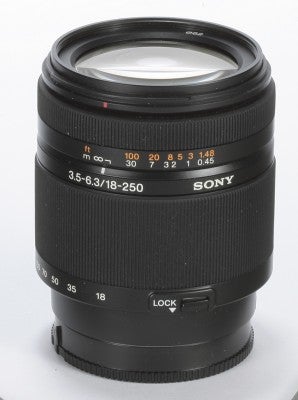



Sony DT 18-250mm f/3.5-6.3 lens
Review Date : Fri, 1 Jan 2010
Author : Jon Tarrant
- Product Shots: See sample image gallery
How does this Sony superzoom stand up to the competition? This Sony DT 18-250mm f/3.5-6.3 lens review from What Digital Camera aims to find out.
| Pros: | Lovely feel |
|---|---|
| Cons: | No image stabilisation |
This lens is designed to cover the APS-C format but was tested using a full-frame Sony A900 body, which automatically records the smaller area when a DT lens is fitted. Although that is a clever trick, the viewfinder does not clearly define the APS-C area, making it difficult to frame pictures quickly at speed. Most people will never meet this problem, but it is worth mentioning in case any full-frame owners think of buying a DT lens such as this.
In common with other manufacturers, Sony has positioned its superzoom's focusing ring towards the front of the lens and, as such, it is obstructed when the supplied petal-type lens hood is reversed for storage. More seriously, but not unusually, part of the zoom ring is also obstructed.
Automatic focusing is not particularly brisk, but proved to be very reliable on the A900 body. The manual-focusing ring does not have a particularly nice feel and rotates when the lens is set to AF mode: the need to avoid hampering the ring's rotation makes it difficult to grip the lens firmly, especially at longer focal-length settings.
Curiously, despite being specified with a maximum aperture that varies from f/3.5 to f/6.3, the smallest recorded maximum aperture was f/5.6. The same oddity also appeared at the minimum aperture end of the F-stop scale, where Sony specifies f/40 but the zoom's EXIF data showed f/38.
Chromatic aberration is detectable at both ends of the zoom range (with the fringe colours reversed at opposite extremes) in technical images and demanding real-world pictures, but not in more everyday images.
In terms of MTF performance, Sony's lens works best as a wideangle zoom: it returns a resolution of 0.25 cycles-per-pixel or better at 70mm and below down to f/16, but is slightly weaker at longer focal-length settings. That said, the MTF curves are neatly grouped and indicate smooth transitions rather than abrupt changes in behaviour.

Verdict
Overall, this is a nice lens that feels solid and inspires confidence. Its price may be only slightly less than that of some other lenses that include image-stabilisation technology, but it is still a sound investment.


Have your say!
Latest comments
July 22 16:50
Rob Ellis
Why complain about no image stabilisation, when sony cameras clearly have steadyshot built in? anyway, nice review, might actually take a look at this lens :)
February 18 11:02
Alex
This is a very poor review, where it seems the reviewer has limited knowledge of the Alpha system. It is completely absurd to list the lack of image stabilisation as a con when ALL Sony Alpha DSLRs have in-body stabilisation. It seem the lens wasn't even tested on an APS-C body, for which the lens is designed, plus I see little reason why an A900 owner would want to purchase this lens. I can't fathom why the reviewer complains that part of the zoom ring is obstructed by the lens hood when in the storage position. Take it off then! You're hardly going to need to use the zoom ring when storing the lens. As an owner of this model, I have never experienced the issues with minimum and maximum aperture and I haven't heard reports of this issue elsewhere - maybe you had a faulty sample or maybe the A900 has issues with the lens. As you didn't bother to test it on an APS-C camera, then we'll never know if this was the cause.
February 18 15:50
ML
Just because a camera has sensor-based image stabilisation doesn't mean you wouldn't want a lens-based option available for longer focal lengths. Max & min apertures are stringently tested in a studio/lab environment in the same manner that all WDC lenses are tested. Results are weighed up in light of these tests, and we have a very good idea of comparable lenses across all manufacturers and the way in which these also perform under the same test scrutiny. So it's not a poor review - that's just your personal opinion as an owners of this lens.
February 21 09:46
Alex
Lens based and body based image stabilisation both have their pros and cons, but if both are used simultaneously it has a negative effect on image quality. The user has to remember to switch it off on either the lens or body, otherwise shots will be ruined. Novice users are more likely to not do this at all. For those reasons, it's unlikely that Sony will ever release a stabilised lens for their Alpha system, so adding it to the cons list is nonsensical. I assume lack of in-body stabilisation goes on to the cons list in Canon and Nikon DSLR reviews, right? After you discovered problems with the aperture, did you ask Sony for their comments, and if so, what did they say? You didn't make comment on why you completely omitted testing this lens on an APS-C body. It IS a poor review if you've failed to take account of good, technical reasons for omitting features such as lens stabilisation, if you've failed to ask a manufacturer for their comments on technical faults discovered during testing and not asked for another sample, and if you have failed to test a lens on a camera body for which it is designed. Just my personal opinion, of course.