




The Olympus E620 raises the Four Thirds DSLR standard once more. So is the E620 the Four Thirds DSLR we've all been waiting for? The What Digital Camera Olympus E-620 full review reveals all...
Olympus E-620 Review
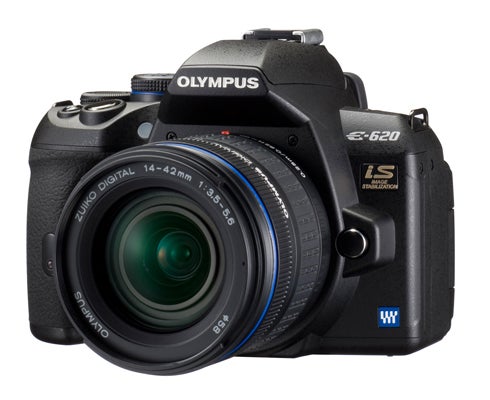
The Olympus E620 is Olympus’s most recent take on the Four Thirds DSLR system, which the past year or so has seen go through something of a renaissance due to the announcement of the Micro Four Thirds format. The Olympus E-620 – maintaining the Four Thirds as opposed to Micro Four Thirds format – has caused considerable interest. But in such a challenging climate, and with the Micro Four Thirds system looming with so much promise, does the Olympus E-620 have enough relevance to be introduced at this time? The What Digital Camera Olympus E620 review reveals all…
Olympus E-620 Review – Features
The Olympus E-620 is the 12th DSLR in Olympus’s Four Thirds family, targeted at enthusiasts and advanced entry-level users. Influenced by the E-30, the E620 builds on the E-420 and E-520 before it, although the company has stressed that it isn’t a replacement for either model.
The Olympus E620 has a 12.3MP LiveMOS device sensor, which in all probability is the same as, or at least similar to, the one found in the Olympus E-30. Measuring 17.3x13mm, images are output in the 4:3 format as standard, in a choice of Raw and JPEG options. The sensor is fronted by a Supersonic Wave Filter, part of Olympus’s dust reduction technology, and is complemented by an image-stabilisation system that claims to offer up to four extra EV stops of usable shutter speeds beyond what’s usually possible.
Olympus E620 Review – Processing Power
As with the recent E-450, the Olympus E-620 hosts an upgraded version of Olympus’s TruePic III processing engine. The TruePic III+ processor provides images with ‘natural colour, brilliant blue skies and precise tonal expression, while lowering noise at higher ISOs’. Its other responsibilities concern the live view system, and a 4fps burst rate, which is maintained for up to five Raw images.
In line with the more expensive E-30, the E620 has high sensitivity to encompasses ISO 100-3200, which, while hardly class-leading, should be capable in most conditions. Another trait both the E620 and E-30 share is the 2.7in LCD screen, which may be pulled away from the body and adjusted around an angle of 270°, though the E-620 does feature a different type of HyperCrystal Technology from the E-30. In any case, this LCD is one of the camera’s headline features, and will no doubt be a huge draw for those wishing for the flexibility of an articulated LCD screen, but not wanting to stretch to the E-30.
Olympus E-620 Review – New AF System

Unfortunately, the Olympus E620’s similarity to the E-30 doesn’t extend as far as the E-30’s 11-point AF system, although the E-620’s system is still a radical improvement on those in Olympus’s previous models. The new system in the Olympus E620 sees five cross-type points along the horizontal, joined by a point each above and below these – making a
total of seven AF points. The Olympus E620 also offers autofocusing in
live view by a trio of options: Hybrid AF, Sensor AF and Imager AF.
Impressively, the E620 goes on to offer a number of features usually reserved for professionally-oriented bodies. AF calibration is possible for up to 20 individual optics, as is wireless flash control for external units
(which, to Olympus’s credit, has been offered for some time now on such
models). It’s also welcome to see a range of bracketing options,
covering not just exposure and flash, but white balance and sensitivity,
too. The E620 has metering options which break free from the standard evaluative, centre-weighted and spot trio, too – including highlight-spot and shadow-spot options in addition to these.
Finally, both xD and CompactFlash memory cards are supported by the Olympus E620, which is handy if upgrading from previous Olympus models; as is the
fact that the battery is the same as those in the Olympus E-420 and E-410 models.
More info:
Olympus E-620 performance, image quality & value
Compare the Olympus E-620 with other products