




It may be pricey, but the Canon 16-35mm full-frame lens is well established. What Digital Camera's Canon 16-35mm lens review finds out if it's still worth splashing out for
Canon EF 16-35mm f/2.8L II USM Review
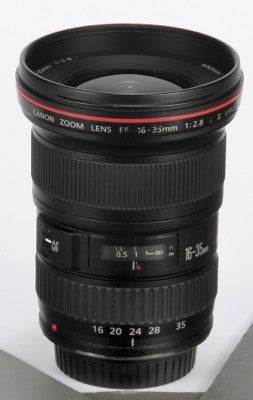
Canon lists two EF 16-35mm f/2.8 zooms on its website. The lens reviewed here is the more expensive of the pair and carries a full SRP of £1,790 but is available for about 35% less from WDC advertisers.
Browsing the specification of the older version it is interesting to note that it was fitted with a gelatine filter holder at the rear and is said by Canon to offer ‘a higher image quality than any other lens in its class’. The tested version of the Canon EF 16-35mm f/2.8 has been completely redesigned both optically and electronically but it is still a fairly old lens that lacks such refinements as image stabilisation.
Handling is excellent thanks to a raised flange at the far end of the lens barrel. The proper purpose of the ‘bulge’ is to allow the front element to move back and forth during zooming without changing the external length of the lens but it also serves as an excellent hand-stop. The focusing ring is foremost and can be used at any time to provide manual intervention, even in AF mode: the ring does not rotate so there is no need to avoid it when gripping the lens. The AF mechanism works quickly and quietly but its effectiveness is not outstanding in terms of sharpness.
The zoom ring is towards the rear of the lens and may be slightly too far back to be controlled comfortably between the thumb and third finger by some users.
While strong at around f/8, the resulting MTF results from technical testing were otherwise rather disappointing. Performance at the 16mm setting was excellent, staying at or above the critical 0.25 cycles-per-pixel level right across the aperture range, but things were less rosy at other focal lengths.
At 25mm the top-quality sharpness range extended only from f/4 to f/16 and at 35mm it extended from about f/5 to f/19.
There was also some visible chromatic aberration in the technical images although real-world pictures did not suffer from any such problems.
It is clear that the actual sample lens reviewed here has been around for a while, with visible signs of wear on the lens barrel itself, such as markings beginning to rub off. These comments are made to highlight the disappointing MTF curves resulting from technical testing, where it is possible that a brand new sample would score more highly.
Canon MTF Graph (see full quality here)

The fact that this is a more widely separated set of curves than would normally be expected of a top-flight lens may be explained by a mixed handling history.
Canon Wide (see full quality here)

Although some chromatic aberration can be seen in technical images the branches in the corner of this picture show only the very slightest sign of this defect.
Canon Tele (see full quality here)

The centre-most corner of the roof, which was used as the focusing point, is visually sharp so concerns raised during technical testing do not significantly affect real-world photos.