




The Panasonic GF1 is the latest in line from Panasonic's G-series - a much-touted Micro Four Thirds system that offers DSLR quality in a compact body. What Digital Camera test the Panasonic Lumix DMC-GF1C kit with the 20mm f/1.7 pancake kit lens...
Panasonic Lumix GF1 Review
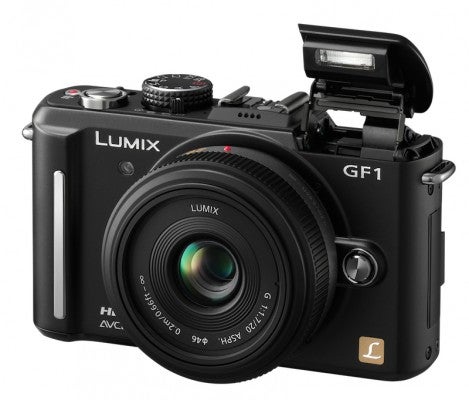
The Panasonic Lumix GF1 is compact in size, yet with a DSLR-type Micro Four Thirds sensor and ability to change lenses – albeit minus the mirror box and, therefore, optical viewfinder – this new wave of camera sits somewhere between the two types. The industry hasn’t quite yet asserted a name convention as yet, but one thing is clear – there’s quite a buzz surrounding what this new format offers. The new Panasonic GF1 further strengthens the already strong G-series lineup. What Digital Camera reviews what is the smallest and lightest interchangeable lens system camera in the world – the Panasonic Lumix DMC-GF1C with 20mm f/1.7 pancake lens.
Panasonic Lumix GF1 review – Features
Brush aside any preconceptions that you may have surrounding the G-series and indeed Micro Four Thirds system and what the Panasonic GF1 leaves you with, at its most simple, is a small-bodied compact-like camera that can take gorgeous, shallow depth of field, DSLR-like images.
It’s nothing like holding or using a compact, yet nothing like using a DSLR either. It truly is an inbetweener and, with its 20mm (40mm in 35mm equivalent) f/1.7 pancake kit lens, very much takes a nod towards the old school way of shooting (at least with this particular kit format).
The ‘50mm purists’ would traditionally attach a prime lens and enjoy the restrictions of its framing, creating memorable and striking street photographs in the earlier part of the 20th century. And whilst the Panasonic Lumix GF1 fully embraces this very idea, it entirely undoes it too – as this is an interchangeable lens camera it can provide a huge scope of potential depending on which lens is on the front. It’s a balance between the old romantic and the new-age techy if you will.
Inherent in its very construction, the 12.1 megapixel Panasonic GF1 lacks a viewfinder and instead the Live MOS sensor will show everything on the rear 460K-dot 3in LCD screen in real time.
The field of view is 100%, meaning what you frame on that screen is exactly what you’ll get in the picture, unlike with many compact cameras – or even DSLRs donning less than a 100% viewfinder for that matter.
An optional electronic viewfinder (EVF) can be added via the GF1’s hotshoe at additional expense as a half-way workaround however.

Pansonic GF1 review sample image – click for full size gallery
Panasonic’s ‘My Colour mode’ feature enables in-camera custom or preset colouration of images from authentic black and white to silhouette mode or even more ‘fun’ options such as ‘retro’. An abundance of compact-like scene modes and intelligent Auto (iA) ensure the best shot whatever the conditions, and a new scene mode called ‘Peripheral Defocus’ allows for a cursor to be moved on the LCD screen to obtain focus at that point.
Of course fully manual options also feature and, unlike with a compact, you can focus using the lens ring itself. It’s the marriage of the simple and the complex in a very smooth transition that ought to appeal to new and experienced photographers alike. However, neither the 20mm kit lens nor body have image stabilisation and, whilst Panasonic usually opts for lens-based stabilisation, this does feel like an oversight at the price point.
As well as Raw and Jpeg shooting (simultaneously if desired), AVCHD Lite also means 720p HD movie can be recorded at the touch of a button too. For stills, a shutter speed of up to 1/4000th second provides exceptional shooting capabilities, though at a maximum of 3 frames per second continuous shooting – for up to 7 frames when shooting Raw – the burst mode isn’t a hugely strong point when compared to some super-fast DSLR cameras of late. The contrast-detect AF system can utilise up to 23 areas but, as per the burst mode, isn’t as nippy as a DSLR’s capability.
So why not buy a DLSR? Well, there are two main points.
Firstly the smaller size will make it an attractive camera to carry around.
Secondly its high-end compact-style control makes for easy, ‘non-daunting’ use. Perfect for someone serious about their photography who wants an immediately simple-to-use camera that houses highly complex possibilities too, where picture quality is paramount.
More info:
What are micro four thirds cameras?