
Verdict


Pros
- Super-fast AF and excellent image quality
- Lots of features and user customisation
- Easy to use and solid build quality
- Good quality EVF and tiltable screen
Cons
- Neck strap can get in the way
- Plastic buttons feel a bit cheap
Key Specifications
- Review Price: £1150.00
- 16.3MP Micro Four Thirds LiveMOS sensor
- JPEG & 12-bit Raw image capture
- ISO 200 - 25,600
- 9fps continuous shooting
- 1.44m-dot EVF / 3in, 610k-dot OLED screen
- 1080/30p Full HD movie recording
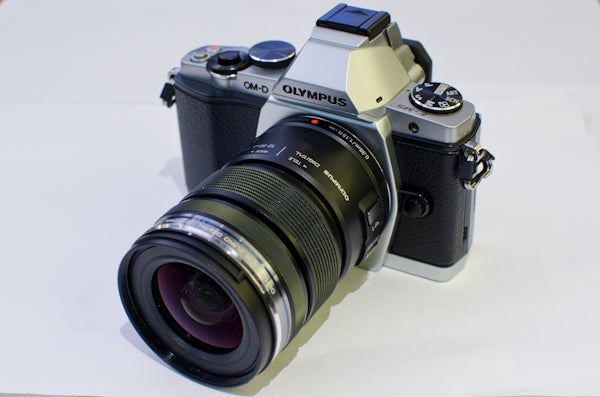
The Olympus OM-D E-M5 is the company’s latest enthusiast-level Micro Four Thirds interchangeable lens compact system camera. Taking its design cues from the company’s esteemed 35mm ‘OM’ SLR range, the EM-5 is the first and, for now at least, flagship model in a new ‘OM-D’ interchangeable lens compact system camera range that will sit alongside the company’s simpler PEN range.
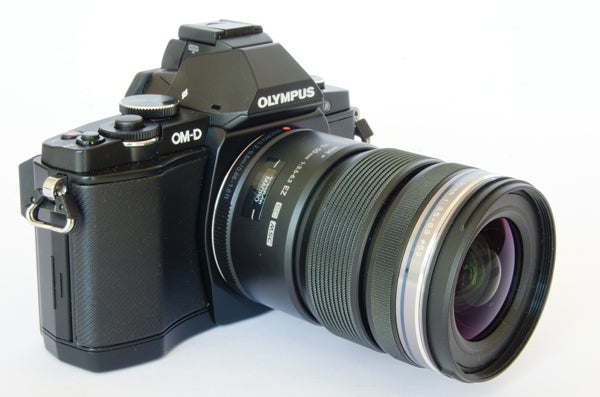
While there are undoubtedly some similarities between the two ranges, Olympus is keen to establish the E-M5 and subsequent OM-D models as a distinct range, and to this end it’s not quite correct to think of it as simply an updated EP-3 with an Electronic ViewFinder (EVF), even though it might be tempting to do so. Indeed, the E-M5 probably has as much in common with the now discontinued Olympus E-620 as it does the EP-3, not least in terms of its DSLR styling and handling.
At around £1,000 body only, or £1,150 with an M.Zuiko Digital ED 12-50mm f/3.5-6.3 kit lens the E-M5 doesn’t come particularly cheap. In terms of the competition, its closest rivals would have to be the Fujifilm X-Pro1, although at £1300 body-only the Fuji is quite a bit more expensive. At around £1,000 (with 18-50mm kit zoom) the Sony NEX-7 is another similarly priced premium-grade CSC, but one that offers a larger 24MP APS-C sized sensor for the money.
Coming in quite a bit cheaper at £450, Panasonic’s Lumix G3 model also boasts a 16MP Micro Four Thirds sensor, a built-in EVF and an adjustable monitor, although it does lack the retro styling and premium build quality of the E-M5. Samsung also offers a couple of DSLR-styled CSC’s in the shape of the 14.6MP NX11 (£300) and also the newer 120.3MP NX20 (£900), both of which come fitted with APS-C sensors and built-in electronic viewfinders. Plenty of tough competition for the E-M5, then. So what’s it packing?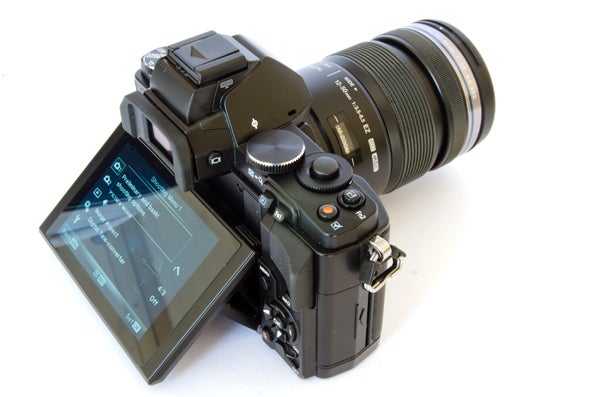
Well, at its heart the E-M5 employs a new 17.3 x 13.0mm (Micro Four Thirds) Live MOS sensor that produces up to 16.1MP photos. This is complemented by Olympus’ latest TruePic VI image processor. Sensitivity stretches from ISO 100 to 25,600, while other notable headline specifications include a 9fps maximum burst rate, the ability to capture lossless 12-bit Raw image files (in Olympus’ proprietary .ORF format), 1080p Full HD movie recording at 30fps, a 324-pixel metering module and, last but not least, what Olympus claims is the “world’s fastest” 35-point contrast-detect AutoFocus (AF) system.
In terms of functions and features the E-M5 is a very well appointed camera indeed. You’ve got a full compliment of manual exposure modes in the shape Program, Aperture-priority, Shutter-priority and full Manual (PASM), alongside an i-Auto mode for hassle-free point-and-shoot photography, 24 individually selectable Scene modes (including a couple of useful Macro options and a 3D image capture option), and last but not least a generous range of 11 Art Filter digital filter effects.
The full range of Art Filters includes: Pop Art, Soft Focus, Pale & Light Colour, Light Tone, Grainy Film, Pin Hole, Diorama, Cross Process, Dramatic Tone, Gentle Sepia, and Key Line. New for the E-M5 is an Art Filter bracketing option, which automatically processes each recorded image with all of the Art Filter effects leaving you to select which one you like the most afterwards. Better still, Art Filter effects can be applied while the camera is set
to any of the PASM exposure modes, which gives you full creative control
over depth-of-field (via Aperture-priority) and shutter speed. This is a
big plus point for the E-M5 as just about all other cameras sporting
built-in digital filters tend to force the camera into automatic mode
when you want to use them. 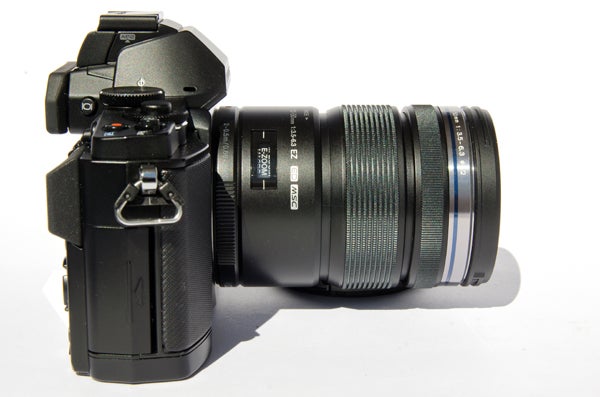
In addition to taking still images the E-M5 is also equipped to shoot 1080p Full HD video at 30fps, at a choice of either 20Mbps or 17Mbps quality levels. These top settings are complemented by 720/30p capture and standard definition 640 x 480 VGA capture, again at 30fps. Sound is recorded in stereo via two microphones either side of the EVF pyramid but while there is a wind-cut option there’s no external microphone input.
There’s no built-in flash either, although Olympus does supply a clip-on
plastic flash that attaches to the E-M5’s accessory shoe that sits on
top of the EVF. As with similar PEN models, this accessory port can be
used to attach more powerful flashguns and other compatible accessories.
The pyramid on top of the E-M5 isn’t just there for show either. This being a mirrorless camera there’s no optical pentaprism inside;
rather it houses a 1.44m-pixel EVF that provides a
100% field of view and a magnification of 1.15x. In use this provides a
relatively large, bright and sharp display that’s more than adequate for
composing the majority of shots with. The eye-sensor, which automatically switches the EVF on and main screen off, is a tad on the sensitive side though, so if
you’d prefer to shoot with the rear monitor you might want to consider
switching it off.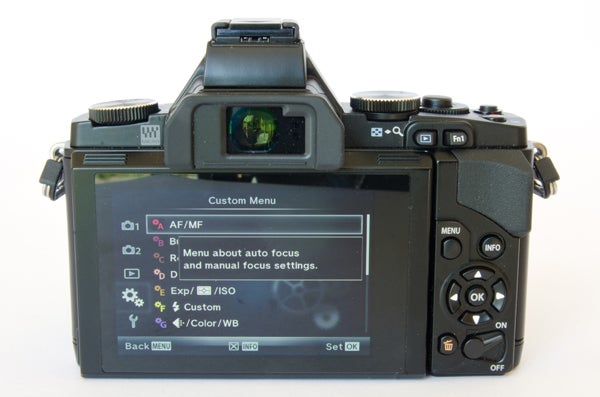
Should you prefer to use the rear monitor then the 3inch OLED screen on the back of the E-M5 offers a resolution of 610k-dots and a bright, sharp display. That said we do feel compelled to question the wisdom of going with OLED screen technology rather than a good old TFT LCD monitor. The reason being that you really do need to view OLED screens head-on in order to see true colours; view the screen from an angle and you get a nasty green hue all over your image, which isn’t ideal. On the plus side, the screen’s 3:2 aspect means there is plenty of space down the sides for current shooting information to be displayed without intruding on your composition. It also offers basic Touch AF and Touch Shutter functionality.
The screen attaches to the body via a hinge on the bottom of the camera with a further hinge part way up allowing it to be tilted upwards by about 90 degrees and downwards by about 45-degrees. While a fully articulated side-hinged screen would offer more flexibility the vertical movement of the E-M5’s screen does make light work of overhead and low-level shooting, and for this reason it remains preferable to a completely fixed screen.
Olympus has long championed the cause of small, portable DSLR-like cameras (think back to the E-420, which at the time of its launch was the smallest DSLR on the market) and the E-M5 is very much an extension of that philosophy. Overall build quality is very high, with the E-M5’s magnesium alloy outer casing fully weather-sealed against dirt and moisture. In addition, the E-M5 also benefits from Olympus’ proprietary Supersonic Wave Filter technology to repel dust from the sensor. Although our review sample arrived in the all-black version, the E-M5 is also available in a titanium silver/black combination. For our money we prefer the more classic styling of silver/black, although the all-black model looks pretty stylish too.
Controls are well spaced and, for the most part, easy to reach. We like how Olympus has put two control wheels on the top of the camera as this makes for more intuitive handling. We’re not so convinced by the positioning and shape of the Fn1 and Playback buttons on the back of the right shoulder; with the tiltable LCD folded flush against the body these become a little fiddly to press. Last but not least, it’s a bit of a shame that all of the buttons are made out of plastic when surely metal buttons would be more in keeping with the E-M5’s otherwise premium build quality.
Size-wise the E-M5 sits quite snugly in small to medium sized hands, although those with really large hands might find it a bit awkward to hold comfortably. Straight out of the box, the E-M5 comes with a relatively shallow finger grip with a more pronounced thumb-grip on the back, both of which are given a textured hard plastic finish. The two work together relatively well to give a secure hold of the camera, although we did find that the neck strap tends to get in the way and can make holding the camera slightly awkward. After some experimentation we found the most comfortable way to deal with this was to thread the neck-strap between our index and middle finger.
If this sounds like it might annoy you then it’s worth bearing in mind that for an additional £229 you can buy the Olympus HLD-6 Battery Grip kit. This comes in two interchangeable parts: a landscape-orientated grip that essentially deepens the regular handgrip for a more comfortable and secure hold (and one where the neck strap doesn’t get in the way), and a portrait-orientated grip that encompasses a shutter release button, two control dials, two Fn buttons and space for an additional battery.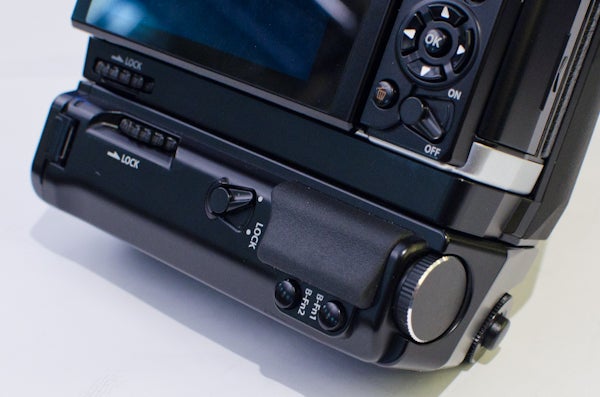
One thing that really impressed us about the E-P3 and E-PL3 PEN models was the level of user customisation they offered, and we’re pleased to report that the E-M5 follows suit. As with those models you’ll need to turn the Custom Menu on from the Setup Menu should you want to access it. Once it has been switched on, though, you’ll find all sorts of user customisation options available – from FN button assignment to AEL metering and shutter release options. If you just want to make quick on-the-fly changes to your main settings then the OK button in the middle of the D-pad calls up a handy Quick Menu. From here, it’s a simple matter up scrolling up or down through the various options to make the changes you want. Overall, it’s a neat and intuitive system that’s easy to get the hang of.
General performance and processing speeds are all pretty impressive and while the E-M5 doesn’t quite have the instant start-up of a DSLR, at a fraction under two seconds it’s certainly no slouch either. Used in Single-shot drive mode, it’s possible to reel shots off at around 1fps – we easily managed 10 shots in as many seconds. Set to Low-speed Continuous drive mode we managed to reel off 30 frames in 10 seconds, although the camera did slow down quite considerably after around 28 shots/eight seconds, after which it took a further 10 seconds for the E-M5 to process all 30 images. In High-speed Continuous drive we managed 30 frames in 10 seconds, although 17 of these were captured in the first couple of seconds, with the rest captured at a much slower rate. Again, the camera took around 10 seconds to process everything.
Autofocus is handled via a 35-point contrast-detect system that Olympus claims is the “world’s fastest”. Without getting into any arguments as to the validity of that claim we can confirm that it is quite jaw-droppingly fast. Not only in bright conditions, as might be expected, but also in more subdued light. Indeed, we’ve been hugely impressed at just how quick the E-M5 is as finding focus when used indoors under less than optimal artificial lighting; where many other cameras would struggle, the E-M5 still manages to lock on and relatively quickly too.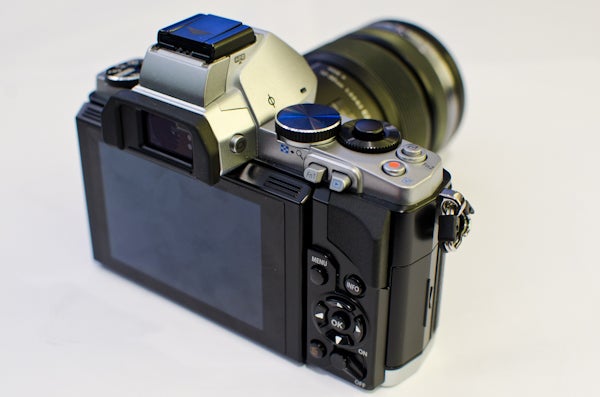
Image quality is yet another area where the E-M5 impresses. Straight out of the camera JPEGs are impressively sharp with excellent levels of fine detail. The E-M5’s five-axis image stabilisation technology certainly helps here, as it not only corrects for vertical and horizontal camera shake but also for pitch and roll. Even with the zoom set at its maximum 50mm we struggled to take a blurry shot at anything under 1/60th of a second, with shots taken at 1/40th often perfectly useable at smaller sizes too.
In terms of colour, tone and vibrancy the E-M5 offers a choice of six Picture Modes – i-Enhance, Vivid, Natural, Portrait, Muted and Monotone – and these will directly influence how your JPEGs will be processed. As with other Olympus compact system cameras we’ve tested in recent months we found ourselves drawn towards the i-Enhance mode on account of the vibrant colour, rich tones and solid contrast it delivers, although there are of course occasions when you may want to opt for something more neutral or muted.
Metering is handled via a 324-zone multi-pattern module that proves consistently accurate, even in trickier lighting situations where lesser cameras might opt to under- or over-expose. White balance is also generally reliable although we did notice a slight tendency for the camera to produce images with an occasional magenta hue when used outdoors on the Automatic White Balance setting. 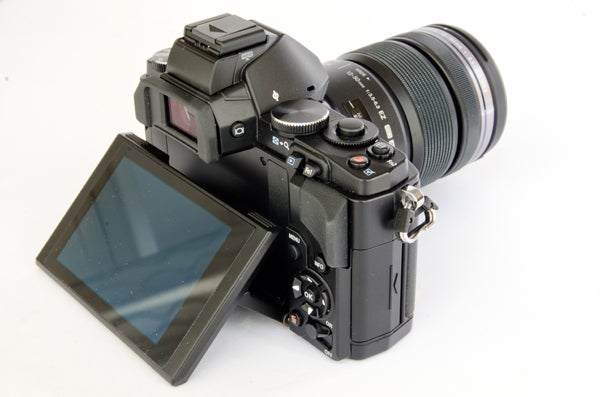
ISO performance also impresses, especially at low to mid-range sensitivity settings. At ISO 200 and ISO 400 images are sharp, detailed and free of noise, while at ISO 800 you won’t see any difference from ISO 400 unless you’re deliberately pixel peeping for it at 100% or more. At ISO 1600 there is a slight softening, although again it’s only really noticeable at 100% and above. ISO 3200 is slightly softer still, but still remains very useable especially for regular image sizes. ISO 6400 is where things do begin to go downhill with a more pronounced softening, especially in shadow areas. The two top settings of ISO 12,800 and 25,600 show a much more pronounced loss of quality with a loss of colour saturation as well as grainy noise visibly intruding on detail, even when viewing images at smaller sizes.
Verdict
The Olympus E-M5 E-M5 is an enthusiast-level compact system digital camera that impresses. Enthusiasts will doubtless appreciate its rich feature set and generous customisation options, but there’s plenty more to like about the E-M5; not least its intuitive handling, excellent build quality and lightening-quick autofocus. Whereas electronic viewfinders have often fallen short in the past the E-M5 offers one that is eminently usable, while the tiltable OLED screen also offers some limited touch-screen functionality. Overall image quality is very good too, with the E-M5 consistently able to produce sharp, detailed and richly toned JPEGs, with the option to record 12-bit Raw image files for more detailed post production. While there are a few minor flaws that prevent it from getting a perfect 10, the E-M5 remains an excellent camera that we have no hesitation in recommending.

ISO 200 is sharp, detailed and noise-free.

ISO 400 shows very little difference from ISO 200.

At ISO 800 the E-M5 is still producing high quality images, with only the merest hint of noise.

At ISO 1600 noise has begun to creep in with a softening of detail, but it’s not a great problem.

ISO 3200 shows a more marked increase in noise, with a more noticeable softening of detail.

ISO 6400 is where image quality begins to break down, especially when viewing images at 100% or more.

At ISO 12,800 and image quality is starting to get a bit ropey.

The top setting of ISO 25,600 might help you out in an emergency but is otherwise best avoided.





Trusted Score
Score in detail
-
Value 8
-
Design & Features 9
-
Image Quality 9
-
Build Quality 9
Features
| Camera type | Mirrorless Camera |


Editorial independence
Editorial independence means being able to give an unbiased verdict about a product or company, with the avoidance of conflicts of interest. To ensure this is possible, every member of the editorial staff follows a clear code of conduct.

Professional conduct
We also expect our journalists to follow clear ethical standards in their work. Our staff members must strive for honesty and accuracy in everything they do. We follow the IPSO Editors’ code of practice to underpin these standards.
Editorial independence
Editorial independence means being able to give an unbiased verdict about a product or company, with the avoidance of conflicts of interest. To ensure this is possible, every member of the editorial staff follows a clear code of conduct.
Professional conduct
We also expect our journalists to follow clear ethical standards in their work. Our staff members must strive for honesty and accuracy in everything they do. We follow the IPSO Editors’ code of practice to underpin these standards.