




The Optio WS80 is waterproof, but how does it fare as a camera? The What Digital Camera Pentax Optio WS80 review puts it through the paces...
Pentax Optio WS80 Review
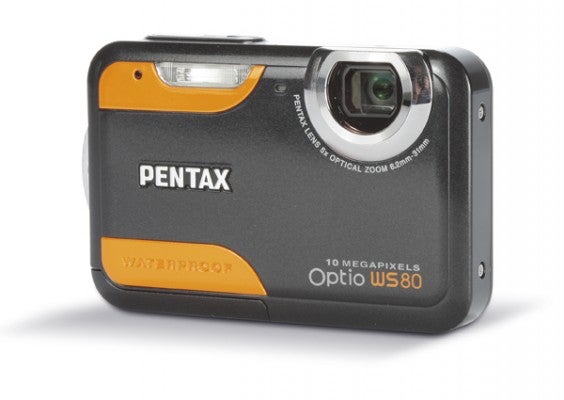
For a long time, only Pentax and Olympus made waterproof compact cameras, but the growth in popularity of outdoor sports and activity holidays has opened up the market for ‘ruggedised’ cameras, and now most of the main manufacturers have models in this category. Pentax’s response has been to add a second waterproof model to its range in addition to the latest model in its long-running Optio W series.
The new Optio WS80 is a lightweight, low-cost compact camera featuring a 10.0-megapixel CCD sensor, an internal 5x zoom lens equivalent to 35-175mm and 1280 x 720 30fpd HD video recording. It is also waterproof to a depth of 1.5 metres for up to two hours, and can be rinsed clean under a tap.
Although the camera body is plastic it feels strong, and although it isn’t advertised as being shockproof it certainly looks capable of surviving a few knock and bumps. The lens is protected behind a glass cover, and the camera’s low weight of 125g fully loaded means it is light enough to bounce rather than break. The WS80 is available in a range of colours including the black with orange stripes seen here, as well as white with pink, white with black and a rather ghastly yellow with green.

Apart from its internal vertically-mounted lens and waterproof body the WS80 shares most of its features with another of Pentax’s recent ultra-compact models, the Optio E80. Like the E80 it is a very basic snapshot camera, with only automatic controls and a range of 12 scene modes, although these do include underwater photography and video modes, as well as a setting for beach and snow.
Despite its simplicity the WS80 does offer a reasonable range of features. It has D-Range contrast compensation with selectable highlight and shadow correction, and saturation, contrast and sharpness can be adjusted. The WS80 also features a much-improved face detection system, able to detect and recognise up to 32 faces in each shot.
There are several interesting features in playback mode too, including red-eye correction, colour filters, composite frames and a bizarre Small Face filter which, to quote the official website, ‘makes the subject’s face appear smaller in proportion to the body than it actually is, to produce attractive, well-balanced portraits’. Personally I like my face the size it is, thanks.
The WS80 performs well for what is essentially a budget compact. The autofocus system is fast and accurate in good light, and although it does slow down a bit in dim light it will still focus in very low light. It has no AF assist lamp though, so it doesn’t work in darkness. In single-shot mode it can take a picture approximately once every three seconds, while in continuous mode it can manage a burst of three shots in just under three seconds at full resolution.
Image quality is, unfortunately, average at best. The lens, shooting through its glass cover, simply doesn’t produce enough contrast or sharp detail for real clarity, and it is also prone to glare if there is any trace of dirt on the lens cover. Wide-angle distortion appears to be corrected electronically, but at the cost of edge sharpness. Image noise is also visible even at low ISO settings.
Verdict
The WS80 is a relatively low cost camera that is built to survive an active lifestyle. It is easy to use, extremely light and compact, and works well in low light. Image quality could be better, but at least it will survive to take a photo in situations where other similarly-priced cameras cannot.
Details
Sample Photos:View sample shots of the Pentax Optio WS80
Other:Waterproof to 1.5m
Weight:105g
Dimensions:95.5 x 59.5 x 22.0mm
Power:Rechargeable li-ion
Memory Card:SD/SDHC
ISO Range:100-12800
File Formats:JPEG
LCD:2.7in 230k
Lens:35-175mm
Sensor:10.0MP