




Judging from Ricoh's CX2, in-camera HDR may just be the next big thing? The What Digital Camera Ricoh CX2 review...
Ricoh CX2 Review
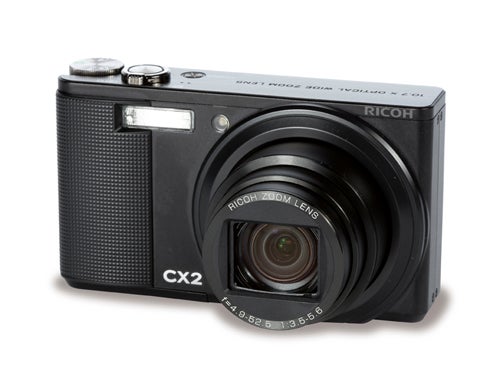
The CX2 is an update of the CX1, launched earlier this year, and shares nearly all of its features including the 9.29MP CMOS sensor, the sharp three-inch 920k monitor, the all-metal body and the clever in-camera HDR feature. The only external difference is the handgrip, which is now more rounded and has a non-slip texture. The main upgrade is the lens, which is a new f/3.5-5.6 10.7x zoom, equivalent to 28-300mm. It’s not the only new feature though. There are several new items on the scene mode menu, including a novel focal plane effect that makes everyday objects look like tiny models.
Other new modes include a discreet shooting setting which disables the flash, the AF assist lamp and the operation sounds, and a high-contrast monochrome mode producing an effect similar to push-processed black and white film. Portrait mode is also improved, with automatic face detection, focusing and white balance adjustment. The high-resolution menu is stuffed with unusual, fun and useful features in both shooting and playback modes, such as focus bracketing with multi-point autofocus, an on-screen spirit level or manual level adjustment feature with three movable points on a histogram.

The only real disappointment is the video recording mode, which is limited to VGA resolution at 30fps with mono audio, and only digital zoom.
One effect of the new longer lens with its complicated folding internal structure is to slow down the start up time. The CX2 starts up in a little under three seconds, which is reasonably quick by most standards, but much slower than the CX1’s sub-two-second start time. However, in all other respects the CX2 shares the CX1’s excellent performance. In single-shot mode it has a shot-to-shot time of an impressive 1.3 seconds.
The multi-point autofocus system is very good, focusing quickly and accurately in all lighting conditions. The CX2 has a very good AF assist lamp with a range of several metres, so it will focus properly in total darkness. The built-in flash is also good, with excellent frame coverage and good close-range metering. The recharge time from an average flash is about five seconds.
While overall image quality is just as impressive as the CX1, there is one respect where the CX2 doesn’t do quite as well as its predecessor. The new lens has an admirable focal length range, and produces very little wide-angle distortion and almost no chromatic aberration, but I suspect that this may be at least partly the result of software manipulation, because corner sharpness is severely lacking.
Image noise is handled extremely well, with virtually no visible noise at ISO 80-200, and better than average image quality at ISO 400. From ISO 800 upwards noise reduction becomes more noticeable, but it is still on a par with any of its main rivals, and overall colour fidelity is good even at ISO 1600.
Verdict
The Ricoh CX2 combines excellent build quality, class-leading performance and superb image quality with innovative features and easy-to-use handling, and even includes a two-year warranty. It's impossible not to be impressed.
Details
Sample Photos:
Weight:185g
Other:Sensor-shift Image Stabilisation (IS)
Dimensions:101.5 x 58.3 x 29.4mm
Power:Rechargeable li-ion
Memory Card:SD/SDHC
ISO Range:80-1600
LCD:3in 920k
Lens:28-300mm
Sensor:9.29MP